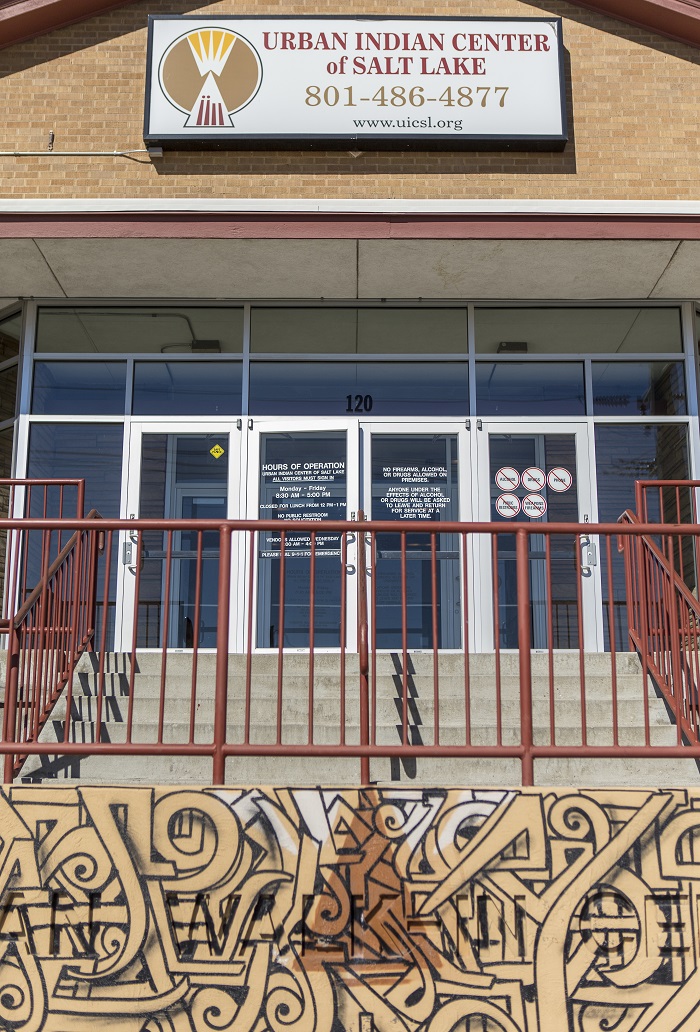
Since 1971 the Urban Indian Center has provided essential support and resources to the Salt Lake Valley’s Native population. This is done by offering a kind of haven and cultural hub away from the hectic pace of urban life. Co-Founder of the Utah League of American Voters, Moroni Benally, says, “Census wise, there’s over 6,000 representing some 250 plus tribal nations. So it’s fairly diverse, but there’s a predominant presence of Navajo.”
Originally the Urban Indian Center was home to several other minority organizations. However, over time those in the Pacific Islander and Latino communities have found their own headquarters. Former Executive Director Anthony Guzman says, “We still try to make ourselves as available to everybody as we can.”
Urban Indian Center offers numerous resources to their community members, including educational groups addressing dating violence, a full service medical clinic, mental health and substance abuse treatment. In one of the rooms that is often utilized as a meeting and training room, black and white pictures taken by photographer Douglas Myles hang along the wall. Guzman says, “With these pictures right here we really wanted to highlight American Indians in an urban natural setting, not so much focused on regalia or traditional. We just wanted to highlight American Indians as they are every day in an urban setting.”
 As the native population is widely integrated in the non-native community of the Salt Lake Valley, they tend to face some of the same issues. This includes access to affordable housing, access to affordable healthcare and childcare and earning a livable wage. Through their mental health services, Urban Indian Center also provides housing assistance. “We just added on Housing Case Managers,” says Guzman. “We use the housing first model, which means if people don’t have stable housing it’s very likely that they don’t have positive outcomes.” This means the housing staff seek to alleviate the stress of homelessness by ensuring the stability of a place to live.
The Urban Indian Center also has partnerships though resources such as the Road Home, Sacred Circle Healthcare, Utah Housing Authority and other state agencies. Benally points out that while these are helpful resources, there is still a great challenge for those impacted by traumatic events which can inhibit the ability to ask for help, to speak up or seek counsel. “Because of the unique needs, services that are cognizant of the historical trauma indigenous people carry are needed” says, Benally. “Things like mascots can trigger feelings of low self-worth which have been empirically show lead to self-harm. The self-harm and suicide rate among indigenous youth is about 3 times higher than white youth their same age, this is especially true for the LGBTQ youth.”
In addition to mental health, the Urban Indian Center provides crucial cultural connection through events like Pow Wows, Sweat Lodge Ceremonies, Indigenous Craft Market and more. According to Guzman, The Sweat Lodge has been adopted by most of the tribes in the country. This is a benefit, since many tribes practice their own specific ways of conducting ceremonies. He says “What’s good about that is that it’s really like a common language, it’s kind of neutral ground for tribes that are coming here. “
Other ways of celebrating indigenous culture has and is manifested through music and art. Throughout the 1980’s and into the present The Urban Indian Center has even been a place for punk and rock ‘n roll. Bands such as The Dead Kennedys and Black Flag graced the Urban Indian Centers gymnasium stage. Although they had to provide their own P.A. Guzman says “A lot of people have been in here. Even the {Punk Rock Flea Market} used to be here as well.”

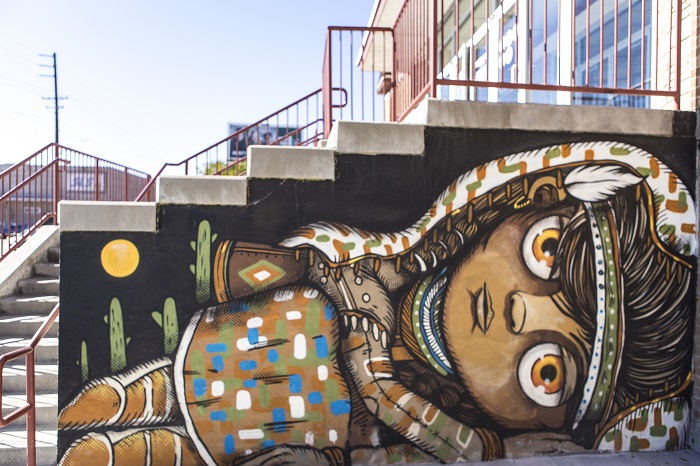
Historically, the native population has always found a home with the subcultures of punk rock, hip hop, skateboarding, DJing, graffiti and EDM. Guzman says, “I really value art.” Art and music are massively important as mediums to share ideas and spark a creative process to uniquely address problems. Guzman, who is also a talented artists, draws art for skateboards inspired by native designs. For him, this is a method that connects with people through sub-cultural avenue. ”I’ve used skateboards in the past as prevention and as psycho education,” says Guzman. “But really what it is kind of a tool or mechanism to reach a population that might get overlooked.“
The Indian Urban Center is located at 120 W 1300 S.