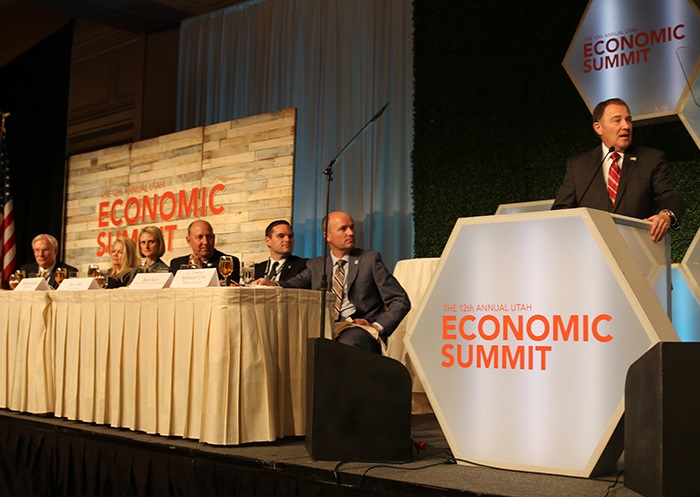
 It’s a perfect spring day. The tulips downtown Salt Lake City Grand America are in full bloom. Entering the Grand Ballroom, I sit as a Zions Bank Executive delivers an over-the-top flattering introduction. “The man who has made Utah’s economy number one in the country for the past four years, Governor Gary Herbert!” The governor walks up to the podium to a rousing applause accompanied by a four-piece horn quartet playing Beethoven. Governor Gary Herbert begins his address at the 2018, 8th annual Utah Governor’s Economic Summit. “Wow! That was a very nice introduction,” he says, with a very convincing air of humility.
Like every previous address the Governor touts how Utah’s economy is top in the nation: We have the lowest unemployment , U.S. News rates Utah number one for four straight … and I’m having a hard time listening. “Whaa, whah, wha”—like the teacher in the Charlie Brown cartoon. As the talk progresses, the applause notes weaken. Taking credit for all things good happening in Utah, eyes are beginning to glaze over. Perhaps because it’s such a nice day. Or perhaps because this same address is getting old. This is my fourth time listening to Herbert’s address, and it gets tiring to watch a man take complete and total credit for Utah’s great economic conditions.
Don’t get me wrong, I don’t dislike Gary Herbert as a person. He paid his respects at my Grandpa’s funeral. My Grandpa knew him and always spoke highly of him. Herbert is a honorable Utah conservative stalwart. But Herbert is only exposed to people with whom he agrees. Herbert has a fine cabinet of men who surround him, all of them at GOED,(Governor’s Office of Economic Development) who have some good ideas and nice initiatives to help students receive training for the skills needed in the 21st century, such as tuition forgiveness for the shortage of trades most needed in our economy: aviation mechanics, diesel mechanics, and software engineers. But the big disconnect I see, even in talking with the gentleman who works in the aerospace industry sitting at the table next to me, is that Herbert is doing close to nothing to preserve our way of life that has made Utah special. He fails to see “standard of living” beyond anything other than dollars and cents and “phenomenal economic growth” provide. “Our economy is a marvel for the nation, it’s a marvel for the entire world!” He gushes. He reminds me of the genie in Aladdin, “Phenomenal cosmic powers!!! Itty, bitty tiny living space.” The living space that Governor Herbert inhabits is so tiny, he fails to see the accurate picture for the greater good of Utah.
Herbert’s vision of the Utah economy—more accurately, the Mormon economy—is in its rightful place on the world stage. We must be number one, because it’s what our heavenly father desires. He boasts how one of Utah’s largest trading partners is Mexico. He didn’t say for what products, but he said that Trump’s threatening NAFTA’s demise would be terrible for Utah. Canada too is a major trading partner with Utah. It’s clear that he wants Utah to become the Zion Kingdom that Brigham Young originally envisioned. But he strays from Brigham Young in one major area. Herbert doesn’t see a need to protect Utah’s farms nor increase Utah’s self reliance and self sufficiency.
This is ironic because a common belief among Mormons is to be prepared for disaster to strike. Disaster preparedness and food storage is a huge industry in Utah, and many residents have months if not years of supplies of food set aside in pantries. But Utah farms are getting gobbled up by Herbert’s developer cronies at an alarming pace. There seems to be nothing slowing or curtailing this trend.
As the great Utah family farms topple like dominoes, Utah’s food security is becoming increasingly reliant on California and Mexico. Herbert never mentions local food security as an issue. He is too laser-focused on national and international trade. Still, I wonder if he believes that the “Latter Days” are near, why wouldn’t he want to have some local farms around?
There has been zero support from the state for the last remaining large farmer in Bountiful, Bangerter Farms, which we are writing about next month. Many in Salt Lake City see our farms as a hugely important asset, evidenced by both the enormous growth of farmers markets around the state and the popularity of both the localvore and farm-to-table movements. Yet to the chagrin of many Utah residents, land preservation and protection of the environment is not an issue anywhere on Herbert’s radar.
Hebert did pay homage to our outdoors in his speech. “Utahns were polled recently asking them their favorite hobby, the majority said, ‘hiking,’ We have a spectacular state for hiking.”
Yes, yes we do Governor, so why are you doing so many things that will make our environment worse off and almost nothing to improve Utah’s greatest treasure? Our airshed, parks, rivers and most recently Utah’s efforts to sue the feds over BLM lands stems from Herbert’s misunderstanding of why so many people from out-of-state are moving here.
Why is Utah’s economy booming?
Economically, Utah’s downtown city growth and infill development has lagged behind Colorado for years. Salt Lake City was the largest city in the western United States in the 1850s, but after the gold and silver rush, Colorado gained much greater investment from the railroad, steel, and cattle industries than Utah. For years, people have chosen to move to Colorado over Utah due to Utah’s quirky liquor policies, which legally punished non-Mormons. Governor Jon Huntsman changed this perception when he removed all the weird laws during the 2002 Winter Games, and helped convince the State Legislature to remove the private club laws. Today, Utah is finally catching up to Colorado in terms of desirability for urbanites. Many California residents are cashing out their million-dollar homes and loving how they can buy a home twice as big for half as much in Sugar House. This trend has dramatically increased real estate prices just in the past year. This trend is also facilitating the high-end luxury apartment market in downtown Salt Lake City at places like 4th West, where monthly rents can exceed $8,000. Currently, at least a couple of Utah Jazz players live there and “don’t feel like they are in Utah.” This is important, because the cloistered, stifling policies designed to keep out non-Mormons is, in large part, the reason why so many Salt Lake City Mormons are no longer practicing. But ever since Jon Huntsman initiated the concept of “welcoming the world,” we are seen the emergence of a nightlife and authentic local culture. This is making Utah more attractive to talented software developers such as Adobe and investment bankers at Goldman Sax.
Thanks to city initiatives by Orem and Provo to attract more tech companies, Silicon Slopes is booming. Companies they have attracted include Ebay, Twitter, Google and likely soon Facebook and Amazon. Herbert’s work at the state level likely attracted the massive NSA spy center in Bluffdale.
Lack of Environmental Awareness
Environmentally, Utah is falling behind states that don’t nearly have the same spectacular environmental assets we have. Governor Herbert doesn’t believe Utah has a serious air quality problem, and the loud cries to do something about the millions of pounds of noxious chemicals and gases emitted into our airshed from industrial polluters have fallen on Herbert’s deaf ears. Cries to restrict or prohibit oil and gas exploration where it could be seen from National Parks are ignored. The extremely sneaky “inland port” legislation, which was passed last session without debate and in the final hours of the State Legislature, to avoid any silly opposition, shows that the legislature and the Governor don’t believe anybody is really paying any attention and they can do as they please. Now we can count on thousands of additional semi-trucks rattling around our freeways. It would be interesting to see how much Herbert and his cronies received from the trucking industry for that one.
Crony Capitalism
Governor Herbert is a pay-to-play Governor. He never met a developer, builder, or industrialist who donated money to his campaign for whom he didn’t, in-kind, return the favor. Herbert is leading the symphony of Utah’s rampant crony capitalism, the impact is that the rich become richer and hard-working entrepreneurs who are providing better products and services are having a more difficult time getting ahead. Today, the majority of the men and women who sit in the State Legislature and on city councils, are at the service of their corporate special interests, very little time or thought is given to making Utah better for local business. It was never brought up in his speech. It’s the wealthy who Governor Herbert serves. He has made his career as a plutocrat. Still, business and outside investment are booming in Utah, where energy is cheap, land is abundant, and regulation and taxes are minimal. But if half as much energy were put into aiding locally-owned business, we would see much stronger locally-vibrant communities and less money being syphoned out of our economy to enrich corporate shareholders. Still, It is an exciting time to live in Utah.
Infill development in and around Sugar House and downtown has more than a dozen residential towers currently rising. While this is creating a lot more traffic and a lot less parking, this is a positive trend. It’s much wiser for a city to grow up than out. Suburban sprawl is eating up all of the best farmland and our cultural legacy of orchards and farmland along the Front.
For the past ten years, Denver has realized a huge inflow of residents from California as well as former residents of the Rust Belt come out west with the desire to live closer to the outdoors in a vibrant city. Now they are coming to Utah, where even more outdoor recreation opportunities are available and real estate prices are cheaper. We have thousands of tech jobs here. Top notch developers can command salaries not much less than what is paid in Palo Alto, and afford twice or three times as much house while being close to the mountains.
While this trend has very little to do with Gary Herbert, every good politician knows how to hitch their wagon to positive trends. Herbert also took credit for the recent success of the Utah Jazz. “We assembled a team of athletes from all over the world: France, Spain, Australia, and we found opportunities where others saw none.” Somewhere Herbert learned that the trick to being a successful politician is excessive use of the pronoun “we.” (I’m just waiting for him to say “we” when he talks about the success of Utah Stories.) Still, the arrogance wasn’t quite as over the top as last year when, after his speech, his staff handed out thousands of tee-shirts silk screened with Herbert’s face. For a moment he believed himself to be the Republican Barack Obama.
I know that personally Herbert is a fine man. He is just what a person becomes when he is surrounded only by people who nearly always agree with them: insular, one-dimensional, and short-sighted.
Still, I’d love to hear what Herbert has to say about all this, and if he would sit down with me for an interview, I’d be happy to print his words in these pages.