Utah Stories

RoHa Brewing Project: Well-Balanced, Solid Beers

Brewmaster Chris Haas for years has wanted his own brewery, but it wasn’t until two years ago that everything clicked. He and pal Rob Phillips, a fellow beer enthusiast, met Josh Stern, and the trio went to work. A year later, RoHa Brewing Project was born.

|


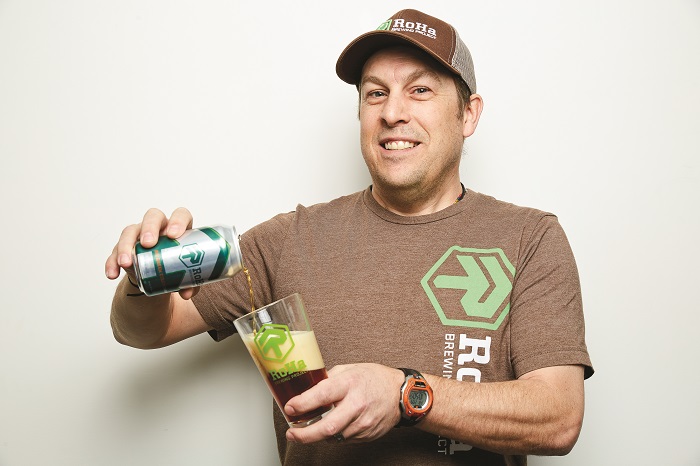
Chris Haas of RoHa Brewing Project. Photos by Steven Vargo – stevenvargo.com.

Brewmaster Chris Haas for years has wanted his own brewery, but it wasn’t until two years ago that everything clicked. He and pal Rob Phillips, a fellow beer enthusiast, met Josh Stern, and the trio went to work. A year later, RoHa Brewing Project was born, “RoHa” being a blend of “Rob” and “Haas.” “Everybody brings something different to the table,” says Chris. Rob is the planner, Josh is the driver, and Chris brews the beer, something he’s been doing for 22 years.

RoHa opened in April of 2017 on Kensington Avenue between State and Main, Salt Lake City, in the Ballpark District. “We really like the neighborhood,” Chris says of RoHa’s location. “We visited a lot of places that could’ve worked, but everyone in the neighborhood here is really solid, so that’s the reason we picked it.” The place is small, intimate.

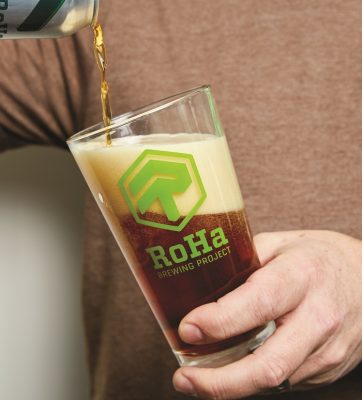
RoHa currently offers five brews. “We have two draft beers—an American Ale, which is a little more full-flavored than a light lager, and a classic pale ale, which is a nice hop-forward, good, easy-drinking ale,” Chris explains. “Then we have our three high-point beers: the Thursday IPA, the Big Green Couch Double IPA, and the Kensington Grand Saison.”

All are available at the brewery, while the drafts can be found at prominent Utah grocers and gas stations, the high-point beers at Utah State Liquor Store locations—except the Kensington Grand, which will be on shelves in the next month or two.

The Kensington is “grand” because it’s an elevated twist on a classic brew. Saisons are brewed with Belgian yeast, fermented warm, unfiltered, and are generally of low-alcohol content. They are also often brewed with spices such as coriander and orange peel. “But our saison is different,” says Chris. “It’s fermented cooler and filtered, so it’s a little more red than usual. And to distinguish it, we use juniper rather than just coriander, then finish it with oak, which rounds out the spice notes.”
RoHa will release two new beers in the coming months: an 8.5% ABV Belgian stout, and a four-percenter made especially for Utah firefighters, which they’ve collaborated on.

Once or twice a month, patrons can join RoHa in giving back during Pints For A Purpose, a designated night of drinking where a percentage of proceeds goes to charitable organizations and their local chapters. Beer lovers have raised money for The Humane Society, The Red Cross, and Engineers Without Borders, to name a few. Think of it as drinking for a cause, or a good cause to drink.

As for long-term plans and projects, Chris says, “We brew well-balanced, solid beers and everyone who has tried them likes them. So we’ll just keep pushing forward and continue making beers that people want to take home.”

Sounds like a recipe for success, and good beer.

RoHa Brewing Project
30 Kensington Ave S,
Salt Lake City, UT 84115
(385) 227-8982

FOR MORE BEER STORIES AND UTAH BREWERIES UPDATES GO HERE

,

Join our newsletter.
Stay informed.


  • Highway 6 and the Midland Trail: Utah’s Transcontinental Highway History

    From Price Canyon to Delta’s desert stretch, Utah played a central role in building the Midland Trail, one of America’s earliest transcontinental highways and the foundation of today’s Highway 6.


  • Utah Acquires US Magnesium Assets in $30M Deal to Protect the Great Salt Lake

    Utah leaders announced the state has successfully won the bid to acquire key assets of the defunct US Magnesium facility on the Great Salt Lake, including its associated water rights and property.


  • Whiskey, Bullets & a Buried Town: Archaeologists Reveal Alta’s Wild Past

    Before Alta was known for powder days and lift lines, it was a silver mining town clinging to the side of a narrow canyon. In the late 1800s, men lived at 8,000 feet, went underground each day, and endured winters that regularly buried buildings in snow. This past summer, that mining town resurfaced — literally — during construction at the Alta Ski Area.

    To understand what Alta really looked like, you don’t begin with legend. You begin with its trash — and this time, that happened almost by accident.

    Alta Ski Area was installing underground water reservoirs to support snowmaking. Because the project sits on Uinta-Wasatch-Cache National Forest land, an archaeologist was required to monitor the excavation. No one expected the trench to produce much.

    But, It did.

    Artifacts began surfacing almost immediately. Enough that the Forest Service contacted the Utah State Historic Preservation Office for help. Lexi Little, who coordinates the Utah Cultural Site Stewardship Program, helped mobilize nearly 30 volunteers to assist with what quickly became a focused two-week excavation.

    Winter deadlines were approaching. The pipes for the reservoirs had to go in the ground. There wasn’t time for a slow, extended dig.

    “It was two weeks of digging in the dirt and helping figure out exactly what we were looking at,” Little said.

    Most of the people screening soil weren’t professional archaeologists. They were trained stewards from around Utah — part of a statewide volunteer network that now approaches 500 people. They poured dirt through shaker screens, scanning for fragments that could piece together a town long buried.

    “Archaeology is human trash,” Little explained. “Archaeologists are very into trash.”

    Alta had left plenty behind.

    https://youtu.be/hzIHzx3OGoo?si=dKcl2CEz-t6FZzYw

    Victorian-style ceramics appeared first — the kind typically used in hotels. Medicine bottles followed. Ink bottles. Hand-blown glass. A porcelain doll’s foot surfaced from the soil, a small detail that shifted the mental image of the town. Families were here. Children were here. This wasn’t only a camp of miners.

    The bottles helped establish time. Manufacturing details — whether glass was hand-blown or mold-made, whether a maker’s mark appeared on the base — allowed archaeologists to date many of the artifacts to the 1870s through the 1890s, when Alta was booming as a silver mining town.

    “That gives you that range of dates for when Alta was really booming,” Little said.

    One reusable soda bottle clearly stamped “Salt Lake City” connected the canyon to the valley economy below.

    Then something unusual rolled out of a dirt pile.

    A corked bottle. Intact. Liquid still inside.

    To access this post, you must purchase Utah Stories (Digital + Print) or 3 month free trial (Digital).


  • The Only Full Bottle of Alcohol Ever Found in Utah Was Unearthed in Alta

    When a backhoe rolled a corked bottle out of the dirt at Alta this summer, no one immediately grasped what they were holding. It wasn’t empty. It wasn’t shattered. It was full. “The bottle that was discovered up at Alta is the only bottle of alcohol ever discovered in an archaeological excavation in the state…