“Don’t it always seem to go, you don’t know what you’ve got till it’s gone. They paved paradise and put up a parking lot.” ~Joni Mitchell
The 1960s and 70s were a great time to be a kid. Utah was less cosmopolitan back then and our fun was homegrown. I remember the ride from Granger (now West Valley City) to Saratoga Springs, an amusement park and resort on the northwest shore of Utah Lake. In those days there was almost nothing on Redwood Road between Granger and Saratoga, which had only a handful of residents in the mid-1960s.
Parents, grandparents, aunts, uncles, and cousins caravanned there at least once a year to revel in the sights and sounds of a vibrant carnival atmosphere. We’d arrive bearing buckets of KFC, homemade salads, grandma’s melt-in-your mouth chocolate cake, and grandpa’s hand-cranked ice cream maker. (If you wanted ice cream, you had to help.)
The resort was a shady oasis on a summer day, complete with merry-go-round, calliope, two Ferris wheels, and a tilt-a-whirl, the latter of which could quickly make a queasy kid lose his lunch—hurl while you twirl. But our favorite attraction was the naturally warm spring water in the large, walled-in swimming pool.
Saratoga Springs—the resort at least—is long gone. Damaged by fire in 1968, it remained open until 1984. But over the years, the derelict skeleton of the place slowly collapsed on the quiet lake shore, ravaged by time and vandals.
Today, a cookie-cutter subdivision of the same name blemishes the site—a miles-long cluster of look-a-like houses—an urban stronghold of 25,000 people huddled on the shores of a polluted lake filled with toxic algae and invasive trash fish—proof that “progress” isn’t all it’s cracked up to be.
The last time I saw the geothermal spring it was nothing but a moldering mud hole, and today, the refurbished spring is accessible only to members of the Homeowners’ Association. No wonder people yearn for the good old days. And so it goes.
Change, they say, is inevitable, but the past is a secure reminder of the safe and familiar, so we embrace it like a drowning man clinging desperately to a piece of driftwood. Nothing wrong with that.
Who remembers watching John Wayne movies through the windshield of their first car at the Woodland or Valley-Vu Drive-Ins, first dates at Snelgrove’s under the giant spinning ice cream cone in Sugar House, or birthday dinners at Señor Pepe’s on State Street in downtown Salt Lake?
So many wonderful places have been stomped out by the steady march of time. Teenagers in the 1950s hung out at Don Carlos’ drive-in on 9th South and State (now an Arctic Circle), or at Fred and Kelly’s Barbecue less than two blocks away.
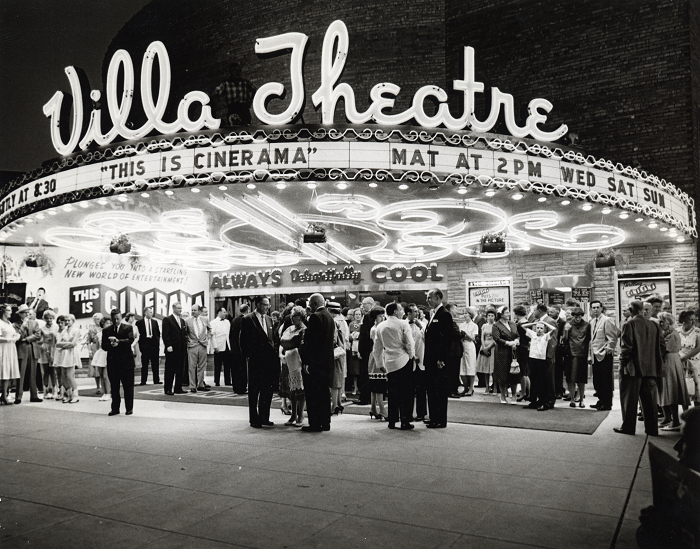
Frostop, Dee’s, and Scott’s drive-ins were the teenage social hubs of the 70s and 80s, along with the long-lost Shakey’s and Der Ratskeller Pizza parlors. Remember Emo’s grave at the city cemetery, the legend of Hobbit Town, and the 49th Street Galleria?

Even as I write this, a 110-year-old valley icon is being scraped off the map. Granite High School, the stalwart landmark at 3300 South and 500 East in South Salt Lake, and alma mater to generations of Granite Farmers, has been relegated to the wrecking ball to make way for a new subdivision. Eleven decades of tradition were erased in a matter of days as proof that the only constant is change.
Nothing lasts forever, and we can’t live in the past, but we can take nostalgic journeys back to it whenever we want.
I think I’ll ride that tilt-a-whirl now.