Utah Stories

Salt Lake City Marches Against Trump

On January 20, 2017, the Students for a Democratic Society (SDS) protested the inauguration of the Trump presidency. They protested in conjunction with others nationwide. Between 1000 and 1200 protesters organized at the Wallace Bennett Federal Building. Among them were members of SDS, Black Bloc Anarchists, Freedom Road Socialist Organization, students, and many other individuals—young…

|

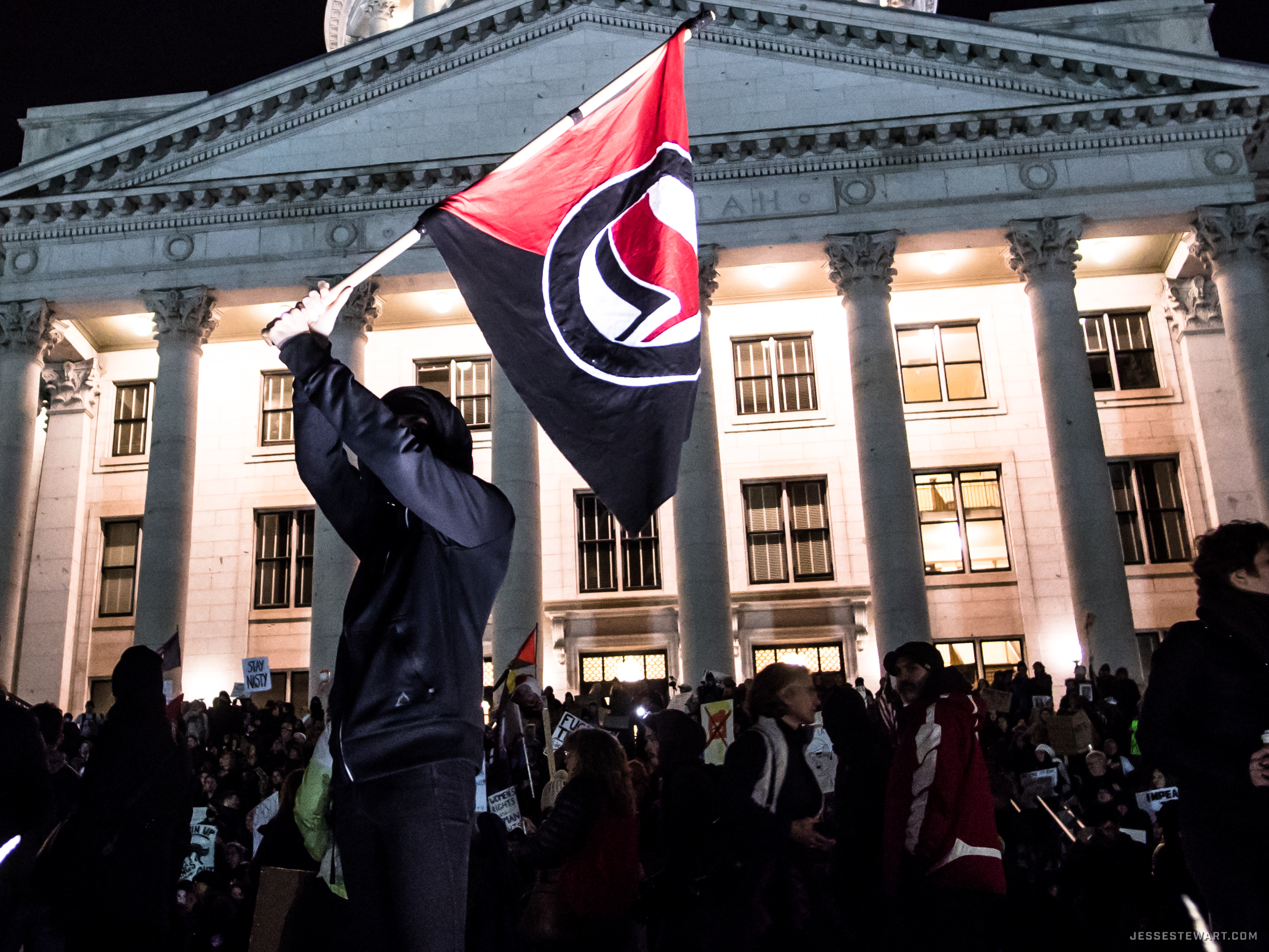
Man waves banner in protest of Trump's presidency

Man waves banner in protest of Trump's presidency
Photos by Jesse Stewart

On January 20, 2017, the Students for a Democratic Society (SDS) protested the inauguration of the Trump presidency. They protested in conjunction with others nationwide. Between 1000 and 1200 protesters organized at the Wallace Bennett Federal Building. Among them were members of SDS, Black Bloc Anarchists, Freedom Road Socialist Organization, students, and many other individuals—young and old who represented all walks of life. Many held signs with creative slogans like “Send Pence To A Conversion Camp,” “ Pussy Grabs Back” or “Welcome To Fascist America.” Some protesters displayed flags symbolizing Anarchism, Anarcho-Communism, Communism, LBGTQ or upside down Stars and Stripes.

Speakers spoke out against what they perceived to be threats looming from President Trump’s agenda. They decried police brutality, Vice President Pence’s support of conversation therapy for members of the LGTBQ community, and other controversial issues. Some more radical speakers pointed out the Holocaust; another noted that the audience should remember that the land they were inhabiting was stolen Shoshoni land. In the same speech, the speaker also called the gathered to remember Standing Rock and the Red Warrior Camp. In addition to voicing opposition, speakers also called for people attending the rally to get involved with activist organizations. Speaker Nick Godfrey asked the gathered crowd, “Will you commit to struggle? Will you commit to organize?”
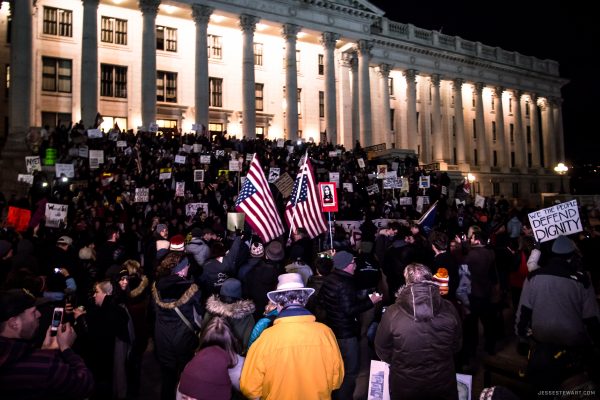
After the speeches concluded, yellow reflective vested SDS peacekeepers deployed to lead the march. The protester took and marched down the middle of the street on 100 S toward City Creek. The protesters chanted slogans like “Dump Trump,” and “Black Lives Matter!” Police cars stayed about a block away to create a perimeter to prevent commuters from running into the protesters.

As the protesters marched, their gathered size and loud chanting drew attention from onlookers. It appeared that most were curious, while some were supportive and others mocked the demonstrators. The march’s route took the demonstrators toward the Salt Palace and past the Mormon Temple. Around this time a section the demonstrators broke into two groups with women chanting “My Body, My Choice” and men responding “Your Body, Your Choice.”

The final route took the demonstrators to the Utah Capital Building, where they occupied the steps and listened again as speakers encouraged those attending to organize and get involved with organizations ready to take to the streets. Riding on this idea, a SDS speaker made it clear of his distaste for establishment political organizations like the Democrats and Republicans. This sentiment was supported by many, although it was clear that those with Democratic leanings were a bit uneasy. While the speakers delivered their final thoughts, a loose police presence was obvious. The police remained distant and did not antagonize or provoke demonstrators; rather they waited and just observed the demonstration. They acted to separate the protesters from the public, a tactic of restraint and isolation to keep the peace that has been seen at many other demonstrations in Salt Lake City.

Admittedly this protest, while not as large as some held before, showed a certain level of unity to oppose the Trump presidency and the Republican establishment. This unity among the different groups was quickly tested as the protest dispersed. A demonstrator lit what appeared to be an American flag on fire. The smell of burning plastic was pungent. A small crowd of demonstrators gathered and tensions flared between supported and dissenters of the flag burning. Within moments Highway Patrolmen stepped in to intervene and break up the confrontation.

Soon the protester’s attention shifted onto a new group who appeared on the scene. These newcomers– two of whom were draped in American Stars and Stripes—held their hands up with peace signs. They seemed to be there to offer an alternative point of view and debated with demonstrators on topics varying from economics to what he perceived the building blocks the United States was built on. It was unclear whether these counter demonstrators’ desire to debate was ill-intentioned or ill-informed, but their attempt to engage protesters was not well received and appeared to come across as even offensive. Despite passions rising however, the confrontation remained largely peaceful.

The protest in its entirety was a show of non-violent displeasure toward the Trump presidency. The march was passionate. It kept peaceful largely thanks to the participants and the SDS peacekeepers. The protest ended with the calls to organize and on what some would call a positive note. It was family-friendly and there was not the traditional occupation or disruption that other protests were known for—although one black bloc anarchist could be heard trying to encourage a peacekeeper to rally support anarchy.

Join our newsletter.
Stay informed.


  • The $7 Million Recruit: How NIL Changed College Athletics Forever

    In 2012, Jabari Parker, a top high school prospect and member of the Church of Jesus Christ of Latter-day Saints, was facing his biggest decision to that point in his life: where to play college basketball. 

    Fans of BYU athletics hoped and perhaps prayed that Parker would pick the school owned by the church he was raised in. BYU was listed as one of his final choices. But he ultimately chose to spend his college years at Duke before attempting a career in the NBA. BYU fans were disappointed, but no one was truly surprised. Duke over BYU was the best choice for a young prospect in 2012. 

    A.J. Dybantsa.

    What changed between 2012 and 2024 when A.J. Dybantsa, the number one high school prospect, chose BYU over every other school? The answer is roughly $7 million dollars. That is what Dybantsa is reportedly making to play basketball at BYU. 

    The deal was supported by Utah Jazz owner Ryan Smith, who met multiple times with the Dybantsa family in multiple attempts to bring the young player to Provo. 

    According to Smith, he had no financial role in bringing Dybantsa to BYU, but the influence of Utah’s most famous billionaire acting as a “booster” or unofficial recruiter certainly swayed the decision.

    Prior to 2021, boosters acting as recruiters was taboo to the NCAA governing body. It was called improper recruiting. But in 2021, California began the modern era of NIL, or the ability of a college athlete to benefit from their name, image, or likeness, when they passed the “Fair Pay to Play Act.” 

    This new law gave college athletes in California the ability to benefit from their NIL, something that was banned in the rest of the country to that point. The NCAA saw that this law would create an unfair advantage for California schools that could now give young athletes the chance to make money off their talent and image while still in college. 

    The NCAA knew they needed to do something quickly, so they rushed through a policy that opened up NIL to all college athletes in the country, and it has been expanding and evolving over the last four years. 

    Grant Duff, who has coached at the University of Utah, Weber State University, and is now the defensive coordinator for Idaho State University, says, “The best part of NIL is that athletes have an opportunity to make good money. The downside comes with the free-for-all that money causes.”

    Dybantsa confers with BYU Head coach, Kevin Young.

    One of the biggest current examples of what a school can do when the boosters are willing to pay for success is Texas Tech University. From 2020-2024, Texas Tech had 34 wins, which works out to 6.8 wins per year with a low of 4 wins and high of 8. Then Texas Tech’s boosters got involved, led by Cody Campbell, an oil industry businessman and Chairman of the Texas Tech board. The football program was given 28 million dollars for NIL with a simple message attached to the large pile of money: Win. And win now. And win they did. 

    By signing NIL deals with athletes in the transfer portal, Texas Tech went from a middle-of-the-pack school in their conference to one of the top 12 teams in the country. They didn’t just win games in 2025, they made many of their opponents look like they didn’t belong on the same field, including the University of Utah and BYU twice. That is what money can buy.

    Continue reading and support independent Utah journalism with a purchase of Utah Stories (Digital + Print) or 3 month free trial (Digital).


  • Cottonwood Heights Corruption Allegations: A Case That Never Reached a Courtroom

    A year ago, we here at Utah Stories recorded a podcast episode that we never published. We were revisiting corruption allegations from ten years ago. We decided not to publish the video, so it sat there on YouTube for nearly 12 months.

    Then somehow the video was published. How? We are not sure, but once it got out there, the comments came pouring in.

    Dozens of viewers, then hundreds, supported the video with their comments on our examination of allegations of police misconduct in Cottonwood Heights. The video recounts how the Police Department was reported by business owners as focusing enforcement on customers of the former Canyon Inn bar. These allegations did not result in a publicly documented, full investigation by Utah’s Justice Department nor the FBI (at least to our knowledge). So why rehash the past?

    We believe the story of The Canyon Inn (and other area business owners) vs. CHPD and Cottonwood Heights Mayor Kelvin Cullimore raises questions about what can happen when allegations surface and do not move forward through a formal legal process with state or federal oversight.

    In 2012, Cottonwood Heights business owners at the mouth of the canyons began publicly objecting to police activity whereby up to seven cruisers were pulling over 711 and Canyon Inn bar customers on their busiest evenings.

    According to those accounts, drivers leaving the bar were frequently pulled over by police and were given DUI tickets, sometimes even after passing a sobriety examination. The volume and concentration of those stops led residents and business owners to complain about the “heavy-handed treatment” of CHPD toward motorists, especially in and around the Canyon Inn and neighboring 711, and eventually the Porcupine Pub.

    Customers responded in predictable ways. Some chose not to return and avoid the area. Others went to different establishments. Over time, the owner of the Canyon Inn, Jim Stojack, stated that his revenue declined by 70% and that he believed police activity near his business was the main contributing factor.

    Utah Stories reported on these concerns by conducting interviews; gathering video documentation provided by those involved; and making public records requests. Through our GRAMA requests, we reviewed DUI citations issued by the Cottonwood Heights Police Department and examined how those cases were resolved in Holladay Justice Court. During that period, we observed a higher number based on our review of DUI cases dismissed in court due to lack of evidence compared to other jurisdictions. One DUI attorney, Tyler Ayers, went on record saying that CHPD was issuing a high volume of DUI citations that were later dismissed.

    That observation raised questions about how cases were being documented and prosecuted. It did not, on its own, establish intent or misconduct, but it became part of a broader set of concerns raised by multiple sources.

    Continue reading and support independent Utah journalism with a purchase of Utah Stories (Digital + Print) or 3 month free trial (Digital).


  • Why Did Salt Lake City Tear Down Its Most Beautiful Buildings?

    If you go into the Utah State Archives and spend time with photographs from the late 1800s and early 1900s, you start to notice something that doesn’t line up with what exists today.

    Main Street looks cohesive. Not in a uniform way, but in a way that suggests the people building it shared an understanding of proportion, material, and permanence. Four-story buildings line the street—stone, brick, cast iron—each one detailed in ways that don’t feel incidental. Arched windows, carved stone, brickwork that changes pattern as it rises. Even the cast iron facades were designed to replicate masonry, not hide behind it.

    Then you go downtown and try to find those same buildings.

    Most of them are gone.

    Out of more than 400 buildings designed by Richard Kletting, over 300 have been torn down. That number alone reframes the conversation. Kletting designed the Utah State Capitol, the Saltair resort, commercial buildings, schools, churches, mansions—virtually every type of structure…

    Continue reading and support independent Utah journalism with a purchase of Utah Stories (Digital + Print) or 3 month free trial (Digital).


  • Momomaru Sushi Review: Salt Lake City’s New Destination for Japanese Hand Rolls

    A new Salt Lake City sushi spot is drawing crowds with Japanese-style hand rolls served fresh, fast, and warm, offering a more intimate and interactive take on traditional sushi.