Utah Stories

Salt Lake City After Dark: Night Beat

The seedy underbelly of Salt Lake City is on clear display at 3:00 am

|


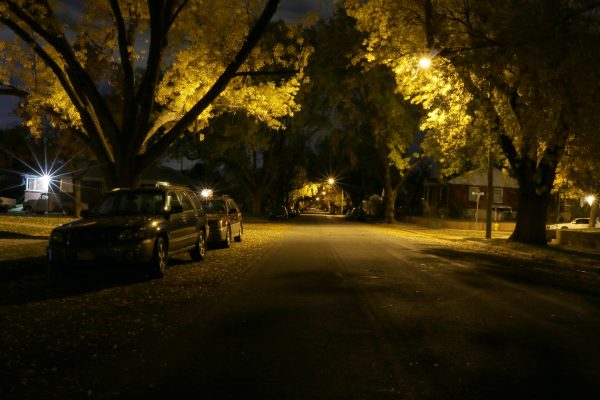
800-east-4-am
Looking down 800 East at 4 am

When Theodore Roosevelt was 33-years-old, he was appointed police commissioner of New York City. One of the first things he did to better understand the city’s crime problem was to walk around at night in plain clothing and examine the problem areas. I’ve always wanted to go on my own night beat in Salt Lake, I have witnessed a huge problem with bicycle theft and burglary in my neighborhood and I thought I would see if I could gather any clues by going out on a night beat.

It’s 2:30 AM. I’m dressed in sweatpants and a shirt. No different than if I was out for a jog. To anyone I encounter, I am just some dude.

Although the moon is full, the sky is overcast, and only brief pockets of moonlight fall on the scene before me, there are no cars, no people. Even 700 East is deserted.

I cross the street into Liberty Park. Rounding the corner past Tracy Aviary, I see a shadowy figure sneak behind a tree. Then there is a flashlight signal: one long flash followed by three short flashes. I don’t respond. Again, the pattern repeats. Then I see the “flasher” duck behind the tree and a lady wearing a midriff cross the street. Is she bait? And is the flasher signaling me in some code to take the bait? I have no idea, and I don’t intend to find out.

At 500 East and 800 South, the Bagel Project is the first business I find with signs of life insidea lone baker is preparing dough for proofing. Along this street I see several cats on the prowl. The toms show no sign of fear; they appear to be the rulers of the night.

Westbound on 300 South, near the YWCA, I see another couple. A young lady, again in a midriff, runs across 300 South away from a man she had words with. I wonder if she is trying to get away from her partner or maybe she’s getting instructions from her pimp. She circles back around, again seeming to test me my intentions. Since I say nothing she goes back to her partner.

I see a parked, idling police car just east of Junior’s Tavern. A homeless man is sitting on a bench looking at me surreptitiously. This also feels like a set-up situation. But it could just be I have a heightened sense of paranoia.

Now southbound on Main Street: The only bar on Main Street with signs of lifea cleaning person. Whiskey Street, Bodega and Maxwell’s are all closed.

Main Street has two sleeping lonely souls curled up on planters their worldly belongings piled beside them.

I approach Little America and hear blaring, rather intense elevator music. A lone girl is meticulously scrubbing away at the brass door handles. She is fixated on her job and doesn’t notice me pass.

Eastbound on 600 South: trucks, men and commotion are all concentrated on the corner where an all-night crew is pouring concrete behind a sign that reads, “Affordable Housing Redefined.” There must be 50 men. Passing Sears, Taco Time and State Room, I hear a biker approach me from behind. It’s a young boy, maybe 12, out at 3:45 am on a school night. He rides right behind me slowly before passing. I neither look behind nor engage him. Next, another biker, then a skateboarder ride right behind me. He’s another young kid, probably 18 or 19. A thin kid on his bike circles back around toward me. Am I in shark-infested waters? The skateboarder begins muttering obscenities behind me. “Nigga don’t want to talk… Nigga don’t want to say anything. Where’s this nigga going?”

Is he a pimp? A drug dealer? I don’t know and I don’t want to engage with him, because I have no backup. The skinny biker again circles around me. I decide to start jogging. From 10th South to 16th South I continue jogging. They continue following. I’m not really scared because these are skinny kids. But I do realize there are no cars, no one to flag if they attempt a mugging. I see a biker slowly hauling a BoB trailer heading Northbound. I hasten my pace and run toward him. His goateed face and sunken steely eyes are striking. Then I realize he might think I’m pursuing him, so I quickly run past him.

In my one second scan of his ballast, I notice dozens of stacked bicycle parts: forks wheels, crankshafts. Is he a scavenger, a coyote for spare parts, or perhaps a bike thief? I take a quick look back down State Street and see that my pursuers have disappeared into the darkness.
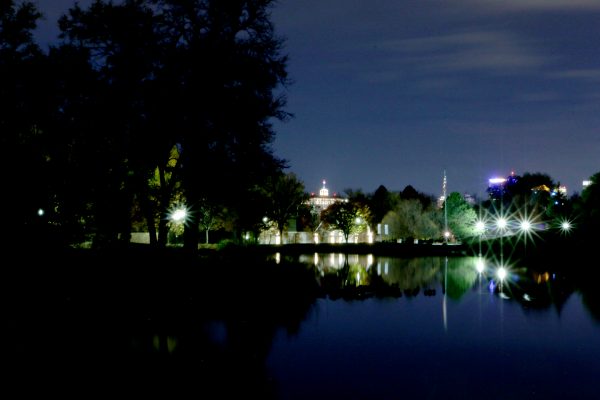
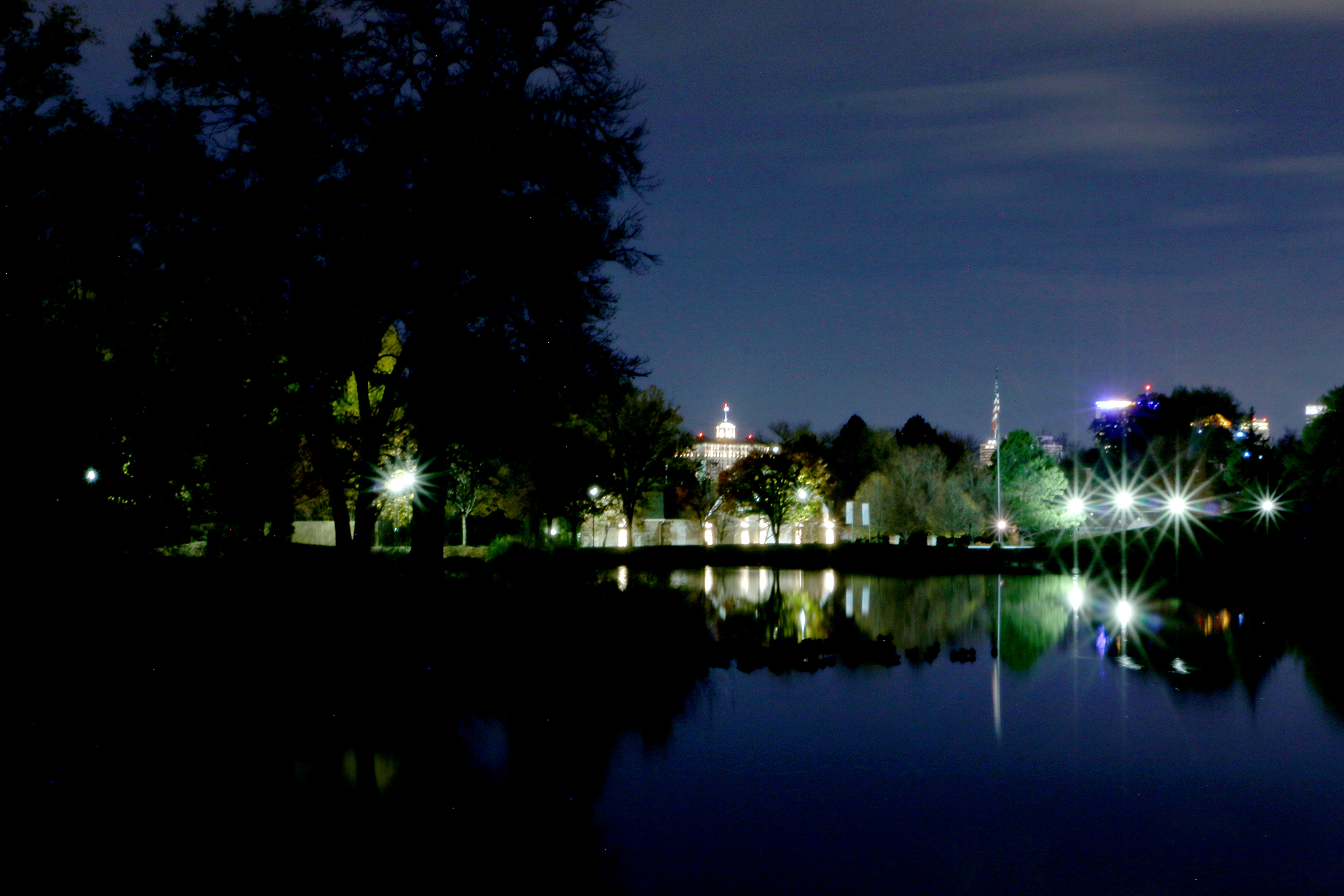
liberty-park-pond-looking-west-grand-america-in-distance
Liberty Park pond with the Grand America in the distance.

At this witching hour, there is a marketplace and business being conducted, just as there is during the day. On foot, as an unassuming walker in sweats, I could be anybody. It’s a unique vantage point, which is not visible to police in patrol cars, and completely invisible to motorists or bikers. On foot I’m a troller, a nightwalker. What lurks around the corners are the true creatures of the night, but I’m too timid to know them.

The next night, my cousin James joins me. It’s 1 am on a Friday.

The same city I visited 22 hours ago has not yet emerged. Now the streets are very much alive: the night time party is in full swing. Every bar we pass is packedDick and Dixie’s, Twilight Lounge, especially Johnny’s, Beer Bar, Bar X. They are alive with young, loud people. Now past 35, this is no longer my scene. But it’s nice to see it’s a lot cooler than the late night Salt Lake City I knew. We don’t stop. We have ground to cover.

Just east of Main Street a potential fight is ensuing. “You can talk sh*t, but you can’t just walk away. Come back and say that to my face… Seriously dude, I don’t mind you talking sh*t, just come say it right here to my face!” The man’s girlfriend quells potential hostilities. “Listen dude, just back the fu** off!” She is one foot away, unafraid, head raised high, staring in the much larger man’s face. He backs off: girl power.

We visit Pierpont Ave., Lumpys, and then Sky Bar, where two youngsters in club outfits are shamefully puking one right after the other. They hide their faces in shame: party fouls.

An anomaly that becomes obvious is that every place of business with any lawn at all at 1:30 am has sprinklers spraying. No place for drunks or bums to pass out. We proceed to our destination: Pioneer Park. I wouldn’t dare do this if James wasn’t here. But the scene is surprisingthe Park is bare. No campers, no drug deals, not even litter. It’s surprisingly clean. Is this the result of Mayor Biskupski and County Mayor McAdam’s recent crackdown on crime?

We travel further south on 400 West. Campers and homeless people are outside the Catholic Rescue Mission. We cross 400 South, then find a treasure trove under a huge tarp. The dimensions are ridiculous10 feet wide by 20 feet long. I look underneath where probably 30 bicycles are hidden in plain sight.

Were these legitimately left here? That’s hard to imagine. I’ve had two bicycles stolen at or near Pioneer Park. Bikes are currency for the drug trade, but this appears like some type of bicycle limbo. Nobody is protecting the cache, and I wonder if any of my bikes are under there. I wonder if the police know about this plunder?

We continue home. At this hour there are plenty of cars on State Street and nobody says a word or attempts to engage us. It’s nothing like the world I witnessed last night at 3:30 AM. The business of the night won’t open for another two-and-a-half hours.
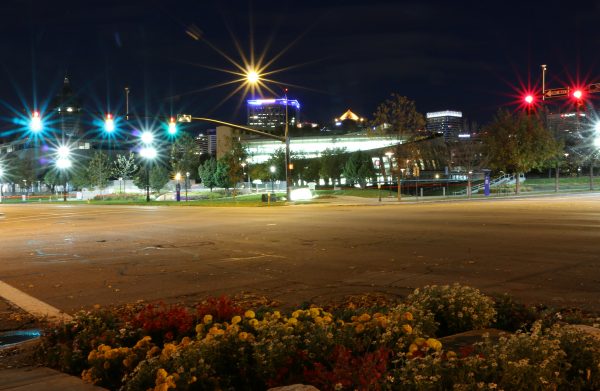
intersection-of-300-east-500-south
Intersection of 300 East and 500 South

Next month I plan to present these bike theft clues to the SLCPD. I’ll offer a follow up story about what they tell me online at UtahStories.com


Join our newsletter.
Stay informed.


  • The $7 Million Recruit: How NIL Changed College Athletics Forever

    In 2012, Jabari Parker, a top high school prospect and member of the Church of Jesus Christ of Latter-day Saints, was facing his biggest decision to that point in his life: where to play college basketball. 

    Fans of BYU athletics hoped and perhaps prayed that Parker would pick the school owned by the church he was raised in. BYU was listed as one of his final choices. But he ultimately chose to spend his college years at Duke before attempting a career in the NBA. BYU fans were disappointed, but no one was truly surprised. Duke over BYU was the best choice for a young prospect in 2012. 

    A.J. Dybantsa.

    What changed between 2012 and 2024 when A.J. Dybantsa, the number one high school prospect, chose BYU over every other school? The answer is roughly $7 million dollars. That is what Dybantsa is reportedly making to play basketball at BYU. 

    The deal was supported by Utah Jazz owner Ryan Smith, who met multiple times with the Dybantsa family in multiple attempts to bring the young player to Provo. 

    According to Smith, he had no financial role in bringing Dybantsa to BYU, but the influence of Utah’s most famous billionaire acting as a “booster” or unofficial recruiter certainly swayed the decision.

    Prior to 2021, boosters acting as recruiters was taboo to the NCAA governing body. It was called improper recruiting. But in 2021, California began the modern era of NIL, or the ability of a college athlete to benefit from their name, image, or likeness, when they passed the “Fair Pay to Play Act.” 

    This new law gave college athletes in California the ability to benefit from their NIL, something that was banned in the rest of the country to that point. The NCAA saw that this law would create an unfair advantage for California schools that could now give young athletes the chance to make money off their talent and image while still in college. 

    The NCAA knew they needed to do something quickly, so they rushed through a policy that opened up NIL to all college athletes in the country, and it has been expanding and evolving over the last four years. 

    Grant Duff, who has coached at the University of Utah, Weber State University, and is now the defensive coordinator for Idaho State University, says, “The best part of NIL is that athletes have an opportunity to make good money. The downside comes with the free-for-all that money causes.”

    Dybantsa confers with BYU Head coach, Kevin Young.

    One of the biggest current examples of what a school can do when the boosters are willing to pay for success is Texas Tech University. From 2020-2024, Texas Tech had 34 wins, which works out to 6.8 wins per year with a low of 4 wins and high of 8. Then Texas Tech’s boosters got involved, led by Cody Campbell, an oil industry businessman and Chairman of the Texas Tech board. The football program was given 28 million dollars for NIL with a simple message attached to the large pile of money: Win. And win now. And win they did. 

    By signing NIL deals with athletes in the transfer portal, Texas Tech went from a middle-of-the-pack school in their conference to one of the top 12 teams in the country. They didn’t just win games in 2025, they made many of their opponents look like they didn’t belong on the same field, including the University of Utah and BYU twice. That is what money can buy.

    Continue reading and support independent Utah journalism with a purchase of Utah Stories (Digital + Print) or 3 month free trial (Digital).


  • Cottonwood Heights Corruption Allegations: A Case That Never Reached a Courtroom

    A year ago, we here at Utah Stories recorded a podcast episode that we never published. We were revisiting corruption allegations from ten years ago. We decided not to publish the video, so it sat there on YouTube for nearly 12 months.

    Then somehow the video was published. How? We are not sure, but once it got out there, the comments came pouring in.

    Dozens of viewers, then hundreds, supported the video with their comments on our examination of allegations of police misconduct in Cottonwood Heights. The video recounts how the Police Department was reported by business owners as focusing enforcement on customers of the former Canyon Inn bar. These allegations did not result in a publicly documented, full investigation by Utah’s Justice Department nor the FBI (at least to our knowledge). So why rehash the past?

    We believe the story of The Canyon Inn (and other area business owners) vs. CHPD and Cottonwood Heights Mayor Kelvin Cullimore raises questions about what can happen when allegations surface and do not move forward through a formal legal process with state or federal oversight.

    In 2012, Cottonwood Heights business owners at the mouth of the canyons began publicly objecting to police activity whereby up to seven cruisers were pulling over 711 and Canyon Inn bar customers on their busiest evenings.

    According to those accounts, drivers leaving the bar were frequently pulled over by police and were given DUI tickets, sometimes even after passing a sobriety examination. The volume and concentration of those stops led residents and business owners to complain about the “heavy-handed treatment” of CHPD toward motorists, especially in and around the Canyon Inn and neighboring 711, and eventually the Porcupine Pub.

    Customers responded in predictable ways. Some chose not to return and avoid the area. Others went to different establishments. Over time, the owner of the Canyon Inn, Jim Stojack, stated that his revenue declined by 70% and that he believed police activity near his business was the main contributing factor.

    Utah Stories reported on these concerns by conducting interviews; gathering video documentation provided by those involved; and making public records requests. Through our GRAMA requests, we reviewed DUI citations issued by the Cottonwood Heights Police Department and examined how those cases were resolved in Holladay Justice Court. During that period, we observed a higher number based on our review of DUI cases dismissed in court due to lack of evidence compared to other jurisdictions. One DUI attorney, Tyler Ayers, went on record saying that CHPD was issuing a high volume of DUI citations that were later dismissed.

    That observation raised questions about how cases were being documented and prosecuted. It did not, on its own, establish intent or misconduct, but it became part of a broader set of concerns raised by multiple sources.

    Continue reading and support independent Utah journalism with a purchase of Utah Stories (Digital + Print) or 3 month free trial (Digital).


  • Why Did Salt Lake City Tear Down Its Most Beautiful Buildings?

    If you go into the Utah State Archives and spend time with photographs from the late 1800s and early 1900s, you start to notice something that doesn’t line up with what exists today.

    Main Street looks cohesive. Not in a uniform way, but in a way that suggests the people building it shared an understanding of proportion, material, and permanence. Four-story buildings line the street—stone, brick, cast iron—each one detailed in ways that don’t feel incidental. Arched windows, carved stone, brickwork that changes pattern as it rises. Even the cast iron facades were designed to replicate masonry, not hide behind it.

    Then you go downtown and try to find those same buildings.

    Most of them are gone.

    Out of more than 400 buildings designed by Richard Kletting, over 300 have been torn down. That number alone reframes the conversation. Kletting designed the Utah State Capitol, the Saltair resort, commercial buildings, schools, churches, mansions—virtually every type of structure…

    Continue reading and support independent Utah journalism with a purchase of Utah Stories (Digital + Print) or 3 month free trial (Digital).


  • Momomaru Sushi Review: Salt Lake City’s New Destination for Japanese Hand Rolls

    A new Salt Lake City sushi spot is drawing crowds with Japanese-style hand rolls served fresh, fast, and warm, offering a more intimate and interactive take on traditional sushi.