
A man’s autobiography can be read in his failed attempts at constructing the perfect man cave.
My first man cave was a kid’s cave or Sultan’s tent. Parents weren’t allowed and they were okay with that. Overturned picnic tables held up the sides. Suspended rope was anchored on either side of the tables to hold the blankets. We placed a tarp over the blankets, and sticks and logs fortified the entrance. We whittled spears, knives and arrows—weapons of war in the event of an enemy attack. We placed foam mattresses and sleeping bags inside until “sleeping out in the fort” became a nightly occurrence.
We stocked a cooler with Coke and Sprite to offer visitors, and added a black-and-white TV. At just 8-years-old, it was heaven to come “home” to my own place with my own rules. Friends came over and we played cards and checkers. Our cats decided to move in with us. We would grace our parents with our presence for dinner. The rest of the time we were happy in the fort.
One day a skunk paid us a visit, which had the effect of a nuclear attack! Pine tree car air fresheners alone cannot overpower skunk stench, and the fort had to be dismantled.
Subsequent forts came and went. In high school, my friend Mike and I once dug a very deep hole high in the mountains. We worked on it for weeks and had a twenty-foot hole in which to hang out. The only problem was that we only had enough space to stand. Still, It was cool—literally. It was much cooler down there than outside. We were about to put a lid on it and a climbing rope and add provisions, but when we came to work on it one day, it had collapsed. Lucky for us, we weren’t in it at the time.
What is it with men and man caves? Perhaps men want to feel like we have a comfortable cave in which to dwell and escape the stressors of everyday life—a place that contains all the necessities of life, like beer, sports and privacy. My man cave, aka my garage, is where essential tools are carefully placed within arm’s reach. And then there’s my man fort (my downtown office). Why do I now value these spaces more than ever? Probably because I no longer feel my space or my time is my own as it once was. I sometimes need an escape hatch from all the rigors and pressures of life. A place to come up for air. The man cave and the mountains provide these things for me.
Pat’s Saloon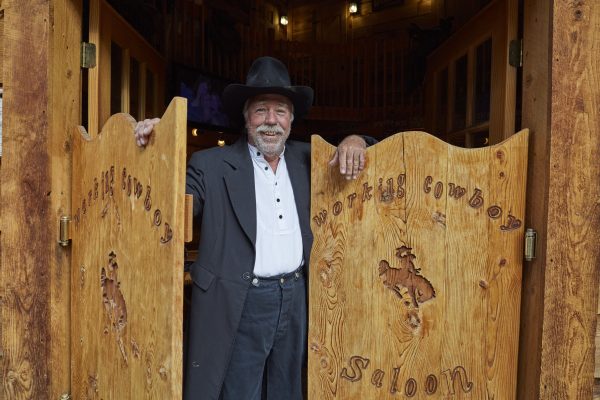
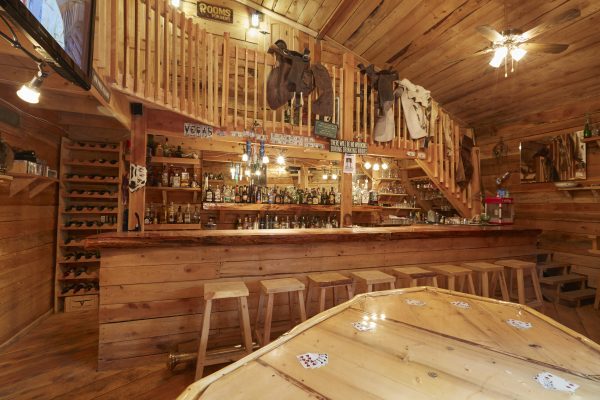
Walking into Pat Brennan’s Eden, Utah saloon is more than walking back in time. The space is to Pat what the Sistine Chapel was to Michelangelo—a veritable masterpiece of craftsmanship, authenticity and history. Besides the decor, including a 19th century piano that was hauled across the plains by Pioneers, nearly all the timbers were personally chosen by Pat, and he made sure each board was milled irregularly.
“They didn’t have a lot of precision back then, so I didn’t want a lot of precision in mine,” Pat says. The interior joists, siding and walls are all slightly irregular. Walls don’t meet at ninety degrees, railings and furniture are made from debarked pine logs.
Pat says, “I picked trees out and I took them to a buddy, and he would chalk line one side of them, hand cut one, then run it through the table saw. I figured that back in the 1800s they didn’t have a lot of precision either, so they filled a lot of them holes with mud and stuff. I just left them that way. The rough-hewn pine is one part, but the way the walls buttress each other at angles that are greater or less than 90 degrees creates a sense that the structure and design was built organically, where decisions were made as he went.
Everything is a bit out of place and yet everything appears perfect, like the brush strokes of an impressionist painter. While the space is compact, it can hold up to 60 people for the parties Pat and his wife, Sherrie, host annually. They have a Western party (which Pat explains is much different than a cowboy party). The have a redneck party where ladies wear dresses made from PBR cartons and men don wife beater t-shirts. The saloon has certainly turned into a community gathering space, and invitations are coveted. So how did it all come about? It turns out that Pat just needed somewhere to store his lawnmower.
“It just started with a wall,” Pat says. “Then I got my kids involved, and it just took off! I was just building a wall out here and I was just going to close it, and I thought, ‘how am I going to build a roof on this?’ And the next thing I know, I talk to an engineer buddy of mine, and he said, ‘just go for it.’” Once completed, Pat’s became a magnet for great parties and folks who simply wanted to donate stuff to include in the decor.
While the overall engineering and structure might appear haphazard, it’s anything but. Pat has 40 years of experience in construction and excavation under his belt, and the entire build only took 3 months to complete.
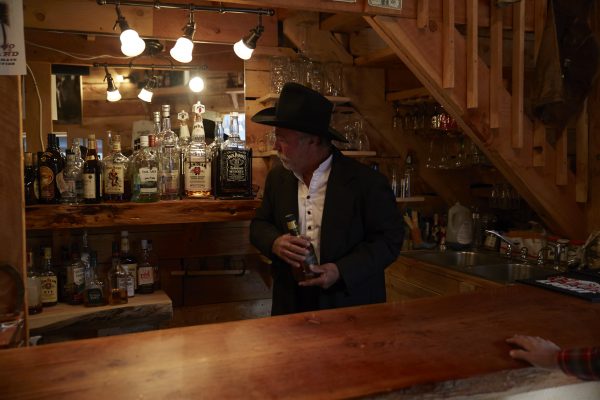 One night Pat’s was hosting a party when he says, “A lady walked in decked out in Western wear and petting a lamb. She put the lamb down and started playing the piano. We were asking each other, ‘who is she? Do you know her?’” The next thing Pat knew, a man walked in dressed to the nines like Doc Holliday as a Sheriff. The the man fired his pistol in the air and ordered everyone, “OUT!” His guests were screaming and they quickly evacuated. Yelling and brandishing weapons, a drama unfolded like scene in a Western movie. Pat said the participants were actors from the Salty Dinner Theater. “They were so incredible. That was one of the most amazing nights we have had here.”
Pat has maintained a great attitude throughout the good times and the bad. He explained that his excavation company once employed 11 men, until overnight, most of the construction in Eden came to a halt. He was forced to lay off most of his workers and find new ways to earn income, so he decided to build a food shack in his workshop just to test the waters. It turned out that while it didn’t attract many skiers, the locals loved Pat’s Food Shack.
He moved the shack near another lot. “I dug out a septic tank and poured a foundation and we were in business!” Pat says proudly. He has seen many restaurants in Eden come and go but his business does consistently well. “A family of five can come here and get out for around fifty bucks. Some of these new places want to charge one-hundred bucks for two people, and they wonder how I can make it.” Pat opened a saloon near his food shack before he was forced to close due to a $13,000 snafu with DirectTV. Pat and Sherrie shrug off the unfortunate circumstance with a smile.
Pat’s touch in building and excavating can be seen throughout Eden. His primary occupation is excavation, and he has built rock walls, streams and lakes for properties all throughout Utah. Like Sherrie says, “He is an artist.”