Utah Stories

Turning Bike Chains and Discarded Engines Into Art

Andrew Smith, self-taught artist, machinist, welder and craftsman turns his passions into art.

|


Andrew’s eye for a particular kind of design element, the skill he uses to make manifest his imagination, and the levity that permeates his work, have earned him an established yet playful place in the serious world of art. 
hy2a3230
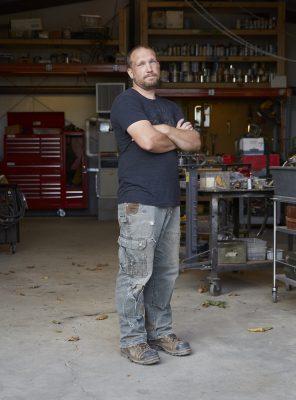
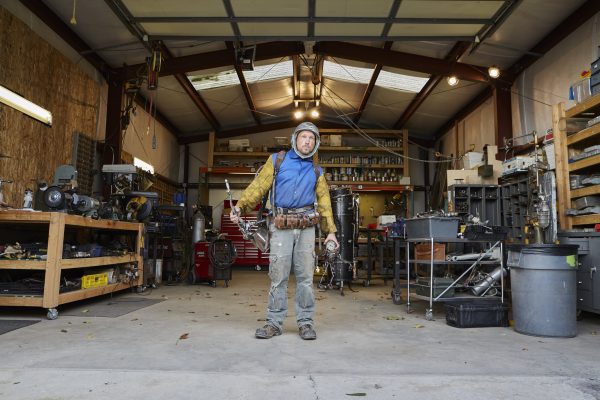
Andrew Smith in his artist workshop. Photos by Steven Vargo

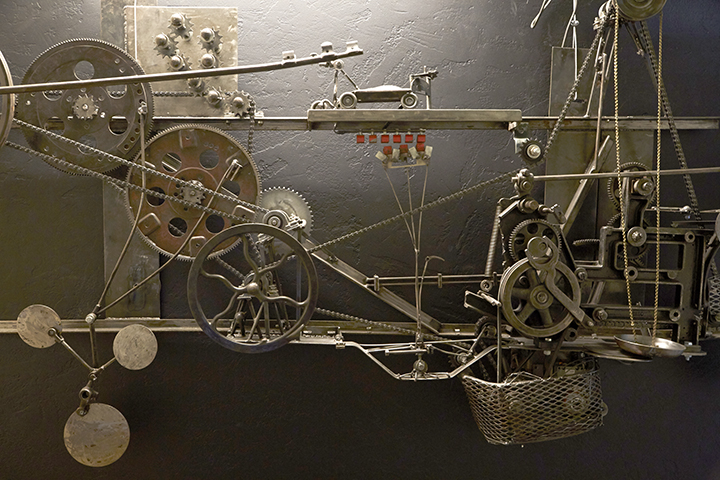
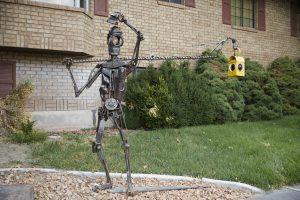
Andrew Smith’s found-object kinetic sculpturesworks that spin gears, move water, twirl rotors and guide rolling ballsare a fusion of materials, science and fun. A self-taught artist-machinist-welder-craftsman, Andrew had to overcome his own self-imposed limitations when he recognized he’d identified his passion.

I realized that if I’m going to be an artist, I don’t have to be serious. I can just make stuff that’s cool. That’s enough.” Andrew asserts that his sculptures don’t express deep metaphors or political statements. Conceptually, the meaning of his art is “fun.” “It has no purpose other than itself,” he relates.
hy2a3139

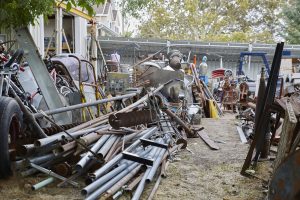
The materials Andrew grinds, welds, rivets and drills are objects that might otherwise end up at the scrap yard. Some may call it junk, but to Andrew, the uniquely shaped and rusted aviation or military equipment parts are useful sculptural elements infused with character.

Andrew’s repurposing of old sewing machine parts or pieces from defunct amusement park rides is also an exercise in preserving the past. “Older people, or farmers who typically wouldn’t care about art often recognize and connect to some piece in a sculpture,” he notes.
hy2a3216

Andrew’s imagination is the adult expression of the most general definition of child’s play. For him, “play is discovery through enjoying the process. You have to let go of expectations to allow yourself the freedom to discover things.”

Inherent in Andrew’s free-flowing creations are unique challenges. “Sometimes people say, ‘Oh you just play around. You just weld stuff together,’” but each sculpture, he says, is the result of “trial and error experimenting.” Without design sketches or computer modeling, Andrew allows the idiosyncrasies of the materials, the junk, to inform the design and fabrication in real time.

The process of assembling directs him to the next required item to further the emerging concept. “Sometimes there’s the ‘Aha!’ moment, like when you’re doing a jigsaw puzzle and find the right piece,” he says of locating the perfect object. Alternatively, a particular function of a sculpture, such as a steel ball bearing, dictates design materials.
hy2a3253

Commissioned pieces can present new challenges. Andrew was tasked with creating moving robotic sculptures for Glenn Beck’s 2013 “Man in the Moon” performance at USANA Amphitheatre.

“There was so much troubleshooting and problem-solving involved in that project,” he says. For example, in order to transport the two 18-foot automatons, Andrew deduced that he must build the sculptures on their transport trailer beds. He had to calculate the design to accommodate not only the weight of the assembled metal, but also create a functional aggregate of disparate yet complementary metal pieces that could be animated. When he identified how he was going to animate the robots, he then had to learn the software that would allow him to control the digital air pneumatic cylinders.


, ,


Join our newsletter.
Stay informed.


  • Highway 6 and the Midland Trail: Utah’s Transcontinental Highway History

    From Price Canyon to Delta’s desert stretch, Utah played a central role in building the Midland Trail, one of America’s earliest transcontinental highways and the foundation of today’s Highway 6.


  • Whiskey, Bullets & a Buried Town: Archaeologists Reveal Alta’s Wild Past

    Before Alta was known for powder days and lift lines, it was a silver mining town clinging to the side of a narrow canyon. In the late 1800s, men lived at 8,000 feet, went underground each day, and endured winters that regularly buried buildings in snow. This past summer, that mining town resurfaced — literally — during construction at the Alta Ski Area.

    To understand what Alta really looked like, you don’t begin with legend. You begin with its trash — and this time, that happened almost by accident.

    Alta Ski Area was installing underground water reservoirs to support snowmaking. Because the project sits on Uinta-Wasatch-Cache National Forest land, an archaeologist was required to monitor the excavation. No one expected the trench to produce much.

    But, It did.

    Artifacts began surfacing almost immediately. Enough that the Forest Service contacted the Utah State Historic Preservation Office for help. Lexi Little, who coordinates the Utah Cultural Site Stewardship Program, helped mobilize nearly 30 volunteers to assist with what quickly became a focused two-week excavation.

    Winter deadlines were approaching. The pipes for the reservoirs had to go in the ground. There wasn’t time for a slow, extended dig.

    “It was two weeks of digging in the dirt and helping figure out exactly what we were looking at,” Little said.

    Most of the people screening soil weren’t professional archaeologists. They were trained stewards from around Utah — part of a statewide volunteer network that now approaches 500 people. They poured dirt through shaker screens, scanning for fragments that could piece together a town long buried.

    “Archaeology is human trash,” Little explained. “Archaeologists are very into trash.”

    Alta had left plenty behind.

    https://youtu.be/hzIHzx3OGoo?si=dKcl2CEz-t6FZzYw

    Victorian-style ceramics appeared first — the kind typically used in hotels. Medicine bottles followed. Ink bottles. Hand-blown glass. A porcelain doll’s foot surfaced from the soil, a small detail that shifted the mental image of the town. Families were here. Children were here. This wasn’t only a camp of miners.

    The bottles helped establish time. Manufacturing details — whether glass was hand-blown or mold-made, whether a maker’s mark appeared on the base — allowed archaeologists to date many of the artifacts to the 1870s through the 1890s, when Alta was booming as a silver mining town.

    “That gives you that range of dates for when Alta was really booming,” Little said.

    One reusable soda bottle clearly stamped “Salt Lake City” connected the canyon to the valley economy below.

    Then something unusual rolled out of a dirt pile.

    A corked bottle. Intact. Liquid still inside.

    To access this post, you must purchase Utah Stories (Digital + Print) or 3 month free trial (Digital).


  • The Only Full Bottle of Alcohol Ever Found in Utah Was Unearthed in Alta

    When a backhoe rolled a corked bottle out of the dirt at Alta this summer, no one immediately grasped what they were holding. It wasn’t empty. It wasn’t shattered. It was full. “The bottle that was discovered up at Alta is the only bottle of alcohol ever discovered in an archaeological excavation in the state…


  • How Horses Help Kids Heal: Inside Utah’s Equine Therapy World

    Kelty Johnson trains horses for a living, but her deeper work happens in the quiet space between animal and human. On the Utah Stories podcast, she explains how equine therapy helps children regulate emotions, build confidence, and reconnect through presence rather than pressure.