Development Projects

Bluff, Utah benefits from U of U Architectural Design Program

University of Utah program aims to build up a community as well as student’s skills.

|


cedar-hall-104
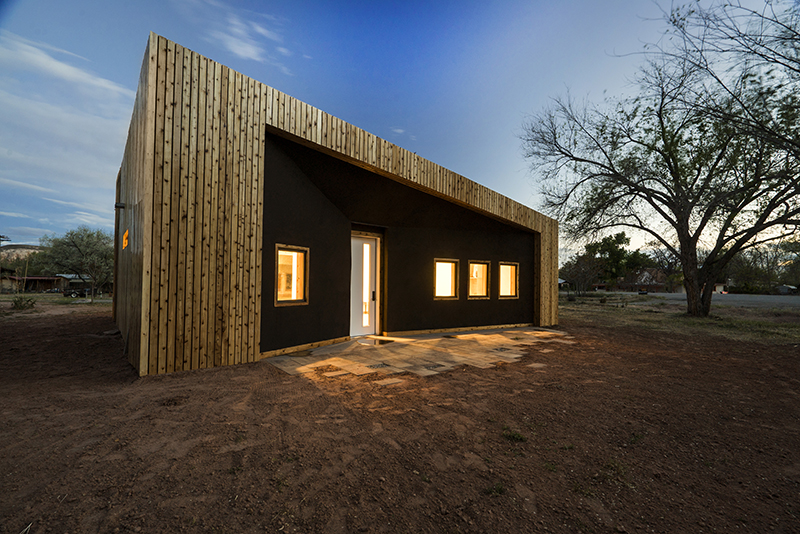
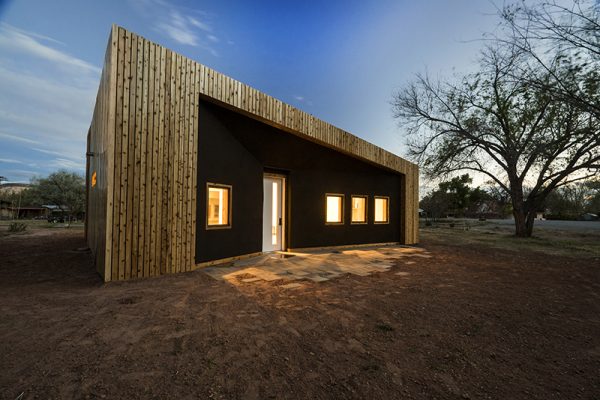
Cedar Hall – community gathering place

Few professions in the construction industry practice as many different skills as architects. In addition to exercising creativity they must also understand engineering, building codes, properties of different building materials, and perhaps most importantly, listen closely to their clients to parse out exactly what is being asked for.

For the past 12 years, the Design Build Bluff program in the college of Architecture and Planning at the University of Utah has been immersing graduate students in an environment intended to develop the multiple skills they will need as professionals and contribute to a community in need.

Working from the town of Bluff, on the Navajo reservation in Southeastern Utah, the students have designed and built 16 homes, mostly from donated and recycled materials, for families in the region.

“We want to develop two sets of skills,” said DBB Director Professor Jose Galarza. “There are a set of ‘hard skills’ and that is the hands-on construction and giving the students the chance to lift their ideas off the paper and put them into practice. The other is developing a sensitivity for the real world. We want to be facilitators and help build capacity and resiliency in this community. I want students to be very cautious about thinking they know better than the community they are serving. We have methods we develop to talk with clients and engage with them to make sure we are both getting the most out of the process,” said Galarza.  

Over the course of the program, students take the information from client interviews and begin to develop a design. In mid-January they return to the reservation for months of hands-on construction work and more community engagement.  

“In the past I had done some construction and carpentry. I had educational experience but the DBB program really tied it all together for me,” said former student and program graduate Nancy Kole, who is now working for a design-build firm in Boulder, Colo. “I learned new skills and the program challenged me to use them. I got to draw sections and then build those walls with my own hands.”
12513808_10153874219028622_3372172609498763252_o
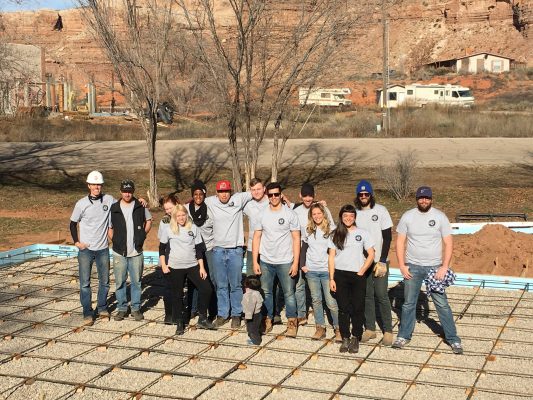
University of Utah students on site at the project. Photos courtesy of Design Build Bluff

Galarza said that in recent years he’s tried to emphasize the facilitator role architects can play in responding to the needs in a community.

“The Navajo community has already suffered from years of colonization and outsiders coming in saying they knew what was best,” said Galarza. “Sometimes architects disassociate themselves from the community or are ‘helicoptered’ in to solve a problem.”

DBB’s most recently completed project, Cedar Hall, was built with the intention of integrating the “campus” where students live, work and store materials to the wider Bluff community.

Rather than serving as a single family home, Cedar Hall is a community gathering place and more formal workshop for the students.

“We wanted to create face for the campus. The building faces the street and has a place for people to gather. It connects us to the town and people in the community.” Galarza said. 

All the DBB projects can be viewed on the program website at www.designbuildbluff.org.dbb-stairs

, ,

Join our newsletter.
Stay informed.


  • Ogden Utah: Boomtown, Bargain, or Utah’s Next Unaffordable City?

    With its reinvigorated downtown and close proximity to mountains and river pathways, this northern Utah city is enjoying a renaissance. Ogden’s stock of affordable housing — compared to other metros along the Wasatch Front — currently draws people in for a closer look. 


  • The End of an Era? FanX and the Salt Palace Closure

    For more than a decade, FanX has called the Salt Palace home. With the convention center set to close for a massive renovation, founder Dan Farr is preparing for a new chapter while planning one final celebration in its longtime venue.


  • The Stratos Project and Corporate Power: Who Controls Utah’s Future?

    If we were all just consumers, Governor Cox, Mike Lee, Speaker Schultz, and Kevin O’Leary would have it easy. If we were just more concerned about money, jobs, and tech, and less concerned about raising our kids in communities (not in front of screens), culture, the environment, and water, those smart dudes would get exactly what they want — Stratos: a city of the future, buzzing with processors and transistors, making all of our AI dreams come true! 

    The world we could live in would be a dazzling, Mr. Wonderful kind of place. We would beat those pesky Chinese in the AI war; our AI robots could do all of our farming and ostensibly harvest the water we need for the Great Salt Lake out of thin air. But apparently, we just don’t get it. We haven’t yet reached the point predicted by Aldous Huxley’s vision in Brave New World, where we are completely distracted, dopamine-driven consumers who only need sex, drugs, and stuff to remain happy.

    Maybe Stratos will be an amazing marvel, and somehow, as Governor Cox claims, “. . . add more water to the Great Salt Lake.” But we aren’t sold. While this Stratos project has received considerable attention, it’s worth taking a step back to attempt to understand how corporate power appears to have usurped civic power.

    Civics is the practice of shaping our society through our collective voices and community involvement. Ask the residents in Tremonton, Utah how well that is working out for them. Can we still shape our world through our elected leaders? Does it matter who we vote for at the ballot box if organizations like UDOT, UTA, and MIDA can supersede our local government authority and citizen backlash? 

    The corporatization of our communities and the interests that impact our political leaders’ decision making processes are seen as far more of a concern than the average Utah resident’s concerns. Special interests and corporate power are shaping Utah’s future more than ever. 

    It’s worth asking: ‘How can we regain control over shaping Utah’s future in light of the growing power and billions that the technocrats now wield in shaping our world today?’ Amazon’s market cap exceeds the GDP of Canada. The “Magnificent Seven” tech stocks now have a greater market cap than the entire GDP of Europe ($23.6 trillion. EU countries have $19.3 trillion GDP). Will tech companies become their own nation-states and dominate their own chunks of various states? Will we become their subjects?

    There are two sides to this coin: We love Utah not just because we have the most outdoor wilderness playgrounds, but also because of Utah’s prosperity and job market. This is because Utah has become a tech hub. Our tech leadership has minted several billionaires and billion-dollar businesses. Utah offers a market and an educated workforce that more businesses and giant corporations want to be a part of. This is a benefit for even non-tech Utahns.

    The problem with this success is that as we dole out more money to attract more tech businesses, data centers, fulfillment centers, and big corporate retailers, it becomes more difficult to carve out our “sense of community.” As corporate sovereignty replaces local business sovereignty, we see that our voices and our votes matter less.

    Ask who our politicians work for, and nearly every Utahn believes they work far more for their corporate donors than they work for the average Utah citizen. So how do we best regain control over our communities?

    Continue reading and support independent Utah journalism with a purchase of Utah Stories (Digital + Print) or 3 month free trial (Digital).


  • The Utah Farm That Refuses to Give Up as Development Closes In

    Running a farm is hard enough, but rapid city growth makes it even tougher. More than a decade ago, the late Verl Cook faced a series of staggering hurdles that threatened to wipe out his family’s livelihood.

    First, the city decided to treat the Cook’s greenhouse — the most profitable part of the farm — like a big-box retail store. They demanded the family build a paved parking lot, a project that would cost $200,000.