Utah Stories

Ogden’s Tentsile Tree Tents

A new tent design moves campers off the ground and into the trees.

|


IMG_20160419_154150729_HDR
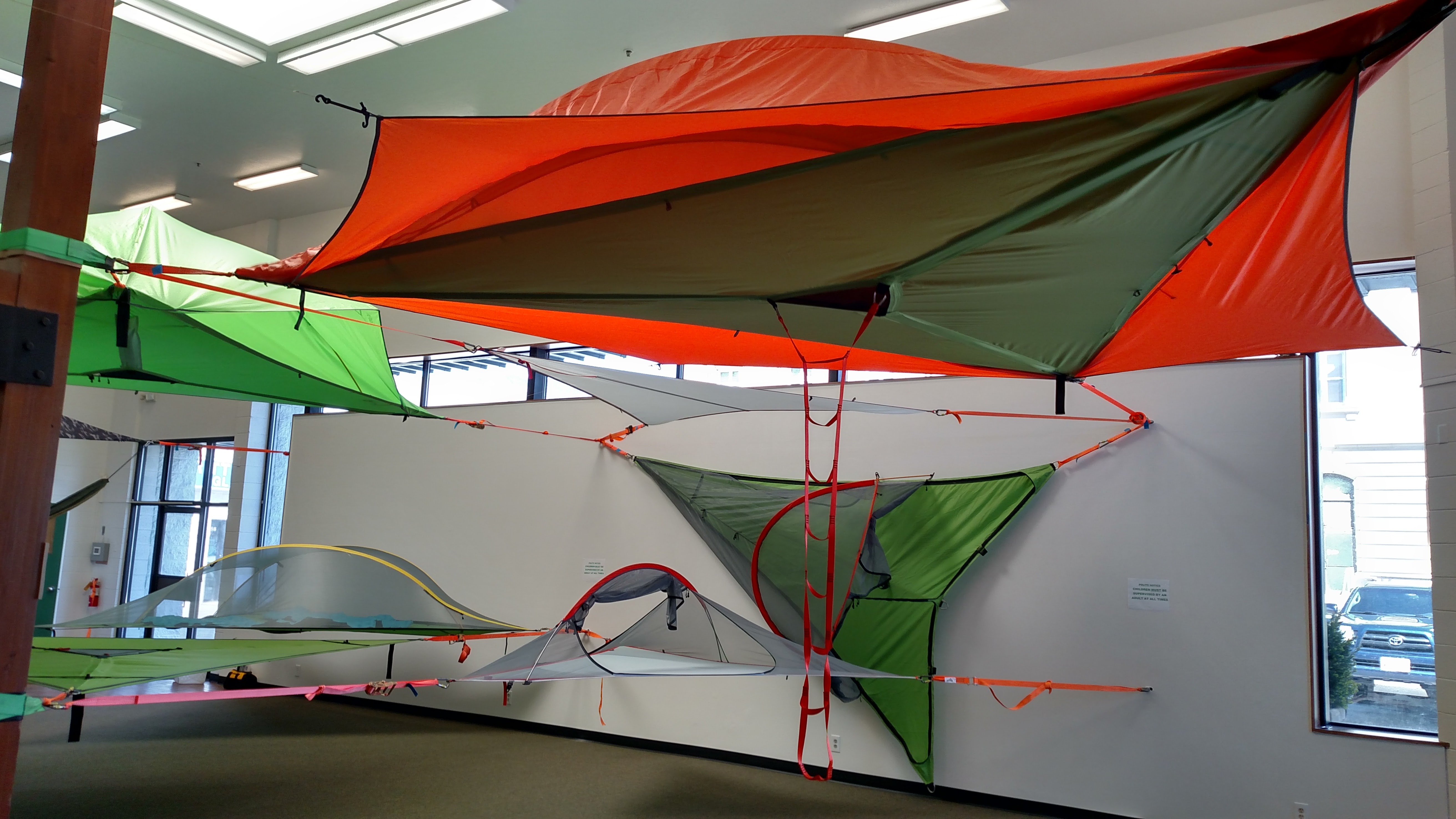
Tentsile Tents. Photo by Maria Milligan

The trouble with your typical camping hammock is that it fits only one person, provides little cover, and tends to dump its occupant into the dirt. For hammock lovers, one company has solved these problems in designing a unique tent that many folks are adding to their gear collection.

Tentsile Tree Tents on 24th Street in Ogden is a warehouse, an office and a store, making it a hive of activity for the company that sells its products worldwide. According to founder Alex Shirley-Smith, “Our headquarters are still in London. We are a UK company needing to be where our largest customer base is. Production in China, headquarters in London, and our main shop in the USA. We are a small global company.”

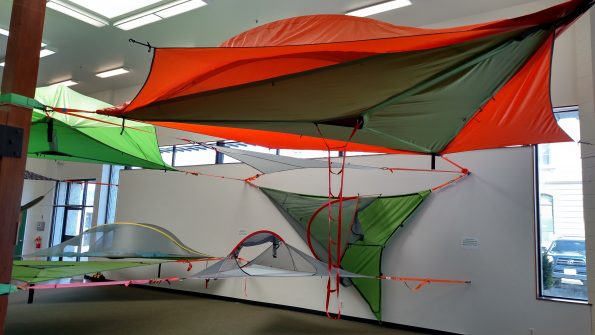
The store is set up with tents, each lashed with slack line at three points and stretched above the showroom floor like a forest canopy. Shirley-Smith says, “Our tents are made out of pure tension and keep you off the ground.” It’s a simple approach, executed uniquely by these suspended tents.

In the upstairs office, employees take orders, refill stock and communicate with London headquarters. There may be no one in the showroom at first, but if you make your presence known, employees are happy to answer questions and let you test out models.

Climbing into the tent, you may fear that it will collapse or snap free of its lines and anchors. But the tents remain firm, holding the weight of several people without strain. Lying in them is as comfortable as a hammock without the sudden twists when you adjust. The interest for customers, Shirley-Smith says, is simple: People like to climb up into things. As adults, we still want childlike playfulness, but mixed with a sense of security.

Perhaps more interesting than the tents is their purpose. Tentsile’s mission is to create products that leave no footprint, and they use sales income from those products to serve the environment. For every tent purchased for example, Tentsile will plant three trees through the WeForest initiative.

For Shirley-Smith, caring for the environment has been a lifelong passion. For Ogden, the presence of Tentsile Tree Tents means yet another outdoor products manufacturer whose success can benefit the area’s future economic growth. Utah has always been sought after for its scenery. Tentsile is a good Utah business fit as it aims to keep that scenery as unblemished as possible.

The Ogden store hosted a grand opening on May 7th.13254524_1379728238721105_5334772662749634130_n
Join our newsletter.
Stay informed.


  • Highway 6 and the Midland Trail: Utah’s Transcontinental Highway History

    From Price Canyon to Delta’s desert stretch, Utah played a central role in building the Midland Trail, one of America’s earliest transcontinental highways and the foundation of today’s Highway 6.


  • Whiskey, Bullets & a Buried Town: Archaeologists Reveal Alta’s Wild Past

    Before Alta was known for powder days and lift lines, it was a silver mining town clinging to the side of a narrow canyon. In the late 1800s, men lived at 8,000 feet, went underground each day, and endured winters that regularly buried buildings in snow. This past summer, that mining town resurfaced — literally — during construction at the Alta Ski Area.

    To understand what Alta really looked like, you don’t begin with legend. You begin with its trash — and this time, that happened almost by accident.

    Alta Ski Area was installing underground water reservoirs to support snowmaking. Because the project sits on Uinta-Wasatch-Cache National Forest land, an archaeologist was required to monitor the excavation. No one expected the trench to produce much.

    But, It did.

    Artifacts began surfacing almost immediately. Enough that the Forest Service contacted the Utah State Historic Preservation Office for help. Lexi Little, who coordinates the Utah Cultural Site Stewardship Program, helped mobilize nearly 30 volunteers to assist with what quickly became a focused two-week excavation.

    Winter deadlines were approaching. The pipes for the reservoirs had to go in the ground. There wasn’t time for a slow, extended dig.

    “It was two weeks of digging in the dirt and helping figure out exactly what we were looking at,” Little said.

    Most of the people screening soil weren’t professional archaeologists. They were trained stewards from around Utah — part of a statewide volunteer network that now approaches 500 people. They poured dirt through shaker screens, scanning for fragments that could piece together a town long buried.

    “Archaeology is human trash,” Little explained. “Archaeologists are very into trash.”

    Alta had left plenty behind.

    https://youtu.be/hzIHzx3OGoo?si=dKcl2CEz-t6FZzYw

    Victorian-style ceramics appeared first — the kind typically used in hotels. Medicine bottles followed. Ink bottles. Hand-blown glass. A porcelain doll’s foot surfaced from the soil, a small detail that shifted the mental image of the town. Families were here. Children were here. This wasn’t only a camp of miners.

    The bottles helped establish time. Manufacturing details — whether glass was hand-blown or mold-made, whether a maker’s mark appeared on the base — allowed archaeologists to date many of the artifacts to the 1870s through the 1890s, when Alta was booming as a silver mining town.

    “That gives you that range of dates for when Alta was really booming,” Little said.

    One reusable soda bottle clearly stamped “Salt Lake City” connected the canyon to the valley economy below.

    Then something unusual rolled out of a dirt pile.

    A corked bottle. Intact. Liquid still inside.

    Continue reading and support independent Utah journalism with a purchase of Utah Stories (Digital + Print) or 3 month free trial (Digital).


  • How Horses Help Kids Heal: Inside Utah’s Equine Therapy World

    Kelty Johnson trains horses for a living, but her deeper work happens in the quiet space between animal and human. On the Utah Stories podcast, she explains how equine therapy helps children regulate emotions, build confidence, and reconnect through presence rather than pressure.


  • Angela Brown: The Woman Behind SLUG Magazine and Craft Lake City

    Angela Brown is the publisher and owner of SLUG Magazine, one of the city’s longest-running independent publications and a central voice in Utah’s alternative arts and music scene. She is also the founder of Craft Lake City, a nonprofit that has grown into one of the state’s largest platforms for local makers and creative entrepreneurs.