Online Exclusives

Filmmaker Matt Duhamel – Documentaries and Second Chances

Matt Duhamel explores issues and seeks a second chance through documentary film-making.

|


unnamed

Matt Duhamel was a weather anchor on KUTV and a late-night talk show personality on KPNZ, but was charged in 2007 of three sex offenses relating to child pornography.

He operated a website depicting young girls, mainly nine and 10 years old, “modeling” in suggestive clothing and positions. Charging documents state that one photo depicted a nine year-old in black stiletto pumps, a black lace thong, black bra and jacket sitting on a dining room table.

Duhamel was incarcerated until January 2012.“I got involved in something I shouldn’t have,” he said. “I I know what I did was wrong, and now I want to change things around. “When people hear I have a sex offense, they run,” he said. “They are scared, they are fearful and they don’t know what to say or do. I think we need to start opening up that conversation.”

Today Duhamel is trying to make inroads back into media as a documentary filmmaker. His story demonstrates the difficulty of child sex offenders reentering society in a somewhat “normal” manner. Duhmel was attracted to producing a film about the city of Spring City. But can “society” forgive him?

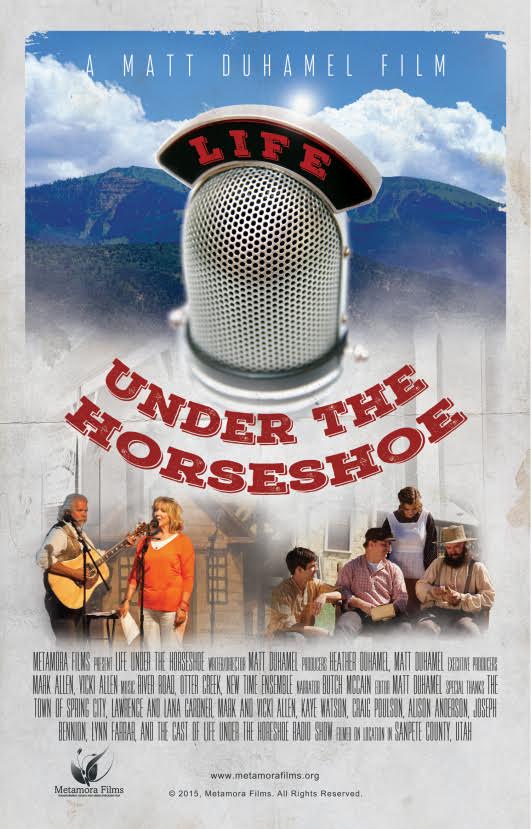
Spring City, Utah might be just a small blip on a map, but the 25-minute documentary by Metamora Films, “Life Under the Horseshoe,” paints a vivid picture of small-town country living that makes you nostalgic for simpler times and places.

The short documentary is about a live radio show, called “Life Under the Horseshoe,” performed every Saturday through the spring and summer in front of a live studio audience. The radio show dramatizes the history and lives of former town members.

“I saw an article about the live radio show in the news,” said documentary creator and director Matt Duhamel. “I started in radio so I really connected with the idea. Once I was there and started meeting the people, I just came to really appreciate the small town-life and the people running this production on a very, very limited budget. I don’t think a lot of people in the United States are doing a live stage radio show.”

Duhamel said he’s always wanted to do documentaries, so with his wife’s and probation officer’s support, he began his production company, Metamora Films.

“The mission for my film company is to transform hearts and minds through film, either through education or just having people think about things,” he said.

Duhamel added that he wants to make films that help others, but when people hear he has a sex-offense, they don’t want to talk to him or be in his films.

“And I don’t get hired for video production jobs,” he said. “I just got rejected this morning for a Sundance project. So it’s a constant struggle that I get rejected and I’m hitting a wall. But I have an inner drive that this is my mission in life. I’m not doing this to say, ‘Hey, look at me. I’m a good person.’ I think it goes back to, you to give people second chances.”

Duhamel’s first film, released in 2013, “What Make’s Me Tic?” about living with Tourette’s Syndrome won several online awards and was picked up by an educational distributor.

The following year, he made “Last Day With Lizzie” about his estranged daughter, which also won several online awards, was an official selection of the Logan Film Festival and was featured in the 2014 Park City Showcase.

In 2015, he explored his own story, as well as that of others, in “The Forgiveness Journey.” It debuted at Salt Lake City’s Broadway Centre Cinemas, with more than 125 people attending.

“‘Life Under the Horseshoe’ is a little bit different than what we’ve done in the past,” Duhamel said. “It’s about Spring City and the live radio show but it goes a little deeper, kind of like my past. I do films I can personally relate to.”

The documentary takes us on a journey to the heart of Sanpete County, where we learn about the town and its history through the eyes of “Life Under the Horseshoe” live radio hosts, Mark and Vickie Allen.

“Knowing the history of both of our families and the legacy they left us is really a great thing,” Vickie said in a documentary interview. “Knowing who they were helps us to find out who we are.”

For more information on “Life Under the Horseshoe” and Metamora Films, visit www.metamorafilms.com

,

Join our newsletter.
Stay informed.


  • The $7 Million Recruit: How NIL Changed College Athletics Forever

    In 2012, Jabari Parker, a top high school prospect and member of the Church of Jesus Christ of Latter-day Saints, was facing his biggest decision to that point in his life: where to play college basketball. 

    Fans of BYU athletics hoped and perhaps prayed that Parker would pick the school owned by the church he was raised in. BYU was listed as one of his final choices. But he ultimately chose to spend his college years at Duke before attempting a career in the NBA. BYU fans were disappointed, but no one was truly surprised. Duke over BYU was the best choice for a young prospect in 2012. 

    A.J. Dybantsa.

    What changed between 2012 and 2024 when A.J. Dybantsa, the number one high school prospect, chose BYU over every other school? The answer is roughly $7 million dollars. That is what Dybantsa is reportedly making to play basketball at BYU. 

    The deal was supported by Utah Jazz owner Ryan Smith, who met multiple times with the Dybantsa family in multiple attempts to bring the young player to Provo. 

    According to Smith, he had no financial role in bringing Dybantsa to BYU, but the influence of Utah’s most famous billionaire acting as a “booster” or unofficial recruiter certainly swayed the decision.

    Prior to 2021, boosters acting as recruiters was taboo to the NCAA governing body. It was called improper recruiting. But in 2021, California began the modern era of NIL, or the ability of a college athlete to benefit from their name, image, or likeness, when they passed the “Fair Pay to Play Act.” 

    This new law gave college athletes in California the ability to benefit from their NIL, something that was banned in the rest of the country to that point. The NCAA saw that this law would create an unfair advantage for California schools that could now give young athletes the chance to make money off their talent and image while still in college. 

    The NCAA knew they needed to do something quickly, so they rushed through a policy that opened up NIL to all college athletes in the country, and it has been expanding and evolving over the last four years. 

    Grant Duff, who has coached at the University of Utah, Weber State University, and is now the defensive coordinator for Idaho State University, says, “The best part of NIL is that athletes have an opportunity to make good money. The downside comes with the free-for-all that money causes.”

    Dybantsa confers with BYU Head coach, Kevin Young.

    One of the biggest current examples of what a school can do when the boosters are willing to pay for success is Texas Tech University. From 2020-2024, Texas Tech had 34 wins, which works out to 6.8 wins per year with a low of 4 wins and high of 8. Then Texas Tech’s boosters got involved, led by Cody Campbell, an oil industry businessman and Chairman of the Texas Tech board. The football program was given 28 million dollars for NIL with a simple message attached to the large pile of money: Win. And win now. And win they did. 

    By signing NIL deals with athletes in the transfer portal, Texas Tech went from a middle-of-the-pack school in their conference to one of the top 12 teams in the country. They didn’t just win games in 2025, they made many of their opponents look like they didn’t belong on the same field, including the University of Utah and BYU twice. That is what money can buy.

    Continue reading and support independent Utah journalism with a purchase of Utah Stories (Digital + Print) or 3 month free trial (Digital).


  • Priced Out of Summer Fun? These Activities Cost Almost Nothing

    As summer approaches, many of us start looking for new ways to be active. Whether you’re emerging from a cozy winter of hibernation, or searching for a replacement for skiing and snowboarding, there are inexpensive and accessible ways to get outside, get active, and make the most of summer. 


  • The Reality of Meth Psychosis on Utah’s Streets

    On the streets of downtown Salt Lake City, psychosis has become part of the landscape.

    People scream at invisible enemies. Some believe they are prophets. Others wander through traffic carrying conversations with voices nobody else can hear. To passersby, it can look theatrical, bizarre, and absurd. But behind many of those episodes is a darker reality few people want to confront directly: methamphetamine-induced psychosis, prolonged sleep deprivation, trauma, addiction, and the slow destruction of a person’s ability to distinguish reality from delusion.


  • Did Utah Leaders Already Sell Out Tremonton to Big Tech?

    When Kevin O’Leary appeared on Fox Business and casually announced that Utah would soon become home to what could be the largest AI data center project in the world, many Utahns had the same reaction:

    Wait… this was already approved?