
Utah Stories

Utah Opera’s World-Class Artisans

Sets and costumes at Utah Opera are in good hands.

|


John Wayne Cook – Set Design
DSC_0103
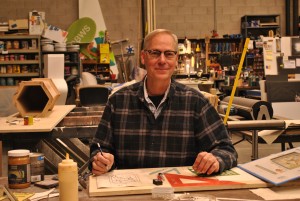
Utah Opera’s John Wayne Cook, at the drawing board. All photos by Mark Salgado

John Wayne Cook transports audiences from a theater seat to locations anywhere from Egypt to Japan or Shakespeare’s England. John, as the company’s scenic artist, designs, builds and paints Utah Opera’s backdrops and sets in a cavernous work space at the Utah Symphony/Utah Opera offices .

Cook’s love for the job has been evident in his 35 years of building beautiful sets. According to Renee Huang, Director of Public Relations for Utah Symphony and Utah Opera, “John is one of the foremost scenic artists around,”
DSC_0074
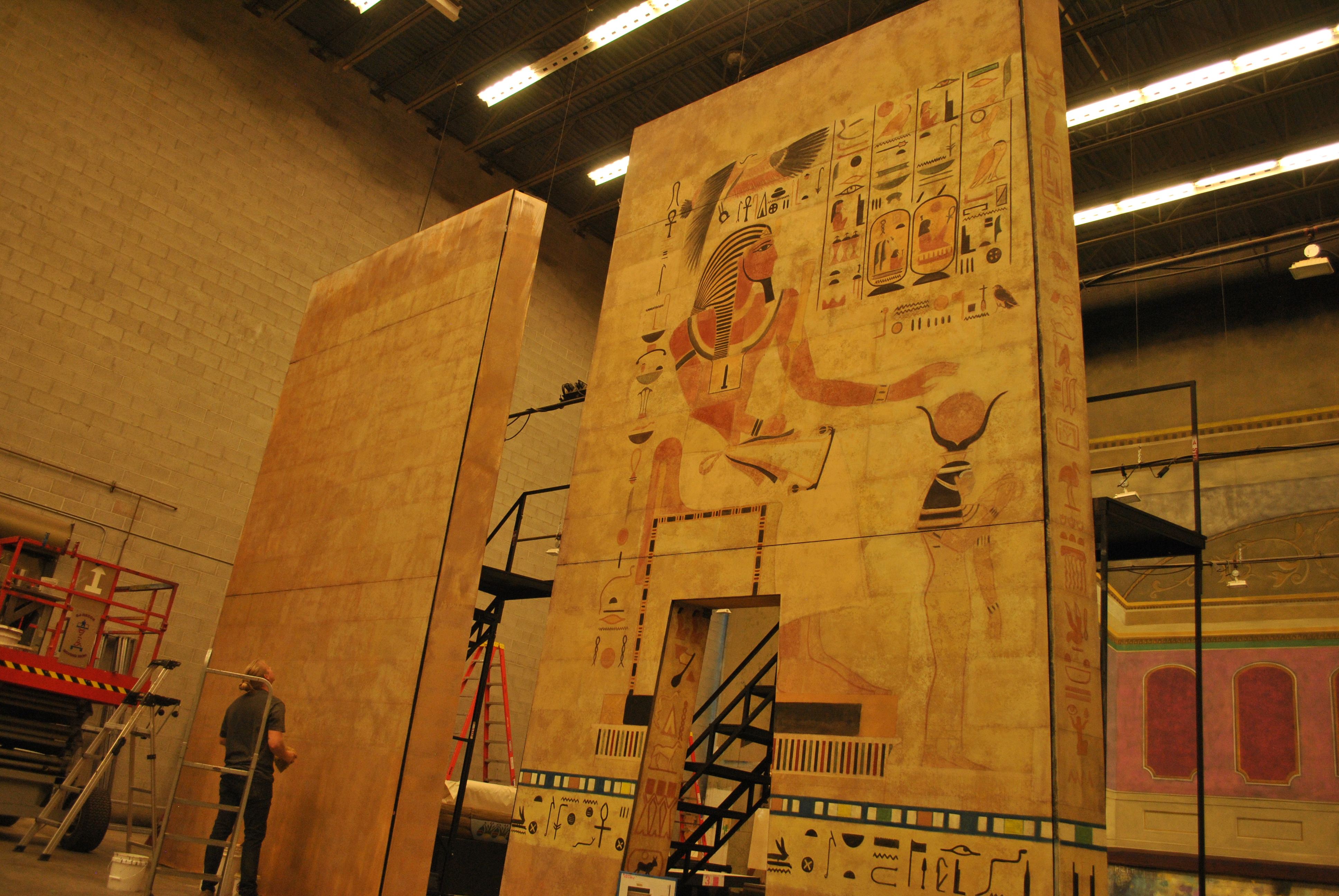
A portion of the Aida set

Currently working on a set for a production of Aida in Sarasota, Florida, Cook concentrates on each tiny detail of the project. He makes new sets for Utah Opera as needed, and other opera companies both commission his work and rent existing sets stored in the Utah Opera warehouse.   

The sets for Aida are massive and evoke Egyptian motifs down to the tiniest details. They are designed with economy of space in mind as they are broken down and transported by truck from city to city.

Cook likes to stay busy and loves his work. In addition to his work for the Utah Opera, Cook works at Bonneville High School as the set design technical adviser, he also does sets for Ballet West and other freelance projects. He is able to devote time to other projects because he has a 35 week contract with the opera, giving him time for other projects.  

Cook started a mentor program and trains U of U art students. Student artists from the U helped him with Aida and also a drop for Ballet West’s “Cinderella”. John supports and mentors many young artists through the jobs he offers them, and they benefit from having professional, hands on experiences.

“People who try to make it as fine artists take a long time to get there, but a scenic artist can make a career and a living,” he says. 

Cook feels blessed to do what he loves and pass it on. He is already looking forward to his next project, a set for  a ground-breaking production of Moby Dick.


Verona Green – Costumes
DSC_0464
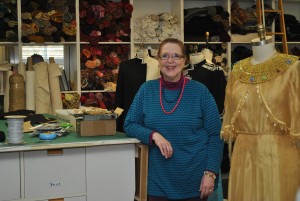
Utah Opera’s Costume Director, Verona Green

On the other side of the building, Verona Green works works as the costume director for Utah Opera. Instead of wood, nails and canvas her tools are fabric, leather, beads and accessories.

Green started out 34 years ago as a stitcher and last year was named Costume Director. 

She deals directly with the stage director for productions. She finds out what the director’s “vision” for a show is and then first looks through the vast inventory to see if something they already have in stock will work. If not, she starts from scratch and tries to help bring to life a director’s dream. 

Utah Opera has a vast collection of costumes stored in complete opera sets or as collections of types of costumes such as clerics, soldiers and peasants. Costume rentals in the U.S. and Canada generate a tremendous source of income for the company.
DSC_0465
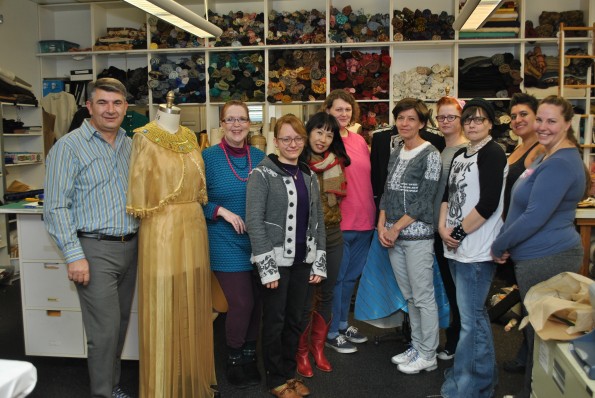
Green with the costume department staff at Utah Opera

The department has stitchers, drapers, fabric dyers and shippers. “There is a lot of crossover in the shop, and people can step in and do multiple jobs.” It also helps she says, “that everyone in the thinks visually.” They all speak the same language, especially when there is so much going on all at once in the shop between designing, cutting, fitting, organizing and boxing up rentals.

She remembers working on costumes for The Merry Widow, 15  years ago. They spread the build over 7 months because it involved so many costumes. “Every chorus woman had 3 outfits and 3 hats  and them men all had tails and that was just the chorus. There was even more for the leads.”

Her first year as costume director Green built 4 shows; Madame Butterfly, The Pearl Fishers, Cosse Fan Tutte and The Rake’s Progress, with fabric that was hand painted in Italy 30 years ago

Green is now creating new costumes for Utah Opera’s Aida. The company had a set on-hand, but the director wanted something new and so they started from scratch. She explained that they will sell the old costumes to another company to make room for the new.
DSC_0489
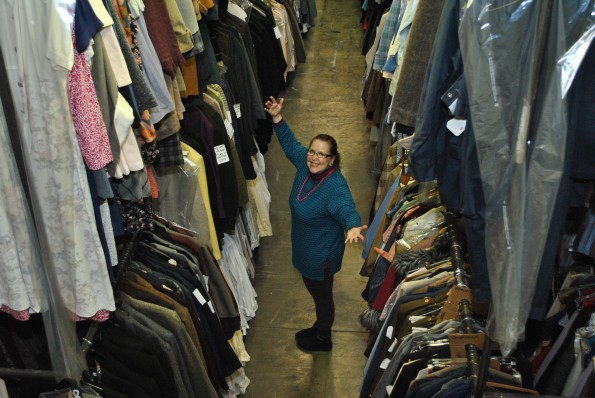
Verona Green in the ultimate walk-in closet at Utah Opera

Walking through rows of costumes, Green stops to explain where a fabric came from, or how she found a particular piece of accent, and with a smile says, “It’s so much shopping.”


Story by Connie Lewis



Join our newsletter.
Stay informed.


  • Highway 6 and the Midland Trail: Utah’s Transcontinental Highway History

    From Price Canyon to Delta’s desert stretch, Utah played a central role in building the Midland Trail, one of America’s earliest transcontinental highways and the foundation of today’s Highway 6.


  • Whiskey, Bullets & a Buried Town: Archaeologists Reveal Alta’s Wild Past

    Before Alta was known for powder days and lift lines, it was a silver mining town clinging to the side of a narrow canyon. In the late 1800s, men lived at 8,000 feet, went underground each day, and endured winters that regularly buried buildings in snow. This past summer, that mining town resurfaced — literally — during construction at the Alta Ski Area.

    To understand what Alta really looked like, you don’t begin with legend. You begin with its trash — and this time, that happened almost by accident.

    Alta Ski Area was installing underground water reservoirs to support snowmaking. Because the project sits on Uinta-Wasatch-Cache National Forest land, an archaeologist was required to monitor the excavation. No one expected the trench to produce much.

    But, It did.

    Artifacts began surfacing almost immediately. Enough that the Forest Service contacted the Utah State Historic Preservation Office for help. Lexi Little, who coordinates the Utah Cultural Site Stewardship Program, helped mobilize nearly 30 volunteers to assist with what quickly became a focused two-week excavation.

    Winter deadlines were approaching. The pipes for the reservoirs had to go in the ground. There wasn’t time for a slow, extended dig.

    “It was two weeks of digging in the dirt and helping figure out exactly what we were looking at,” Little said.

    Most of the people screening soil weren’t professional archaeologists. They were trained stewards from around Utah — part of a statewide volunteer network that now approaches 500 people. They poured dirt through shaker screens, scanning for fragments that could piece together a town long buried.

    “Archaeology is human trash,” Little explained. “Archaeologists are very into trash.”

    Alta had left plenty behind.

    https://youtu.be/hzIHzx3OGoo?si=dKcl2CEz-t6FZzYw

    Victorian-style ceramics appeared first — the kind typically used in hotels. Medicine bottles followed. Ink bottles. Hand-blown glass. A porcelain doll’s foot surfaced from the soil, a small detail that shifted the mental image of the town. Families were here. Children were here. This wasn’t only a camp of miners.

    The bottles helped establish time. Manufacturing details — whether glass was hand-blown or mold-made, whether a maker’s mark appeared on the base — allowed archaeologists to date many of the artifacts to the 1870s through the 1890s, when Alta was booming as a silver mining town.

    “That gives you that range of dates for when Alta was really booming,” Little said.

    One reusable soda bottle clearly stamped “Salt Lake City” connected the canyon to the valley economy below.

    Then something unusual rolled out of a dirt pile.

    A corked bottle. Intact. Liquid still inside.

    Continue reading and support independent Utah journalism with a purchase of Utah Stories (Digital + Print) or 3 month free trial (Digital).


  • The Only Full Bottle of Alcohol Ever Found in Utah Was Unearthed in Alta

    When a backhoe rolled a corked bottle out of the dirt at Alta this summer, no one immediately grasped what they were holding. It wasn’t empty. It wasn’t shattered. It was full. “The bottle that was discovered up at Alta is the only bottle of alcohol ever discovered in an archaeological excavation in the state…


  • How Horses Help Kids Heal: Inside Utah’s Equine Therapy World

    Kelty Johnson trains horses for a living, but her deeper work happens in the quiet space between animal and human. On the Utah Stories podcast, she explains how equine therapy helps children regulate emotions, build confidence, and reconnect through presence rather than pressure.