Utah Stories

Gilgal Gardens

Varied sculptures grace the grounds of this hidden park.

|


Gilgal-0413
Photos by Dung Hoang

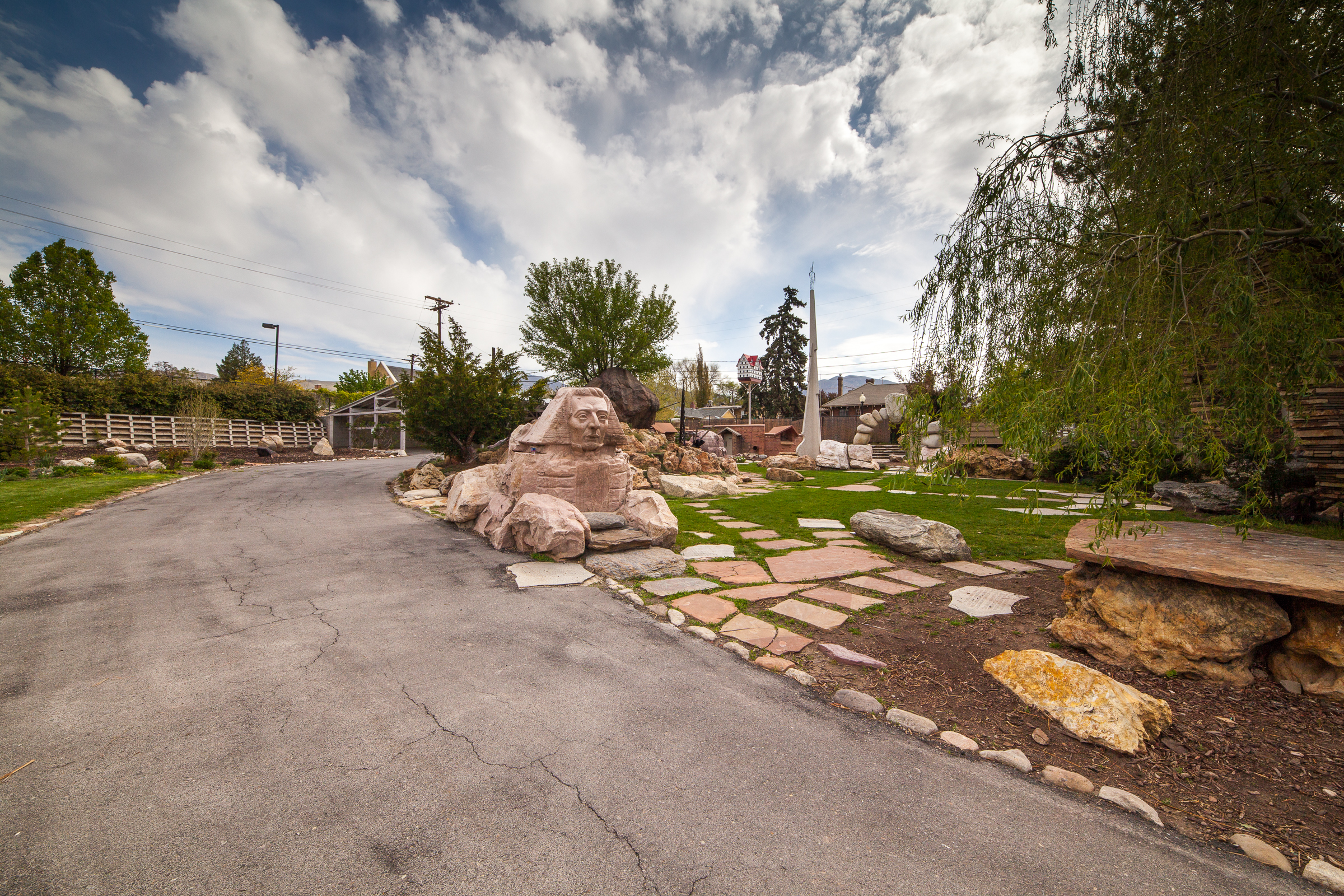
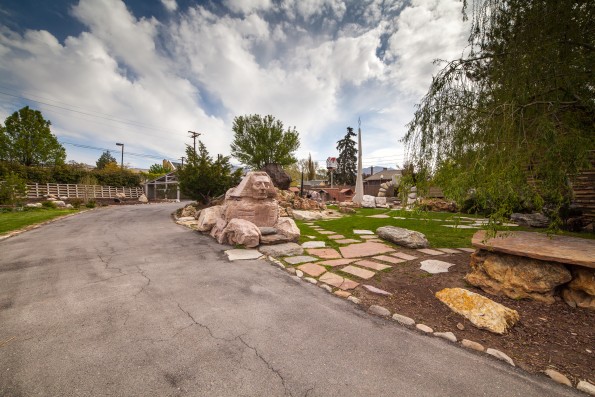
A bust of Joseph Smith appearing as the Sphinx. Biblical and inspirational quotes etched into stones. A life-size self-portrait sculpter with brick pants.

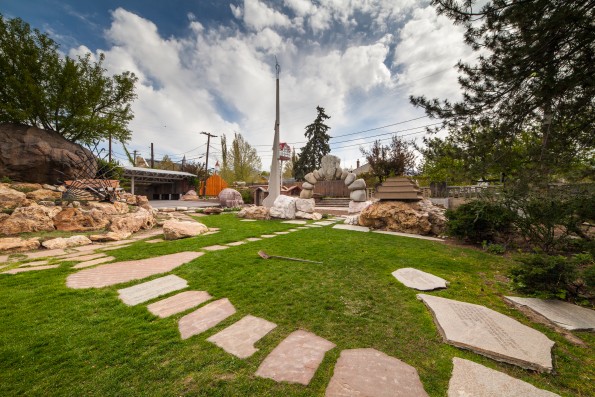
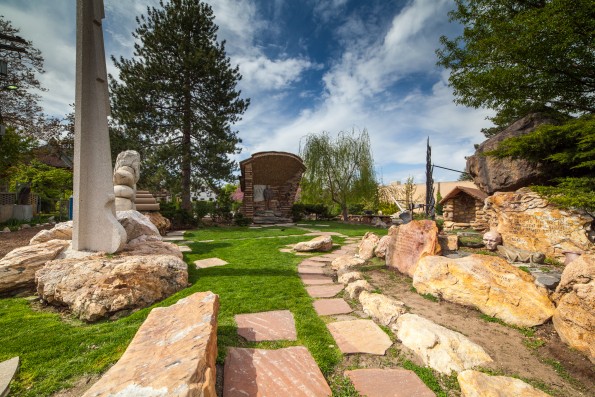
Welcome to Gilgal Sculpture Garden, a three-acre park in the heart of Salt Lake City. Located at 749 East 500 South on a quiet residential street, Gilgal gives visitors an experience altogether different from that offered by a typical public park or community garden.

Thomas Battersby Child, Jr. was 57 years old in 1945 when he began creating the garden in his own backyard. For the remaining 19 years of his life, Child, who lacked formal artistic training, constructed Gilgal exclusively from native Utah stones, which he continually scoured the state. His vision was largely his interpretation of LDS themes and stories from the Book of Mormon. Named for the biblical city of Gilgal, the garden is cited as the only visionary art environment in Utah.
Gilgal-0415“Child did not consider himself an artist. It was giving his ideas physical form that Child found incredibly satisfying,” says Lisa Thompson, who is on the board of Friends of Gilgal Garden (FOGG), a nonprofit organization responsible, since 19974 for curation and stewardship of the garden. With members interested in gardening, historical artifact preservation, religion, and open space initiatives, FOGG worked with the Trust for Public Land and Salt Lake City Corporation to purchase the garden, save it from private development, and make it a city park in 2000.

“Child very much enjoyed the liberties of modern art,” adds Thompson. One of the most noteworthy Gilgal sculptures is that of an eight-foot-tall quartzite sphinx, with the head of LDS Church founder Joseph Smith, carved by Utah sculptor Maurice Brooks with an oxyacetylene torch, a technique that Child claimed was developed in his garden.

Testament to Child’s exhaustive passion is a round purple stone he had begun to carve into a globe before his death in 1963. According to local lore, an almond tree that once stood in the center of the garden, planted by Child for its pink blossoms that matched an adjacent stone structure, died that same year.

FOGG’s future conservation efforts in Gilgal are focused on the bowery house and the many horizontal, engraved stones that have begun to wear. “We will have to reach out to the community to find some experts to help us,” says Thompson.

Free walking tour brochures are available at the Gilgal Sculpture Garden entrance, and there is no admission charge. For hours and more information, please visit www.gilgalgarden.org.Gilgal-0417
Join our newsletter.
Stay informed.


  • Highway 6 and the Midland Trail: Utah’s Transcontinental Highway History

    From Price Canyon to Delta’s desert stretch, Utah played a central role in building the Midland Trail, one of America’s earliest transcontinental highways and the foundation of today’s Highway 6.


  • Whiskey, Bullets & a Buried Town: Archaeologists Reveal Alta’s Wild Past

    Before Alta was known for powder days and lift lines, it was a silver mining town clinging to the side of a narrow canyon. In the late 1800s, men lived at 8,000 feet, went underground each day, and endured winters that regularly buried buildings in snow. This past summer, that mining town resurfaced — literally — during construction at the Alta Ski Area.

    To understand what Alta really looked like, you don’t begin with legend. You begin with its trash — and this time, that happened almost by accident.

    Alta Ski Area was installing underground water reservoirs to support snowmaking. Because the project sits on Uinta-Wasatch-Cache National Forest land, an archaeologist was required to monitor the excavation. No one expected the trench to produce much.

    But, It did.

    Artifacts began surfacing almost immediately. Enough that the Forest Service contacted the Utah State Historic Preservation Office for help. Lexi Little, who coordinates the Utah Cultural Site Stewardship Program, helped mobilize nearly 30 volunteers to assist with what quickly became a focused two-week excavation.

    Winter deadlines were approaching. The pipes for the reservoirs had to go in the ground. There wasn’t time for a slow, extended dig.

    “It was two weeks of digging in the dirt and helping figure out exactly what we were looking at,” Little said.

    Most of the people screening soil weren’t professional archaeologists. They were trained stewards from around Utah — part of a statewide volunteer network that now approaches 500 people. They poured dirt through shaker screens, scanning for fragments that could piece together a town long buried.

    “Archaeology is human trash,” Little explained. “Archaeologists are very into trash.”

    Alta had left plenty behind.

    https://youtu.be/hzIHzx3OGoo?si=dKcl2CEz-t6FZzYw

    Victorian-style ceramics appeared first — the kind typically used in hotels. Medicine bottles followed. Ink bottles. Hand-blown glass. A porcelain doll’s foot surfaced from the soil, a small detail that shifted the mental image of the town. Families were here. Children were here. This wasn’t only a camp of miners.

    The bottles helped establish time. Manufacturing details — whether glass was hand-blown or mold-made, whether a maker’s mark appeared on the base — allowed archaeologists to date many of the artifacts to the 1870s through the 1890s, when Alta was booming as a silver mining town.

    “That gives you that range of dates for when Alta was really booming,” Little said.

    One reusable soda bottle clearly stamped “Salt Lake City” connected the canyon to the valley economy below.

    Then something unusual rolled out of a dirt pile.

    A corked bottle. Intact. Liquid still inside.

    Continue reading and support independent Utah journalism with a purchase of Utah Stories (Digital + Print) or 3 month free trial (Digital).


  • The Only Full Bottle of Alcohol Ever Found in Utah Was Unearthed in Alta

    When a backhoe rolled a corked bottle out of the dirt at Alta this summer, no one immediately grasped what they were holding. It wasn’t empty. It wasn’t shattered. It was full. “The bottle that was discovered up at Alta is the only bottle of alcohol ever discovered in an archaeological excavation in the state…


  • How Horses Help Kids Heal: Inside Utah’s Equine Therapy World

    Kelty Johnson trains horses for a living, but her deeper work happens in the quiet space between animal and human. On the Utah Stories podcast, she explains how equine therapy helps children regulate emotions, build confidence, and reconnect through presence rather than pressure.