Utah Stories

Ogden’s Historic 25th Street Continues to Evolve

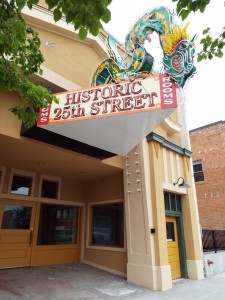
As Ogden’s Historic 25th continues to grow the iconic Star Noodle neon dragon sign looks on

|


unnamed (4)
Photo by Kim Bowsher

With all the recent praise extolling Ogden’s Historic 25th Street, it’s hard to believe that any of the street’s buildings still remain vacant. However, apart from stalwarts such as Roosters and Wiseguys Comedy Club, many of the buildings have lain dormant for years.

One unoccupied building was the former home of the famous Star Noodle Parlor with its iconic neon sign. Built in 1912, the structure originally housed live theater under the moniker, the Revere Theater. The subsequent and short-lived Cherry Theater was quickly replaced with the Rex Theater which remained until 1929. The space later hosted a movie theater, and even had a short stint as a boxing venue.

In 1944, the Star Noodle Parlor moved in and remained for over 60 years. Upon arriving, Star Noodle erected a 3D neon dragon sign to attract local patrons. The sign quickly became a prominent element on 25th, and has defined the street for both locals and travelers.

When the building was sold in 2007, uncertainty surrounded the sign’s fate. On June 13, 2008, the iconic sign was removed. Locals immediately questioned its whereabouts. Rumors and speculation swirled around town, but the same question loomed large. What happened to the dragon?

After years of doubt regarding its true whereabouts, locals created a “Save The Dragon” Facebook page to bring attention to the issue. Through the page, information was obtained from Ogden City regarding the sign. They have kept an eye on the sign ever since it was taken down, and they were pushing for it to be reinstalled on the building. However, the renovation of the building had been put on hold due to lack of financing.

Finally, in early 2015 the city announced that its beloved sign would be rightfully replaced atop the renovated building at 225 25th Street. Bringing the whole project full circle, the sign was remodeled and installed by YESCO, the company that originally designed and erected it. A ceremony was held on February 6 to celebrate the lighting of the beloved dragon sign for the first time in over six years.

In addition to welcoming back an Ogden icon, 25th Street will also be adding new businesses to its already diverse offerings. Zucca Trattoria, a local Italian restaurant featuring authentic Italian regional cuisine with a modern approach, will occupy the old Star Noodle building. Next door, Pig & A Jelly Jar will open their second location. They offer a from-scratch menu with a unique twist on comfort food.

Berlin’s Fine Meats & Delicatessen will be moving in at the corner of 25th St. and Grant Avenue. Berlin’s is  a hybrid of sorts, with the finest fresh meats from a full or self-service meat counter. Smokey’s BBQ will be moving into the building adjacent to Alleged, serving up their take on smoked meats and everything BBQ.

Another addition is Office Evolution. They focus on all things office related, such as, executive suites, virtual offices, conference and meeting rooms. A local software developing company, Anzan Technologies, will be moving into their new offices above Pig & A Jelly Jar.

Reflections Academy is setting up a second location on 25th St. They specialize in belly dance, martial arts, power tap and yoga. Urban Sanctuary Skin, Spa & Lash Studio will also be join the scene, and provide a wide variety of healing and beauty services. Lastly, the recently opened Funk ‘n Dive bar resides in the basement of the old courthouse. A typical Funk ‘n Dive outing may include drinks, live music, trivia, bingo, and food in a one-of-a-kind venue.

All of these businesses add new energy to the already diverse range of goods and services that Ogden has to offer. This city has been injected with fresh vitality and is teeming with personality.

Follow us on Instagram @ogdenreborn for more information on new or improved businesses in Ogden, Utah.


Join our newsletter.
Stay informed.


  • Highway 6 and the Midland Trail: Utah’s Transcontinental Highway History

    From Price Canyon to Delta’s desert stretch, Utah played a central role in building the Midland Trail, one of America’s earliest transcontinental highways and the foundation of today’s Highway 6.


  • Whiskey, Bullets & a Buried Town: Archaeologists Reveal Alta’s Wild Past

    Before Alta was known for powder days and lift lines, it was a silver mining town clinging to the side of a narrow canyon. In the late 1800s, men lived at 8,000 feet, went underground each day, and endured winters that regularly buried buildings in snow. This past summer, that mining town resurfaced — literally — during construction at the Alta Ski Area.

    To understand what Alta really looked like, you don’t begin with legend. You begin with its trash — and this time, that happened almost by accident.

    Alta Ski Area was installing underground water reservoirs to support snowmaking. Because the project sits on Uinta-Wasatch-Cache National Forest land, an archaeologist was required to monitor the excavation. No one expected the trench to produce much.

    But, It did.

    Artifacts began surfacing almost immediately. Enough that the Forest Service contacted the Utah State Historic Preservation Office for help. Lexi Little, who coordinates the Utah Cultural Site Stewardship Program, helped mobilize nearly 30 volunteers to assist with what quickly became a focused two-week excavation.

    Winter deadlines were approaching. The pipes for the reservoirs had to go in the ground. There wasn’t time for a slow, extended dig.

    “It was two weeks of digging in the dirt and helping figure out exactly what we were looking at,” Little said.

    Most of the people screening soil weren’t professional archaeologists. They were trained stewards from around Utah — part of a statewide volunteer network that now approaches 500 people. They poured dirt through shaker screens, scanning for fragments that could piece together a town long buried.

    “Archaeology is human trash,” Little explained. “Archaeologists are very into trash.”

    Alta had left plenty behind.

    https://youtu.be/hzIHzx3OGoo?si=dKcl2CEz-t6FZzYw

    Victorian-style ceramics appeared first — the kind typically used in hotels. Medicine bottles followed. Ink bottles. Hand-blown glass. A porcelain doll’s foot surfaced from the soil, a small detail that shifted the mental image of the town. Families were here. Children were here. This wasn’t only a camp of miners.

    The bottles helped establish time. Manufacturing details — whether glass was hand-blown or mold-made, whether a maker’s mark appeared on the base — allowed archaeologists to date many of the artifacts to the 1870s through the 1890s, when Alta was booming as a silver mining town.

    “That gives you that range of dates for when Alta was really booming,” Little said.

    One reusable soda bottle clearly stamped “Salt Lake City” connected the canyon to the valley economy below.

    Then something unusual rolled out of a dirt pile.

    A corked bottle. Intact. Liquid still inside.

    To access this post, you must purchase Utah Stories (Digital + Print) or 3 month free trial (Digital).


  • The Only Full Bottle of Alcohol Ever Found in Utah Was Unearthed in Alta

    When a backhoe rolled a corked bottle out of the dirt at Alta this summer, no one immediately grasped what they were holding. It wasn’t empty. It wasn’t shattered. It was full. “The bottle that was discovered up at Alta is the only bottle of alcohol ever discovered in an archaeological excavation in the state…


  • How Horses Help Kids Heal: Inside Utah’s Equine Therapy World

    Kelty Johnson trains horses for a living, but her deeper work happens in the quiet space between animal and human. On the Utah Stories podcast, she explains how equine therapy helps children regulate emotions, build confidence, and reconnect through presence rather than pressure.