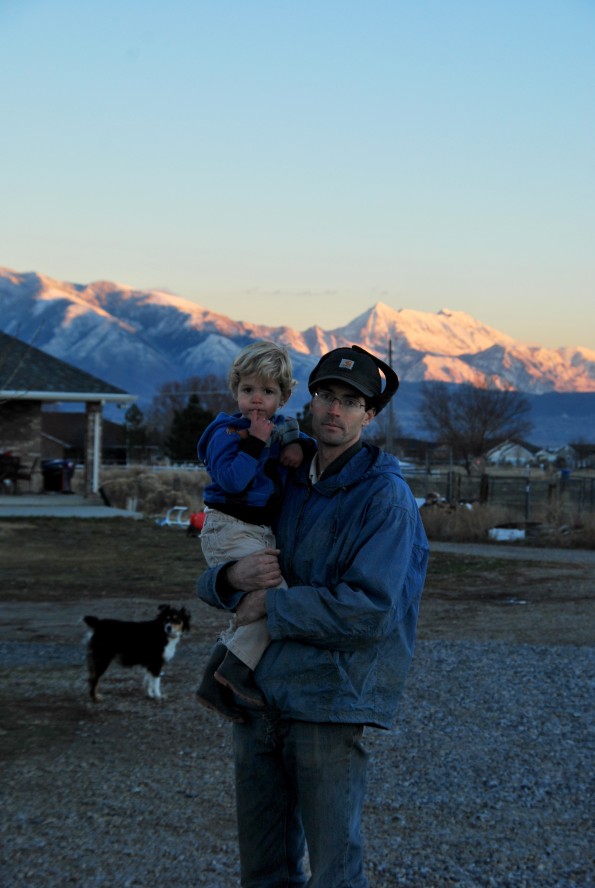
Salt Lake County’s last beef rancher feeling growing suburban pressure.
Driving out to Utah Natural Meat, there are acres of homes and new suburban development. Tall signs for WinCo and Jordan Landing draw the eyes of motorists. Just twenty years ago this area was all farms. Today there is no sign for the farm store of the third-generation last remaining beef rancher in Salt Lake County. After passing it three times, I finally find the turn off. So why no sign?
“West Jordan City won’t allow me to put up a sign for my farm store,” says Shayn Bowler. He adds, “They told me I could pay $700 for a hearing on a conditional use permit, but they could then either vote yes or no, so I’m not sure it’s worth the trouble.” Shayn says this with a smile on his face, without a trace of anger or vitriol.
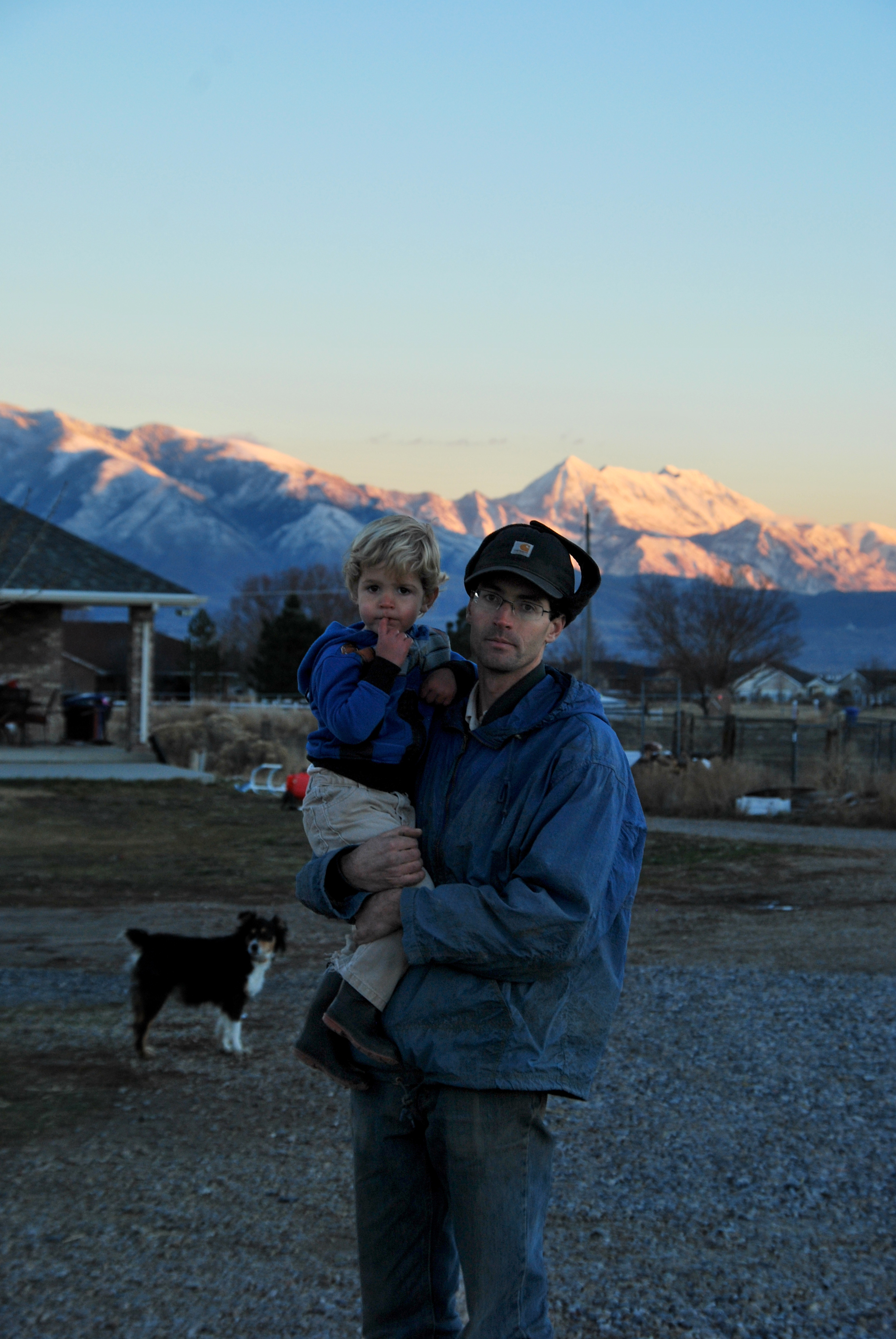
Turning down his dirt road into his farm I find I enter another universe, where different laws are at work. From Shayn’s farm one can see a wide expanse of land and the majestic Wasatch Range. Here is a little homestead in the middle of suburbia.
Everyone in the suburbs, adores their “toys”: boats, RVs, ATVs, TVs and nice cars—these are the things they commute hours per day for, to sit in their Dilbert cubicle working for. Here Bowler is obviously very proud of his independence and happy animals and store. His ruddy-faced two-year-old son Grandin is at his side most of the time helping him move his draft horses to pasture to feed them hay. “I prefer to use a horse. It’s very detached to sit in a tractor to plow innumerable acres of land. It keeps it on a small scale for me and it makes it more enjoyable.”
Despite his love of horses over tractors, Bowler isn’t opposed to technology and innovation, in fact he has adopted some of the most innovative methods for raising pasture-fed livestock on minimal land with minimal water, with minimal use for petrochemicals and expensive farm equipment. Bowler has no problem doing things the hard way, earning less money than he otherwise could, because he is able to take great pride in his end product: pasture-fed chicken, beef, pork and eggs.
He sells all of his products out of his unmarked farm store in West Jordan. It’s a tribute to his passion that without signage, marketing or any indication that he is open for business, he can maintain a retail operation and produce enough income to support his family. “I don’t earn a lot of money doing this,” Bowler says, he adds, “but we don’t need a lot because we can grow nearly everything we eat.” He says that it would not be possible for him to maintain his farm if it weren’t for the ground being in the family and his access to an underground well. Still he says that land and water are very scarce, which has required him to find ways to adapt.
Grass Fed Revolution
It turns out that Utah’s Natural Meat is part of a much larger national movement, a movement that could be even more significant that the “organic” food movement. It’s the, ethically-raised, antibiotic-steroid-free, happy-animal, non-petrochemical dependent, locally-sustainable, grass-fed beef movement.
It’s not easy to define in a nutshell, but Shayn is something of a disciple who considers his farm as much more than a vocation, and more of a calling. He adheres and follows the teachings of a man known as the “High Priest of Pasture” —Joel Salatin— who farms and writes books about his innovative methods. Salatin was featured in the award winning documentary Food Inc. The followers of this movement adhere to buying and eating pasture-raised animals as devout parishioners
An Alternative Way
The best-selling book Omnivore’s Dilemma clearly explains the huge problems associated with industrial food production or “factory farms”. Author Michael Pollan profiles Farmer Salatin (of Polyface Farms), who believes that despite all of this production, innovative progress, and the scientific marvel of corn production the current factory farm, fossil fuel chemically dependent paradigm neglects three critical components:
- Land Stewardship: The current practices of farming use fertilizers and herbicides and insecticides. These practices are eroding and depleting the soil our most fertile areas. The massive amounts of corn produced in the Great Plains is deplete the topsoil by as much as three inches per year. Eventually our bread basket will lose all of it’s topsoil which took a millennium to produce by the process of large herbivore migration. Salatin is able to farm in a way the increases the overall fertility of the soil by using his animals as manure producers and spreaders. He uses polycultural systems ( raising chickens along with cattle) which build topsoil and fertility. He grows perennial native grasses rather than annual grains which require expensive heavy farm equipment: massive tractors, plows, fertilizer spreaders.
- The ethical treatment of animals: The majority of chickens in this country are raised with their beaks cut off, confined to tiny cages where they aren’t able to move or even turn around. Tyson chicken farmers refer to themselves as “protein providers”, as if a living creature has nothing to do with the end product they produce. He points out that under this model factory farmers raising chickens for Tyson can barely turn a profit, small towns suffer from too great of a concentration of fecal waste, and only entities earning good profit are the corporate buyers: Tyson Foods, Cargill and ADM. Rural economies come to depend on the corporate factories, turning farmers into serfs.
- Local Sustainability: Salatin and Bowler produce and market directly to customers who live within driving distance of their farms. Their farm stores enable them to sell directly to customers and thus earn enough margin to operate on a small scale. They would never allow their products to be shipped on freight-liners for distant destinations. Instead they invite customers to visit the farm, see how the animals are raised; examine their pastures and their living conditions. This type of farm puts customers and area residents in contact with their local food chain. Bowler’s farm is as much a museum/petting zoo/inventors workshop as it is a farm. This provides a meaningful experience when a customers buy their food. Salatin points out how most of our food requires three calories of energy (in the form of transportation) for every one calorie of food energy it provides. This is why food prices are so dependent upon cheap gasoline. The grass-fed movement is against the long-distance transport and the centralized nature of our current food production system. Currently 80% of all our beef is processed in just two facilities in the United States.
Salatin’s method and ideology was to recreate the conditions which currently exist on the Serengeti Plains, and which once existed in the Great Plains. His strategy is to keep the animals moving. He moves his cattle through a series of “paddocks” which are a 2-4 acre areas, maintained with electric fences. This way the cattle only take one bite of the grass in the area then move on, giving the grass time to grow to optimal height before cattle are allowed to return and harvest again. Approximately 14 days pass before cattle are rotated back to the original paddock, and by this time the grass is again long and has grown to its optimal height and nutrition density. Salatin says that his pastures produce more edible food in a season then if he had planted corn. And they sequester more carbon from the atmosphere than trees.
This practice mimics the seasonal migrations of millions of large grass-eating animals that once existed on the Great Plains. Salatin describes it as, “the primal herbivore-predator-disturbance-rest dance.”
Read part II of this story.