 Goblin Valley. There is hardly a more Halloween-sounding name in the United States. But when it comes to Utah, wait! There’s more! The insight behind names such as Death Hollow, Skull Valley, and Poison Spring are not so obvious. Some were named after tragic or mysterious events to which they played host. Others only sound like it. In some instances, creepy names have the power to bring entirely imagined histories to life.
Satan’s Speedway
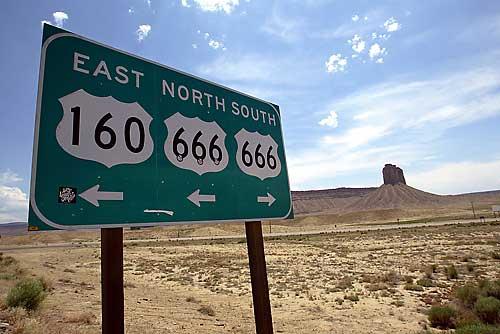
You’d be hard-pressed to find anyone in the U.S. who hasn’t heard of the famous Route 66, but how about its offshoot, Route 666? Opened in the Four Corners region in 1926, this two-lane road, known as Satan’s Speedway or Devil’s Highway, is the alleged site of several mysterious occurrences. A nightgown-clad specter of a young girl, a ghostly pack of vicious dogs, and a demon were-car that runs drivers into the ditch during full moons have all been reported on this stretch of pavement.
Additionally, the fatal crash rate (along the New Mexico portion, anyway) was higher than the national average, and the situation was worsened by continual theft (or disappearance) of road signs. Many attribute these spooky and unfortunate events to the number’s significance in Christian lore as the “Mark of the Beast (i.e., Satan).” However, it is difficult to determine whether the name spurred these happenings, or if the road was opened on an already haunted expanse of land. Route 666 even inspired a comic book series of the same name in the early 2000s.
The interstate highway system all but eliminated the need for Route 66, and in 1985, this famous highway lost its designation. As a consequence, Route 666 became an isolated tributary. To the relief of the superstitious, the latter was reopened as Route 491 in 2003. Whether a result of renumbering or more stringent safety measures in recent years, fatality rates have dropped.
Poison Canyon
Perhaps influenced by the iconic image of Snow White eating the apple that would make her (almost) meet her demise, many people attach a certain amount of deliberateness to the word “poison.” It is somewhat surprising then, if not disappointing, to discover that Poison Canyon takes its name from an accident involving livestock instead of humans.
When this canyon was discovered by cowboys in the 1800s, it appeared to be a prime grazing spot. To their horror, all their livestock died shortly after. Further inspection of the canyon’s vegetation revealed large amounts of deadly larkspur growing there. Regardless of whether this canyon was cursed from the beginning, the constructed and aptly named Poison Canyon Trail is now overgrown and all but impossible to find.
Slaughter Slopes
Generating visions even more violent is the name given to an area in Emery County: Slaughter Slopes. Near the Muddy Creek Gorge in the San Rafael Swell, this is the site where a large number of wild horses were killed in the 1930s and 1940s. The horses were a nuisance for ranchers, so the government supplied the latter with ammo to take care of the problem.
Suicide Canyon
Originally known as Green Tree Canyon, this geological formation is located, appropriately, south of Death Canyon in Garfield County. Growing next to a sandstone wall a short distance into the canyon, a large cottonwood tree seems to give off an air of vivacity – but only to those who do not know the story behind the canyon’s name. For the rest, its quietly whispering leaves will forever tell about the tragic day in the early 2000s when a man took his own life among its branches.
Those who find themselves in the places discussed in this article will have to decide for themselves which came first: legend or name. Those who are keen on bestowing a name upon a geological formation would do well to be careful what they bring to life.