
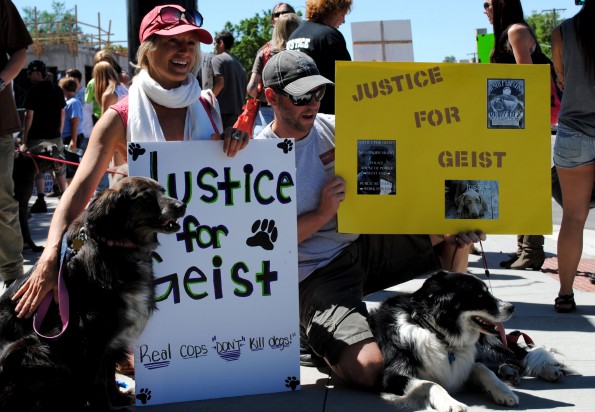
When the case of Geist (the dog shot during a canvass for a missing child) came before the Police Civilian Review Board, it was a difficult case. With the exoneration of the officer, the judgment entered into an already controversial public conversation around police use of excessive force. A dog,in Sean Kendall’s yard had been killed in the public theater. In a replay of similar narratives, the dog is replaced by other individuals: Darrien Hunt, Dillon Taylor, Danielle Willard, Michael Brown. These names are united in narrative under the category “lethal tragedies’’ at the hands of police officers. How can this be accepted?
In the Geist case, his owner could respond with a lawsuit and decide not to accept. The ACLU Utah’s legal director, John Mejia, considers litigation a path which the ACLU reserves for high-impact cases with the potential to change bad policy. PCRB investigator Rick Rasmussen predicts that a lawsuit would fail, being subjected to the same interpretation of policy that the Board practices.
‘’He’ll lose, because the law is near crystal clear. The fact still remains, ‘Do we want our cops looking for missing kids or not?’ And if the answer is ‘no,’ change the law. We’ll enforce it. But if the answer is ‘yes,’ then it becomes a training issue. We deal with what the law and policy say, not what emotion says. Was the officer properly in the backyard, and, were his actions as they were related to the dog reasonable?’’
If policy were a game, then the rules would be to determine if the entry into the yard and the shooting of Geist could be explained as “objectively reasonable.” The entry into the yard was justified under “exigent circumstances.” A child was missing. Children who are kidnapped are often killed within a short span of time, satisfying the “life-threatening emergency” and “danger of physical harm” requirements. The shooting justification was satisfied by the Deadly Force Policy requirement that the officer perceived potential serious bodily injury from the dog. Killing justified.
In the estimated five seconds between when Olsen saw Geist and taking action, he chose between a Taser and a gun. Officers rarely train on Tasers, and, by a mechanical particularity, he judged it possibly ineffective. Officers train with guns. Decision made.
Emotionally, the case is complicated. If the narrative portrays the incomprehensible killing of a dog defending its yard, like most dogs do, a slight shift could shape the narrative differently. Years ago, Officer Brett Olsen was searching for a different child, Destiny Norton. She was found too late, murdered. The tragedies compound.
In the September 16th City Council Work Session, ‘’Dangerous Animals’’ training, an ordinance requiring training in non-lethal use of force, and a $150,000 Use-of-Force simulator were under discussion. The police department’s Fall 2014 Trimester Training already includes the recommended training, with the Geist case as a specific scenario. These actions suggest a proactive response on the part of the PCRB, the police chief, and the City Council.
A death is irreversible. Is training enough? Would training diminish the fatality of future outcomes? Mejia affirms that our PCRB would be a desirable addition to any community. An upcoming ACLU study on civilian complaint processes in Utah may contrast it with a widespread need for any civilian oversight, and yet, a complaint-by-complaint model lacks a mandate to examine broader issues of policy, review, training, and supervision. Is there justice for Geist, and the others unnecessarily lost, when interpretation of policy is the only institutionalized response?