Utah Stories

Sharing Fruit with SLCgreen Fruit Share

Salt Lake City’s fruit share programs gets fruit and produce off the ground and to people who need it.

|


At the peak of fruit tree harvest season, it’s hard to walk down some neighborhood streets without getting thumped in the head by a falling apricot or plum. Ok, maybe that’s an exaggeration, but throughout summer and fall, the Wasatch Front is rich with trees heavily laden with choice produce. In fact, there is such an abundance of ripe riches that the prosperity creates a problem. Often homeowners either cannot utilize the bounty, or they dislike the sludgy mess of fruit that has fallen in their yards. Food goes to waste, or, unfortunately, homeowners may choose to remove the perceived nuisance.

A few years ago, creative minds in SLC’s Division of Sustainability and the Environment teamed up with the Food Policy Task Force and designed SLCgreen-Fruit Share, a program through which fruit harvested from private properties gets allocated to people who can benefit from nature’s bounty. “You can’t turn down a city block in Salt Lake City without seeing fruit on the ground,” Sustainability Program Manager Bridget Stuchly says, “so we started this program to start getting that fresh produce into the hands of people who need it, and to help homeowners take care of these trees so they are not tempted to take them out.”

The harvest is divided into thirds among homeowners, food assistance programs and volunteer fruit-pickers. Property owners also benefit from volunteers’ pruning and thinning the fruit trees on their property. But the primary goal of the program, Bridget notes, “is to get rid of food waste and get it into the hands of people who could use it.”

Homeowners register their trees online through the slc.gov website. Avenues resident Melaney Birdsong Farr has registered her apple, plum and pear trees. “It’s a fantastic idea,” she says. “The extra fruit goes to community-based projects. Otherwise, the fruit usually ends up in the backyard and I don’t feel very good about it.”

City partner organizations then coordinate both volunteer fruit-picking opportunities and distribution. The program partners list is comprised of organizations well-rooted in the community. TreeUtah, Avenues Fruitshare, Green Urban Lunchbox, Utahns Against Hungers’ Real Food Rising and Salt Lake Community Action Program all participate in assessing community need, organizing volunteer events and transporting produce. SCLgreen-Fruit Share always needs volunteers, as more trees are added to the register every week. Registration is processed online, and volunteers under 18 require parental or youth group leader supervision.

“We all need to eat; food is common to us all,” says Real Food Rising Director, Mike Evans. “We want to help people who have lower incomes have access to healthy, organic food, and to help bridge those gaps when possible. We take a lot of the produce to Hildegard’s Food Pantry, Salt Lake Cap Northwest and the Community Action Program,” he adds. Real Food Rising, and their team of fruit-picking volunteers harvested 10,000 pounds of fruit last year.

Shawn Peterson is the Executive Director for Urban Green Lunch Box. Shawn too is dedicated to making sure that community members receive quality sustenance. “We don’t like to give damaged fruit to food banks because it’s kind of a degrading experience if all you get is seconds. We like to always give the prime best fruit,” he says. “We use the damaged or misshapen fruit for our ‘Value Added Program’ and make syrups, jams and chutneys. These are sold at farmers markets and all proceeds go back to fund the program.”

An additional goal that The Green Urban Lunch Box shares with the SLCgreen-FruitShare program is to care for the trees along the Wasatch Front. “We want to make the program self-sustaining,” Shawn says. Thus, they have launched a pilot program in which they provide tree-owners with “all the tools, liability insurance, and volunteer recruitment, and we just pick up the fruit,” he says.
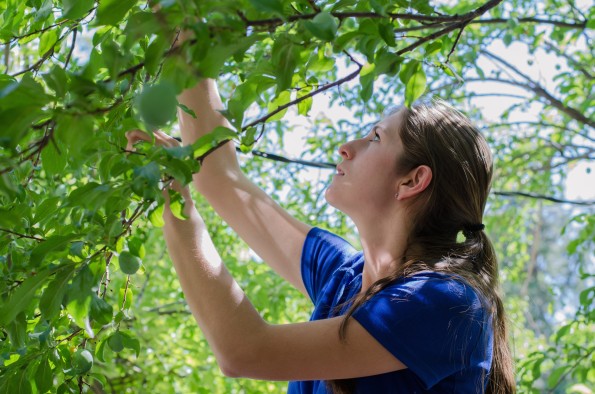
Lauren Cunico thins young fruit from a plumb tree in the Avenues in Salt Lake City
Lauren Cunico thins plums from an Avenues fruit tree Photo by Mike Jones

Real Food Rising, Utahans Against Hunger and The Green Urban Lunch Box have helped the SLCgreen-Fruit Share program expand their reach beyond Salt Lake City limits. Real Food Rising now branches out into Salt Lake County, and The Green Urban Lunch Box extends their services into southern Davis County.




Join our newsletter.
Stay informed.


  • Highway 6 and the Midland Trail: Utah’s Transcontinental Highway History

    From Price Canyon to Delta’s desert stretch, Utah played a central role in building the Midland Trail, one of America’s earliest transcontinental highways and the foundation of today’s Highway 6.


  • Whiskey, Bullets & a Buried Town: Archaeologists Reveal Alta’s Wild Past

    Before Alta was known for powder days and lift lines, it was a silver mining town clinging to the side of a narrow canyon. In the late 1800s, men lived at 8,000 feet, went underground each day, and endured winters that regularly buried buildings in snow. This past summer, that mining town resurfaced — literally — during construction at the Alta Ski Area.

    To understand what Alta really looked like, you don’t begin with legend. You begin with its trash — and this time, that happened almost by accident.

    Alta Ski Area was installing underground water reservoirs to support snowmaking. Because the project sits on Uinta-Wasatch-Cache National Forest land, an archaeologist was required to monitor the excavation. No one expected the trench to produce much.

    But, It did.

    Artifacts began surfacing almost immediately. Enough that the Forest Service contacted the Utah State Historic Preservation Office for help. Lexi Little, who coordinates the Utah Cultural Site Stewardship Program, helped mobilize nearly 30 volunteers to assist with what quickly became a focused two-week excavation.

    Winter deadlines were approaching. The pipes for the reservoirs had to go in the ground. There wasn’t time for a slow, extended dig.

    “It was two weeks of digging in the dirt and helping figure out exactly what we were looking at,” Little said.

    Most of the people screening soil weren’t professional archaeologists. They were trained stewards from around Utah — part of a statewide volunteer network that now approaches 500 people. They poured dirt through shaker screens, scanning for fragments that could piece together a town long buried.

    “Archaeology is human trash,” Little explained. “Archaeologists are very into trash.”

    Alta had left plenty behind.

    https://youtu.be/hzIHzx3OGoo?si=dKcl2CEz-t6FZzYw

    Victorian-style ceramics appeared first — the kind typically used in hotels. Medicine bottles followed. Ink bottles. Hand-blown glass. A porcelain doll’s foot surfaced from the soil, a small detail that shifted the mental image of the town. Families were here. Children were here. This wasn’t only a camp of miners.

    The bottles helped establish time. Manufacturing details — whether glass was hand-blown or mold-made, whether a maker’s mark appeared on the base — allowed archaeologists to date many of the artifacts to the 1870s through the 1890s, when Alta was booming as a silver mining town.

    “That gives you that range of dates for when Alta was really booming,” Little said.

    One reusable soda bottle clearly stamped “Salt Lake City” connected the canyon to the valley economy below.

    Then something unusual rolled out of a dirt pile.

    A corked bottle. Intact. Liquid still inside.

    Continue reading and support independent Utah journalism with a purchase of Utah Stories (Digital + Print) or 3 month free trial (Digital).


  • The Only Full Bottle of Alcohol Ever Found in Utah Was Unearthed in Alta

    When a backhoe rolled a corked bottle out of the dirt at Alta this summer, no one immediately grasped what they were holding. It wasn’t empty. It wasn’t shattered. It was full. “The bottle that was discovered up at Alta is the only bottle of alcohol ever discovered in an archaeological excavation in the state…


  • How Horses Help Kids Heal: Inside Utah’s Equine Therapy World

    Kelty Johnson trains horses for a living, but her deeper work happens in the quiet space between animal and human. On the Utah Stories podcast, she explains how equine therapy helps children regulate emotions, build confidence, and reconnect through presence rather than pressure.