Utah Stories

Making It Work – From Home

Utahns who chose to work for themselves at home rather than at the grunt of the cubical.

|


Starting from nothing and building a life, whether clearing land for a farm or gambling on an enterprise, is the image many people have of the Old West. That spirit continues today with people who take a chance, people who turn their backs on corporate models and blaze new trails. Three local businesses have done just that – starting home businesses and finding success.
Roundy Boots

Don Roundy preping a sewing machine for work on a new boot.
Don Roundy getting ready to work on a pair of custom boots. Photo By Mike Jones

Don Roundy started repairing shoes in 1974. Today he works, making custom boots, shoes and sandals, from a studio he built behind his house. He also makes saddles, a skill he learned from Brad McClellan in Vernal, Utah.

Don grew up in a ranching community and speculates that maybe his draw to the profession is in his blood. “I don’t know if it made a difference, but I have saddle and harness makers on both sides of my family back from when horses and buggies were the means of transportation.”

Through the years, he learned his craft from several teachers and through personal study. He now passes on his knowledge at Salt Lake Community College, teaching classes on boot making and shoe design. For him, it is a matter of trying to pass on a disappearing trade.
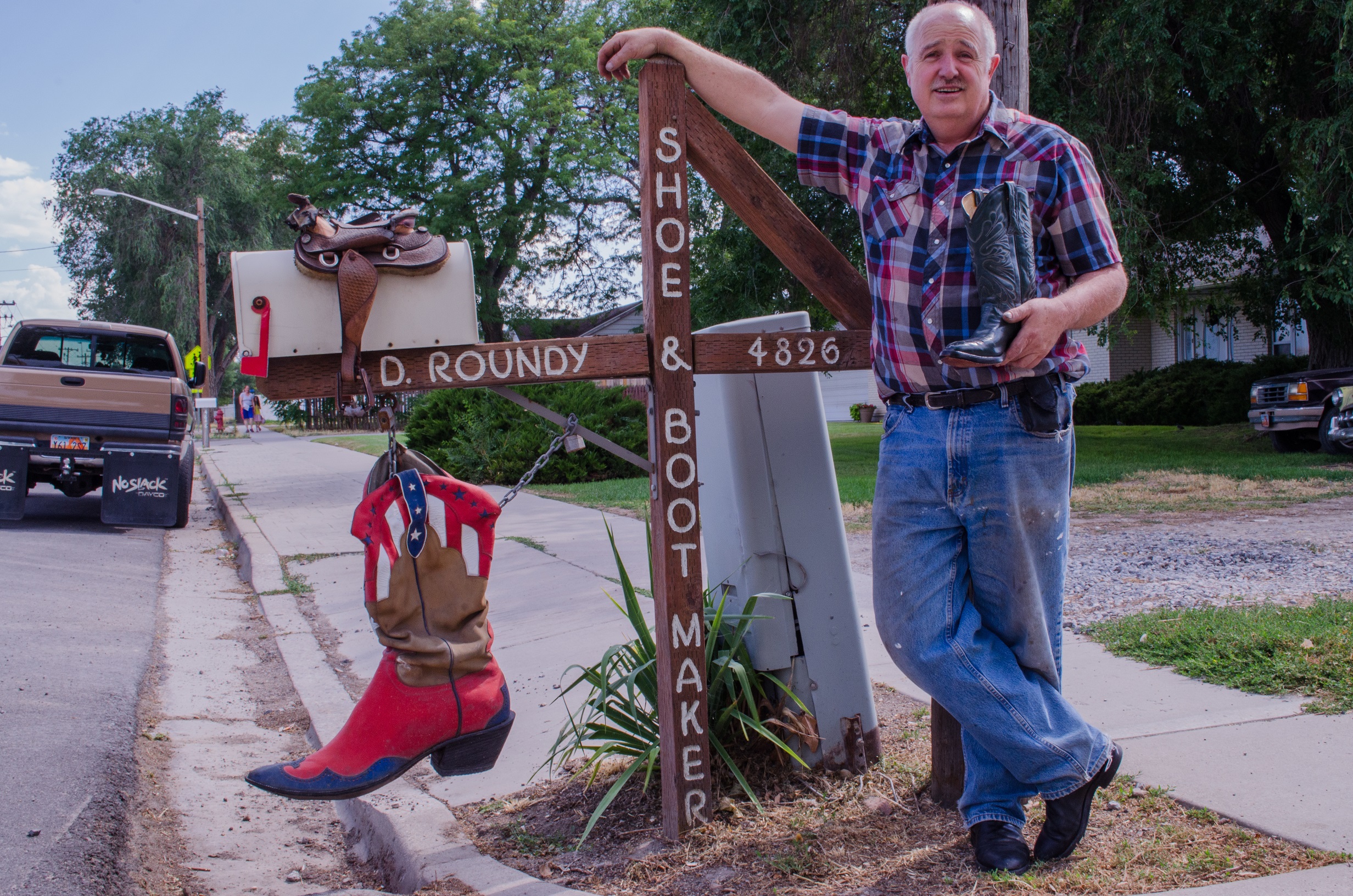
Don Roundy outside of his residential shop

Don makes each order according to his customer’s specifications. In the time-honored tradition of quality hand-craftsmanship, he builds them one at a time at his work bench. Don says, “Every day I learn more by practicing excellence with every repair and every custom order I am blessed with.”

The wait for a pair of custom boots can be three to four months, but, as his customers can attest, they’ll be the best boots or shoes you’ve ever owned.

Roundy Boots is located at 4826 S 2200 West.

http://www.roundyboots.com/index.html

Oasis Gardens and Koi

Matt Mayer has raised fish since he was a kid. A few years ago he moved into a house in Sandy and decided he wanted a pond with aquatic plants and koi. He started shopping and found only overpriced supplies that were not up to his standards. So, he decided to raise the fish and plants himself.

Ornamental Koi
Ornamental Koi

He started the business as a sideline while working a full-time job. Then, when his life circumstances changed and he took over most of the domestic duties around his house, he made the enterprise a full-time occupation.

Koi are ornamental varieties of domesticated common carp. Popular in Japan, koi can be found in different colors and patterns. Besides breeding koi, Matt also cultivates aquatic plants for ponds such as lilies, lotus, cattails and rushes.

His business has led him into pond design, and Matt is currently working on a large pond project for a golf course in St. George. He maintains his business in Sandy through internet sales and drop-in business by appointment.

Offering a better product at a better price is Matt’s goal. Through growing his business, he’s gained knowledge and expertise, noting that “Anyone who wants anything to do with koi comes to me.”

https://www.facebook.com/ogko

 

Verlo Ottley Nightcrawlers

Emily of Nightcrawlers
Emily Mendenhall of Nightcrawlers

Spreading the word through business cards, signs and Facebook, Verlo Ottley Nightcrawlers is a home business in the Taylorsville Gardens neighborhood. Verlo started the business in 1975 and grew through walk-in traffic and word-of-mouth.

The sign out front boasts that they are open 24/7. This is possible because they sell their worms from a vending machine. The worms are packaged in cups with a special bedding Verlo invented that keeps them alive for six to eight weeks.

Besides people who drop by their home location, the business supplies worms to Harmons, some gas stations and pet stores.

Emily Mendenhall started helping out with the business five years ago, and assumed ownership nearly three years ago. She started raising red worms that are sold for composting. Worm composting is using worms to recycle food scraps and other organic materials. When the scraps pass through the worm’s body, they become a nutrient rich soil amendment called vermicompost.

Stop by 4300 South 2200 West and stock up on worms both for fishing and gardening.

https://www.facebook.com/pages/Verlo-Ottley-Nightcrawlers/207963755925429?id=207963755925429&sk=info




Join our newsletter.
Stay informed.


  • Highway 6 and the Midland Trail: Utah’s Transcontinental Highway History

    From Price Canyon to Delta’s desert stretch, Utah played a central role in building the Midland Trail, one of America’s earliest transcontinental highways and the foundation of today’s Highway 6.


  • Whiskey, Bullets & a Buried Town: Archaeologists Reveal Alta’s Wild Past

    Before Alta was known for powder days and lift lines, it was a silver mining town clinging to the side of a narrow canyon. In the late 1800s, men lived at 8,000 feet, went underground each day, and endured winters that regularly buried buildings in snow. This past summer, that mining town resurfaced — literally — during construction at the Alta Ski Area.

    To understand what Alta really looked like, you don’t begin with legend. You begin with its trash — and this time, that happened almost by accident.

    Alta Ski Area was installing underground water reservoirs to support snowmaking. Because the project sits on Uinta-Wasatch-Cache National Forest land, an archaeologist was required to monitor the excavation. No one expected the trench to produce much.

    But, It did.

    Artifacts began surfacing almost immediately. Enough that the Forest Service contacted the Utah State Historic Preservation Office for help. Lexi Little, who coordinates the Utah Cultural Site Stewardship Program, helped mobilize nearly 30 volunteers to assist with what quickly became a focused two-week excavation.

    Winter deadlines were approaching. The pipes for the reservoirs had to go in the ground. There wasn’t time for a slow, extended dig.

    “It was two weeks of digging in the dirt and helping figure out exactly what we were looking at,” Little said.

    Most of the people screening soil weren’t professional archaeologists. They were trained stewards from around Utah — part of a statewide volunteer network that now approaches 500 people. They poured dirt through shaker screens, scanning for fragments that could piece together a town long buried.

    “Archaeology is human trash,” Little explained. “Archaeologists are very into trash.”

    Alta had left plenty behind.

    https://youtu.be/hzIHzx3OGoo?si=dKcl2CEz-t6FZzYw

    Victorian-style ceramics appeared first — the kind typically used in hotels. Medicine bottles followed. Ink bottles. Hand-blown glass. A porcelain doll’s foot surfaced from the soil, a small detail that shifted the mental image of the town. Families were here. Children were here. This wasn’t only a camp of miners.

    The bottles helped establish time. Manufacturing details — whether glass was hand-blown or mold-made, whether a maker’s mark appeared on the base — allowed archaeologists to date many of the artifacts to the 1870s through the 1890s, when Alta was booming as a silver mining town.

    “That gives you that range of dates for when Alta was really booming,” Little said.

    One reusable soda bottle clearly stamped “Salt Lake City” connected the canyon to the valley economy below.

    Then something unusual rolled out of a dirt pile.

    A corked bottle. Intact. Liquid still inside.

    Continue reading and support independent Utah journalism with a purchase of Utah Stories (Digital + Print) or 3 month free trial (Digital).


  • The Only Full Bottle of Alcohol Ever Found in Utah Was Unearthed in Alta

    When a backhoe rolled a corked bottle out of the dirt at Alta this summer, no one immediately grasped what they were holding. It wasn’t empty. It wasn’t shattered. It was full. “The bottle that was discovered up at Alta is the only bottle of alcohol ever discovered in an archaeological excavation in the state…


  • How Horses Help Kids Heal: Inside Utah’s Equine Therapy World

    Kelty Johnson trains horses for a living, but her deeper work happens in the quiet space between animal and human. On the Utah Stories podcast, she explains how equine therapy helps children regulate emotions, build confidence, and reconnect through presence rather than pressure.