Utah Stories

Ririe-Woodbury Turn 50

With innovative programs and choreography, as well as outreach programs for Utah Schools, Ririe-Woodbury looks forward to the next 50 years.

|


In 1964 two University dance professors, Joan Woodbury and Shirley Ririe, combined their love of choreographing, performing and teaching by starting Ririe-Woodbury Dance Company. 50 years later the group is an internationally known and renowned contemporary dance company.

Current Artistic Director, Daniel Charon, would like to continue the philosophy of Joan and Shirley by making dance accessible, but thought provoking. Charon says, “Dance is emotional, introspective and self reflecting.” He wants to not only entertain, but challenge audiences by evolving and morphing to reflect changes in society.
Ririe-Woodbury salt lake city
Artistic Director: Daniel Charon. Dancers featured are Mary Lyn Graves, Yebel Gallegos, Tara Roszeen McArthus, Brad Beakes, Alexandra Jane Bradshaw, and Bashaun Williams


As the Artistic Director Charon is not only in charge of the company’s artistic vision, he also choreographs his own pieces, commissions choreography from all over the world, teaches class, mentors new dancers, trains, plans the programs, writes grants and handles administrative duties. Handling both creative and administrative due can be daunting, but Charon says, “I have a good team and we all work together. It can be overwhelming, but I like it.”

Charon spent 15 years in New York as a dancer/choreographer with Limon Dance Company and with Doug Varone and Dancers. When the job opened up with Ririe-Woodbury he was interested and applied through the normal channels. He was offered the job and packed up and moved to Salt Lake. He feels his experience makes him a good fit for the company. He is excited to be here for the 50th anniversary and looks forward to propelling them into the next 50 years. One of the ways he wants to do that is by changing the audience experience moving it away from a theater full of people watching dancers on a proscenium stage by using video technology in performances.

As long as Ririe-Woodbury has been around they have been involved with teaching dance and making it accessible to new audiences. Gigi Arrington is the Director of Education for Ririe-Woodbury. She thinks Utah is an amazing place for a dance company and it is because of our state legislature. Thanks to a funding programs called POPS, Professional Outreach Program in Schools, professional dancers are able to take their art and teach it to school children all across the state.
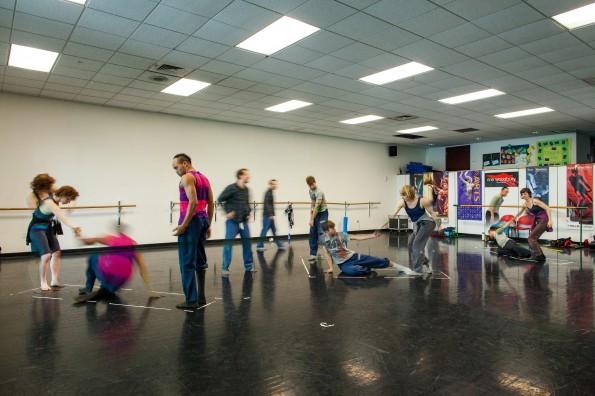
Photos by Dung Hoang


The company sends dancers to six elementary schools each year for an in-depth residency. The program starts with an assembly for the whole school where elements of dance are introduced and they teach school children what life is like for a professional dancer.

After the initial assembly two dancers teach for two weeks to three lucky classes every day. They also offer evening classes for children to attend with their parents and they can dance together. The kids become the “experts” and they are in charge as their parents get to see what the children have learned during the day.

On the last day of the residency the new dancers put on a performance for the school. The idea, according to Arrington, isn’t to teach just for the performance, but to give kids a chance to learn about dance from world renowned dancers and choreographers. “But performing is fun.”

The schools involved are also invited to a performance at Capitol Theatre. Students get to meet the dancers and even get on stage to dance with them. They learn to understand dance in the workshops and then are able to see a fully produced performance in a beautiful theater.

POPS funding guarantees that rural areas of the state also experience dance education from Ririe-Woodbury. The Rural Dance Tour goes to remote schools where the dancers perform assemblies and if schedules permit they teach mini-community parent/child classes. Arrington says, “Our dancers have probably seen more of Utah than native Utahns.”

Arrington can’t say enough about the dancers of Ririe-Woodbury. “They are amazing and technically skilled. They are electric on stage and wonderful to watch. They are generous, terrific, good people who love working with kids.”

And that, according to Arrington, makes the POPS program a great investment of taxpayer money.

http://www.ririewoodbury.com/


Join our newsletter.
Stay informed.


  • Highway 6 and the Midland Trail: Utah’s Transcontinental Highway History

    From Price Canyon to Delta’s desert stretch, Utah played a central role in building the Midland Trail, one of America’s earliest transcontinental highways and the foundation of today’s Highway 6.


  • Whiskey, Bullets & a Buried Town: Archaeologists Reveal Alta’s Wild Past

    Before Alta was known for powder days and lift lines, it was a silver mining town clinging to the side of a narrow canyon. In the late 1800s, men lived at 8,000 feet, went underground each day, and endured winters that regularly buried buildings in snow. This past summer, that mining town resurfaced — literally — during construction at the Alta Ski Area.

    To understand what Alta really looked like, you don’t begin with legend. You begin with its trash — and this time, that happened almost by accident.

    Alta Ski Area was installing underground water reservoirs to support snowmaking. Because the project sits on Uinta-Wasatch-Cache National Forest land, an archaeologist was required to monitor the excavation. No one expected the trench to produce much.

    But, It did.

    Artifacts began surfacing almost immediately. Enough that the Forest Service contacted the Utah State Historic Preservation Office for help. Lexi Little, who coordinates the Utah Cultural Site Stewardship Program, helped mobilize nearly 30 volunteers to assist with what quickly became a focused two-week excavation.

    Winter deadlines were approaching. The pipes for the reservoirs had to go in the ground. There wasn’t time for a slow, extended dig.

    “It was two weeks of digging in the dirt and helping figure out exactly what we were looking at,” Little said.

    Most of the people screening soil weren’t professional archaeologists. They were trained stewards from around Utah — part of a statewide volunteer network that now approaches 500 people. They poured dirt through shaker screens, scanning for fragments that could piece together a town long buried.

    “Archaeology is human trash,” Little explained. “Archaeologists are very into trash.”

    Alta had left plenty behind.

    https://youtu.be/hzIHzx3OGoo?si=dKcl2CEz-t6FZzYw

    Victorian-style ceramics appeared first — the kind typically used in hotels. Medicine bottles followed. Ink bottles. Hand-blown glass. A porcelain doll’s foot surfaced from the soil, a small detail that shifted the mental image of the town. Families were here. Children were here. This wasn’t only a camp of miners.

    The bottles helped establish time. Manufacturing details — whether glass was hand-blown or mold-made, whether a maker’s mark appeared on the base — allowed archaeologists to date many of the artifacts to the 1870s through the 1890s, when Alta was booming as a silver mining town.

    “That gives you that range of dates for when Alta was really booming,” Little said.

    One reusable soda bottle clearly stamped “Salt Lake City” connected the canyon to the valley economy below.

    Then something unusual rolled out of a dirt pile.

    A corked bottle. Intact. Liquid still inside.

    Continue reading and support independent Utah journalism with a purchase of Utah Stories (Digital + Print) or 3 month free trial (Digital).


  • The Only Full Bottle of Alcohol Ever Found in Utah Was Unearthed in Alta

    When a backhoe rolled a corked bottle out of the dirt at Alta this summer, no one immediately grasped what they were holding. It wasn’t empty. It wasn’t shattered. It was full. “The bottle that was discovered up at Alta is the only bottle of alcohol ever discovered in an archaeological excavation in the state…


  • How Horses Help Kids Heal: Inside Utah’s Equine Therapy World

    Kelty Johnson trains horses for a living, but her deeper work happens in the quiet space between animal and human. On the Utah Stories podcast, she explains how equine therapy helps children regulate emotions, build confidence, and reconnect through presence rather than pressure.