Utah Stories

Two Disabled Utahns, Two Stories of Ability

How did two Utahns overcome their disabilities to live successful lives? Read here to find out.

|


1) Daniel Eckhardt

EckhardtShoppers at the Smith’s Food and Drug on 455 South 500 East often pick the longest checkout line rather than the shortest. The reason? Daniel Eckhardt. He’s a bagger, a hard worker, and always happy—and excited—to be at work. His smile is contagious and people go out of their way to wait in his line.

Daniel has Down syndrome, but it doesn’t define him. A graduate of Skyline High School, Daniel worked with his dad, Scott, on construction jobs. He lost his mom to cancer and has endured open heart surgeries since he was a toddler, excels at video games and has a girlfriend. He’s worked at Smith’s for four years.

He misses his mom and thinks about her, but lives in the moment and enjoys each day. Whether working, playing or hanging out with his family, Daniel makes the most of what he’s got.

Smith’s store manager Landon Judd says, “Daniel brings smiles to lots of faces because he is always smiling and having a good time.” His happiness affects the mood of other employees and creates an upbeat, friendly atmosphere.

His favorite part of his job? “I like staying busy bagging.” And he is fast. Each item is slipped into a bag as it comes down the belt and before the customer can pay, their groceries are waiting in their cart.

In a world where everyone wants to start at the top rather than work their way from the bottom, it is refreshing to talk to someone who loves what he does and always does his best.

 —Connie Lewis

2) Jeremiah Maxey
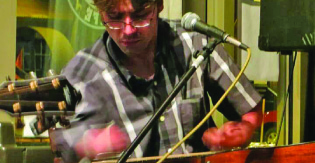
Jeremiah Maxey, performing

“There is always a way to get around a disability.” Guitarist Jeremiah Maxey plays most of his own material and has written—and played—alongside bands such as Robert Randolph and the Family Band, Right Hand Band, and the Telluride Meltdown. He’s also missing his right arm below the elbow and a finger on his left hand as a result of a birth defect.

Maxey was introduced to the guitar by his dad, who was always playing classics like the Beatles, Bob Dylan, Neil Young. “My sister started getting lessons when she was 10. I got really jealous and wanted to learn how to play. So my dad handed me the guitar. I couldn’t play with the standard guitar tuning. One of my dad’s friends told him about open tuning, and then found an old steel lap guitar at a pawn shop.”

Maxey graduated from Central High School and grew up skiing at Deer Valley. He started playing with a church band at Stansbury Park and became obsessed with music and guitar. At age 22, he started playing solo acoustic and then soon after started playing in bands. Maxey currently works at Deer Valley doing lodging reservations and at Esprit Management at their front desk. “I operate a computer, take calls, make reservations, and check people in. I can type using my prosthetic.”

I am a one-handed guitar player and I will always be, but it’s nice to be considered a good guitar player.”

 —Rich Markosian

Join our newsletter.
Stay informed.


  • Highway 6 and the Midland Trail: Utah’s Transcontinental Highway History

    From Price Canyon to Delta’s desert stretch, Utah played a central role in building the Midland Trail, one of America’s earliest transcontinental highways and the foundation of today’s Highway 6.


  • Utah Acquires US Magnesium Assets in $30M Deal to Protect the Great Salt Lake

    Utah leaders announced the state has successfully won the bid to acquire key assets of the defunct US Magnesium facility on the Great Salt Lake, including its associated water rights and property.


  • Whiskey, Bullets & a Buried Town: Archaeologists Reveal Alta’s Wild Past

    Before Alta was known for powder days and lift lines, it was a silver mining town clinging to the side of a narrow canyon. In the late 1800s, men lived at 8,000 feet, went underground each day, and endured winters that regularly buried buildings in snow. This past summer, that mining town resurfaced — literally — during construction at the Alta Ski Area.

    To understand what Alta really looked like, you don’t begin with legend. You begin with its trash — and this time, that happened almost by accident.

    Alta Ski Area was installing underground water reservoirs to support snowmaking. Because the project sits on Uinta-Wasatch-Cache National Forest land, an archaeologist was required to monitor the excavation. No one expected the trench to produce much.

    But, It did.

    Artifacts began surfacing almost immediately. Enough that the Forest Service contacted the Utah State Historic Preservation Office for help. Lexi Little, who coordinates the Utah Cultural Site Stewardship Program, helped mobilize nearly 30 volunteers to assist with what quickly became a focused two-week excavation.

    Winter deadlines were approaching. The pipes for the reservoirs had to go in the ground. There wasn’t time for a slow, extended dig.

    “It was two weeks of digging in the dirt and helping figure out exactly what we were looking at,” Little said.

    Most of the people screening soil weren’t professional archaeologists. They were trained stewards from around Utah — part of a statewide volunteer network that now approaches 500 people. They poured dirt through shaker screens, scanning for fragments that could piece together a town long buried.

    “Archaeology is human trash,” Little explained. “Archaeologists are very into trash.”

    Alta had left plenty behind.

    https://youtu.be/hzIHzx3OGoo?si=dKcl2CEz-t6FZzYw

    Victorian-style ceramics appeared first — the kind typically used in hotels. Medicine bottles followed. Ink bottles. Hand-blown glass. A porcelain doll’s foot surfaced from the soil, a small detail that shifted the mental image of the town. Families were here. Children were here. This wasn’t only a camp of miners.

    The bottles helped establish time. Manufacturing details — whether glass was hand-blown or mold-made, whether a maker’s mark appeared on the base — allowed archaeologists to date many of the artifacts to the 1870s through the 1890s, when Alta was booming as a silver mining town.

    “That gives you that range of dates for when Alta was really booming,” Little said.

    One reusable soda bottle clearly stamped “Salt Lake City” connected the canyon to the valley economy below.

    Then something unusual rolled out of a dirt pile.

    A corked bottle. Intact. Liquid still inside.

    To access this post, you must purchase Utah Stories (Digital + Print) or 3 month free trial (Digital).


  • The Only Full Bottle of Alcohol Ever Found in Utah Was Unearthed in Alta

    When a backhoe rolled a corked bottle out of the dirt at Alta this summer, no one immediately grasped what they were holding. It wasn’t empty. It wasn’t shattered. It was full. “The bottle that was discovered up at Alta is the only bottle of alcohol ever discovered in an archaeological excavation in the state…