Independent News

Clean Air Rally A Huge Success According to Organizers

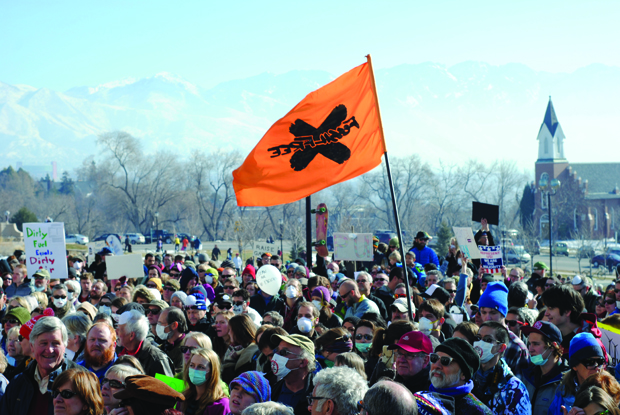
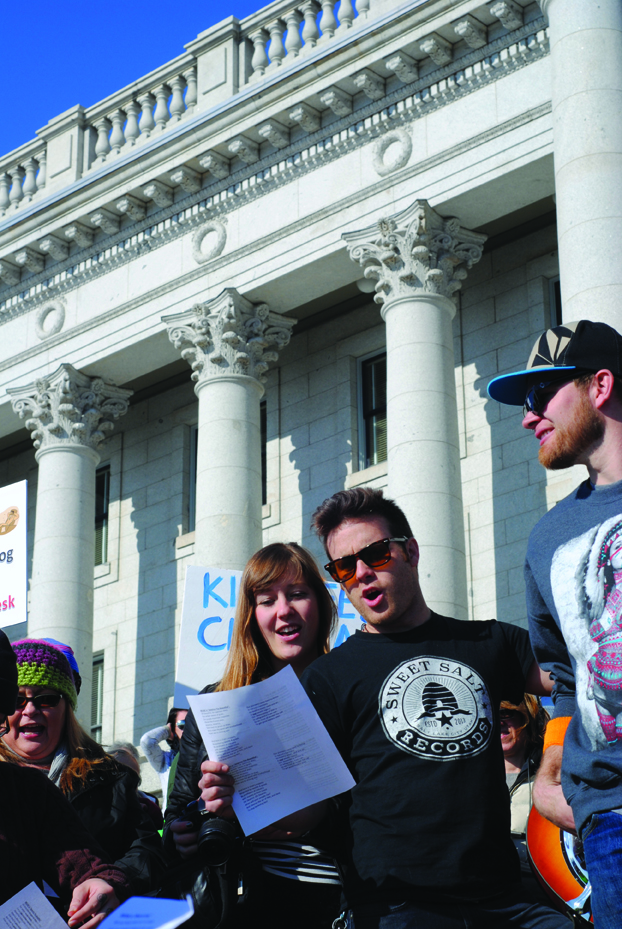
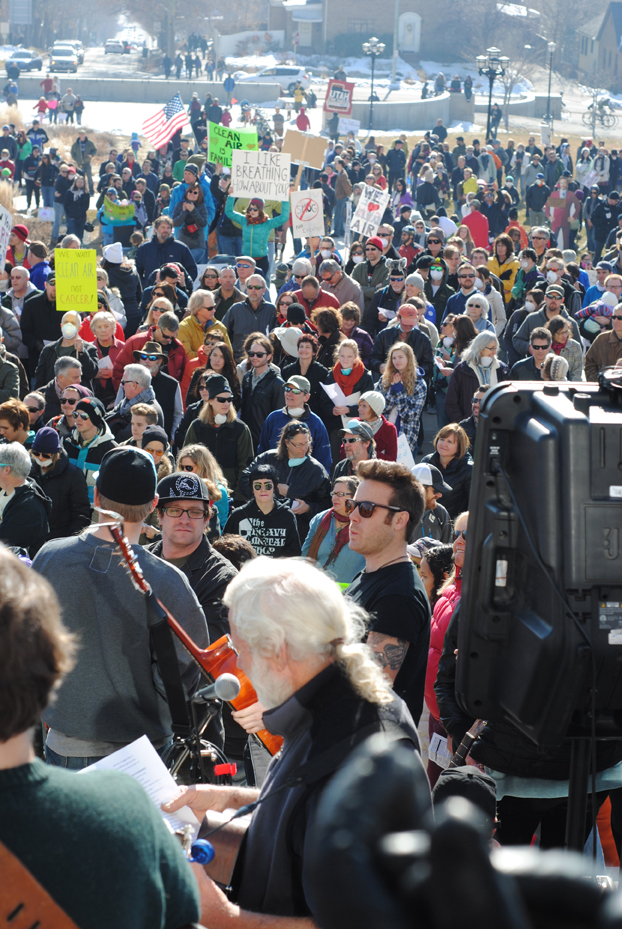
Five thousand protesters organized on Saturday against Utah’s poor air quality.

|


Clean Air No Excuses Rally at the Utah State Capitol on Saturday January, 25th, 2014

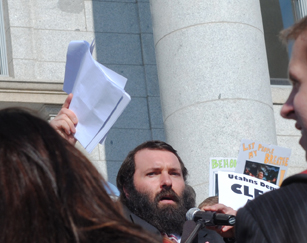
polution speaker utah state capitol building tom bennett polution protest_use

Clean Air No Excuses Rally at the Utah State Capitol on Saturday January, 25th, 2014

“It greatly exceeded our wildest expectations,” says Dr. Brian Moench of Utah Physicians for a Healthy Environment, one of the organizers of the Clean Air, No Excuses Rally held on February 25, 2014 at the Utah State Capitol. According to Moench there were between four to five thousand people there, which was about ten times more than the organizers expected when they first started planning the event six weeks ago.


 He credits the turnout to the long bout of inversion weather the valley has experienced. The other factor is the culmination of seven years of hard work by his organization and others getting the word out to educate the people about just how dangerous the air can be.


  The purpose of the rally was to send a, “clear, strong message to the legislature.” The challenge now is to maintain the pressure on lawmakers. The goal is to make it very difficult for any legislator to vote to make the pollution worse and to not vote to make it better. The public sentiment is very clear – people want change. “The public will drag politicians behind them to make real change,” Moench says.

The rally was a huge success for the planners and they are optimistic that it will be a turning point leading to a cleaner and healthier Utah.

, ,


Join our newsletter.
Stay informed.


  • Utah Homelessness Crisis: Tyler Clancy Challenges ‘Housing First’ Failures

    “It’s not normal to see someone sleeping on the sidewalk in a sleeping bag with a needle sticking out of their arm.”

    That sentence should not be controversial. In a sane society, it would barely need saying. But in Utah — where politicians, nonprofits, consultants, and bureaucrats have spent more than a decade congratulating themselves for “addressing homelessness” while the streets of Salt Lake have become more dangerous, more drug-soaked, and more morally disorienting — it lands like an indictment. And it came not from a crank, a talk-radio host, or a downtown business owner at the end of his rope, but from Tyler Clancy, Utah’s newly appointed homeless coordinator.

    That matters because if Clancy is serious — and after sitting down with him, he appears to be — then he represents something Utah’s homelessness system has not had in a very long time: someone willing to say the obvious out loud. The old script is dead. Everybody knows it, but almost nobody in power has wanted to admit it. 

    For years, Utah’s homelessness policy has been built on a polite fiction — that if we build enough units, distribute enough funding, and avoid being too “judgmental,” the crisis will gradually resolve itself. That story was easier to maintain when Utah was receiving national praise for “solving chronic homelessness.” It is much harder to sustain now, when the conditions on the ground tell a very different story.

    Magnolia Apartments opened to help alleviate homelessness, but the results were not all positive.

    Part of that failure became painfully clear over the last four years. By most accounts, former homelessness coordinator Wayne Niederhauser was a decent man and a very nice guy. But one person close to him described his tenure as that of “a tiger without stripes”— someone with the title, but not the appetite to challenge the sprawling network of nonprofits and service providers receiving millions in taxpayer dollars. That lack of accountability has had real consequences. Multiple former and current residents have told Utah Stories that of the roughly 60 original tenants who moved into Magnolia when it opened, about 20 have since died — most, they say, from accidental drug overdoses. 

    If those accounts are even close to accurate, they should have triggered a public reckoning. Instead, the system kept moving, protected by good intentions, insulated from scrutiny, and largely unbothered by outcomes that would be considered a scandal in almost any other context.

    That is the machine Clancy is stepping into, and unless he is willing to confront it directly — not just coordinate around it — his role risks becoming one more layer of management over the same failures. The reality he inherits is not complicated in the way policymakers like to suggest. It is visible, immediate, and increasingly impossible to explain away. 

    Open drug use, fentanyl addiction, untreated mental illness, rising disorder, and a growing sense among both the public and the homeless themselves all indicate that the system is not working. Complexity exists, but it has also become a convenient shield for cowardice. It is the language people use when they want to avoid saying what is plainly in front of them: Utah has spent years managing visible human collapse while calling it compassion.

    The Lie Utah Told Itself

    For years, Utah’s approach to homelessness rested on a narrative few in power were willing to question. It sounded compassionate. It polled well. And it avoided uncomfortable truths.

    Continue reading with a Utah Stories subscription. Start your 3-month free trial.

    Continue reading and support independent Utah journalism with a purchase of Utah Stories (Digital + Print) or 3 month free trial (Digital).


  • Inside Moab’s Political Divide: Land, Tourism, and the Future of Grand County, Utah

    In the late 1950s, Edward Abbey took a job as a park ranger at Arches National Monument, just outside Moab. What he found there, and what he watched happen to it, would shape the rest of his life. Roads were being cut into the canyon country. Cars were replacing foot traffic. The National Park Service, in the name of accessibility, was engineering a kind of industrialization of the wilderness he’d come to love. Abbey wrote about it in Desert Solitaire, published in 1968, and the anger in that book wasn’t abstract. It came from watching something specific be changed by people who either didn’t understand what they had or didn’t care.

    Grand County has long been the most reliably left-leaning county in the state, a fact that puts it in sharp contrast to nearly everything around it. To understand how that happened, and where things stand now, I spoke with longtime residents and politicians who’ve watched it from the inside, people who’ve served in local government and lived through the shifts firsthand.

    Robert Greenberg.

    Bob Greenberg came from New York in 1976, took a job at the community mental health center, and never left. He went on to chair the Grand County Democratic Party and serve on the county council. When he arrived, he said, “the Democratic Party was said to be able to meet in a phone booth” — and even then, its members were a contradictory bunch. Yellow Dog Democrats from the oil patch were fiscally conservative but surprisingly open socially, allowing different demographics to feel safe moving to the county. 

    “The town fathers were desperate to have new people come to town,” Greenberg recalls. “They just didn’t want the people who actually showed up. They wanted some other people.”

    What followed was a demographic shift nobody planned. The people who filled the gap left by the bust were river guides, federal agency workers, artists, and eventually waves of outdoor recreationists discovering that southeastern Utah was among the most spectacular landscapes on earth. Tourism ended up being the only economic development avenue that actually worked. Manufacturing never had the labor force or market access, sewing factories came and went. The people the tourist economy attracted tended to be younger, more outdoor-oriented, and more liberal.

    Kevin Walker.

    Kevin Walker, a former Grand County commissioner who moved here in 1990 for the landscape, puts the county’s diversity in context. “Moab [is] a pretty diverse place since, I think, at least the 1950s with the uranium mining boom,” he says. “So it’s not a typical Southern Utah town.” 

    Part of what makes Grand County distinct is self-reinforcing. Federal agencies like the Park Service, the Forest Service, the BLM, have large presences here and pull in a different demographic than surrounding counties. People looking to live in Southern Utah with certain values gravitate toward the place where those values already have a foothold. Over time, that critical mass has made Grand County what it is politically, while neighboring counties went in very different directions.

    The defining conflict in Grand County has always been over land.

    In the 1970s and 80s, it was extraction versus preservation in the starkest terms. County commissioners floated toxic waste incinerators. A plan emerged to site a high-level nuclear waste repository at the entrance to Canyonlands National Park. 

    “It really, really galvanized environmentalists everywhere, but particularly in Grand County,” Greenberg says. Activists put up signs at the park entrance, watched them get chainsawed down, and came back with steel reinforcement. That stubborn, physical, unglamorous persistence became part of the local political character.

    Continue reading and support independent Utah journalism with a purchase of Utah Stories (Digital + Print) or 3 month free trial (Digital).


  • The Stratos Project and Corporate Power: Who Controls Utah’s Future?

    If we were all just consumers, Governor Cox, Mike Lee, Speaker Schultz, and Kevin O’Leary would have it easy. If we were just more concerned about money, jobs, and tech, and less concerned about raising our kids in communities (not in front of screens), culture, the environment, and water, those smart dudes would get exactly what they want — Stratos: a city of the future, buzzing with processors and transistors, making all of our AI dreams come true! 

    The world we could live in would be a dazzling, Mr. Wonderful kind of place. We would beat those pesky Chinese in the AI war; our AI robots could do all of our farming and ostensibly harvest the water we need for the Great Salt Lake out of thin air. But apparently, we just don’t get it. We haven’t yet reached the point predicted by Aldous Huxley’s vision in Brave New World, where we are completely distracted, dopamine-driven consumers who only need sex, drugs, and stuff to remain happy.

    Maybe Stratos will be an amazing marvel, and somehow, as Governor Cox claims, “. . . add more water to the Great Salt Lake.” But we aren’t sold. While this Stratos project has received considerable attention, it’s worth taking a step back to attempt to understand how corporate power appears to have usurped civic power.

    Civics is the practice of shaping our society through our collective voices and community involvement. Ask the residents in Tremonton, Utah how well that is working out for them. Can we still shape our world through our elected leaders? Does it matter who we vote for at the ballot box if organizations like UDOT, UTA, and MIDA can supersede our local government authority and citizen backlash? 

    The corporatization of our communities and the interests that impact our political leaders’ decision making processes are seen as far more of a concern than the average Utah resident’s concerns. Special interests and corporate power are shaping Utah’s future more than ever. 

    It’s worth asking: ‘How can we regain control over shaping Utah’s future in light of the growing power and billions that the technocrats now wield in shaping our world today?’ Amazon’s market cap exceeds the GDP of Canada. The “Magnificent Seven” tech stocks now have a greater market cap than the entire GDP of Europe ($23.6 trillion. EU countries have $19.3 trillion GDP). Will tech companies become their own nation-states and dominate their own chunks of various states? Will we become their subjects?

    There are two sides to this coin: We love Utah not just because we have the most outdoor wilderness playgrounds, but also because of Utah’s prosperity and job market. This is because Utah has become a tech hub. Our tech leadership has minted several billionaires and billion-dollar businesses. Utah offers a market and an educated workforce that more businesses and giant corporations want to be a part of. This is a benefit for even non-tech Utahns.

    The problem with this success is that as we dole out more money to attract more tech businesses, data centers, fulfillment centers, and big corporate retailers, it becomes more difficult to carve out our “sense of community.” As corporate sovereignty replaces local business sovereignty, we see that our voices and our votes matter less.

    Ask who our politicians work for, and nearly every Utahn believes they work far more for their corporate donors than they work for the average Utah citizen. So how do we best regain control over our communities?

    Continue reading and support independent Utah journalism with a purchase of Utah Stories (Digital + Print) or 3 month free trial (Digital).


  • Nine Mile Ranch: Preserving Utah’s Historic Nine Mile Canyon

    Nine Mile Canyon is famous worldwide for its Fremont and Ute rock art panels, some of which are pecked ‘petroglyphs,’ while others are painted ‘pictographs.’ The canyon, home to the Fremont people and a seasonal pass-through for the Utes, preserves prehistoric pit houses, rock shelters and granaries. It’s the most concentrated rock art spot in North America.