
The desire for an English pastoral-style yard has been a Utah obsession since the days of the pioneers. With over a million people living across the Wasatch front, water is becoming scarcer (and more expensive) every year. Though we live in a desert, there are ways to conserve, while still maintaining that lush, green landscape you’ve always wanted.
1) Cut down on the watering days
Simply put, Utahns water their lawns way too much, way too often. Following the scale at www.conservewater.utah.gov/Monthly/Default.asp you can save 50% of your water usage.
If you’re worried the lawn isn’t getting enough water, simply test its moisture contents by sticking a screwdriver or soil probe into the surface to test it. If the ground is moist, it doesn’t need any water.
2) Hydrozone your yard
Hydrozoning involves the grouping of plans that absorb similar amounts of water. We aren’t recommending you to completely gut your yard and replant everything from scratch, but if there are a few shrubs that can be moved, or shrubs you wish to plant, learn about their water needs and place them with like-plants. For example, plants that adapt better to the heat might be grouped near the street, while plants that require more shade should be planted closer to the home or by a fence.
3) Get a free water check
For something that costs you nothing, you’ll get quite a bit. Simply visit http://slowtheflow.org/index.php/forms/free-water-check and have a trained expert come to your home to test your soil type, water pressure, sprinkler effectiveness and grass root depth. The process takes only about one hour and is performed from May through August.
Also, if you live in a condo or an apartment, don’t think you’re exempt! These units are among the biggest culprits for over-watering. With the perpetually changing maintenance crews, it’s likely that many problems go undetected. The same goes for large business complexes.
4) Buy the right plants
 Seems like a no-brainer, but let’s be honest, most of us just plant what we think looks nice. When the plant dies, we chalk it up to not having a green thumb. Most of the time, however, if your plants die, it’s because they were never intended to grow in Utah’s soil in the first place. Some plants aren’t adaptable to the volatile weather of the very hot summers and very cold winters. You need to find plants that are referred to as “water-wise.”
Don’t worry, water-wise planting doesn’t just mean prickly cacti and rock formations. Check out www.waterwiseplants.utah.gov and view the various flowers, shrubs and trees that can fill your yard. Also visit http://conservationgardenpark.org/plants that also helps you to find local plant vendors.
5) Harvest your rainwater
This sounds a bit primitive, but a simple barrel of harvested rainwater can help water an entire law. In fact, an above-ground system can pay for itself in as little as three years. Visit www.conservewater.utah.gov/Rainwater%20Harvesting/RWHwebpage3A.pdf for more information.
6) Lay mulch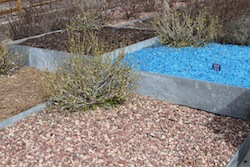
This is an easy one that anyone can do with minimal effort. Lay down a thick layer (three to four inches) of ground mulch on soil surfaces. Bark is inexpensive and easy to maintain. Not only does this help prevent weeds that selfishly hog the water and serve as a garden eyesore, but it also helps to lock in the ground’s moisture.
7) Reconsider your space
Is there a part of your yard that might not necessarily need to be covered in grass? Maybe you could use a back porch or an outdoor barbeque space. What about a sandbox? If you’re not using the grass, you’re wasting it… and needlessly watering it. Make it work for your needs by replacing it with something you will use.
While water usage is down 25% in the Salt Lake Valley since 2000, with 244 gallons per capita down to 191, we are still consuming far too much for our population growth expectancy. The goal is to decrease another 25% by the year 2050 in order to meet the population demand. Have any tips for how to save water? Let us know!
Photos by Jennifer Berrett