Dinesh Patel Inspiring Young Entrepreneurs
In 1985, I reached a turning point. I decided I didn’t want to spend the rest of my life working for someone else,” says Dr. Dinesh Patel, one of Utah’s most successful immigrants and entrepreneurs.
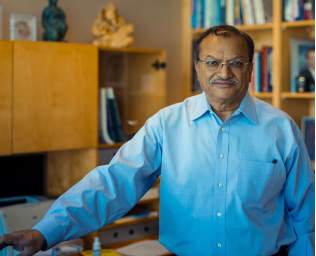
Indian through heritage, Dr. Patel was born in Kabwe, Zambia in 1950. Sitting back in his large conference room chair overlooking the Old Mill Golf course, the gentle-voiced pioneer of Utah’s biotechnology industry quickly remarks that one of his most commonly asked questions is “What brought you to Utah?”
Truth be told, Dr. Patel knew practically nothing about the state before relocating here to open his first business.
In fact, living in Utah had never before crossed his mind. He graduated from Gujarat University in Gujarat, India in 1973 with a Bachelor of Science. He then made the life-changing decision to move with his wife to Pennsylvania to attend the Philadelphia College of Pharmacy and Science, earning his Masters of Science in Pharmaceutics in 1975, and capped off his education with a PhD in Physical Pharmacy from the University of Michigan in 1978.
After conducting research with large corporations for several years, the young PhD realized in 1985 that he did not want to spend the rest of his life trying to climb the corporate ladder. Partnering with current U of U College of Pharmacy professor, Dr. William Higuchi, who he met while attending the University of Michigan, he founded TheraTech, Inc. in Salt Lake City. “I moved here to start a business because my colleague was here” Patel concedes. “Other than that, I had almost no connections to Utah.” It’s as simple as that.
It was a risk that paid off handsomely. Specializing in drug delivery, which measures ways to increase the efficiency of drug dosages over set durations of time, their combined expertise allowed the business to flourish very quickly. Co-founders also included University of Utah pharmacy professor Dr. Sung Wan Kim and Utah entrepreneur and philanthropist Gary Crocker. To meet financing demands, he partnered with several major pharmaceutical companies, including Procter & Gamble and Pfizer.
The company went public in 1992, which Patel describes as one of his biggest professional accomplishments. “Being able to start a company and take it public… taking it all the way,” he says with a reflective smile.
Five years later, Patel sold TheraTech Inc. to Watson Pharmaceuticals, a company that now employs roughly 500 Utahns.
A multi-millionaire at the age of 49, Patel shrugs, “I couldn’t just play golf or go to the beach every day,” so, in 2000, along with businessmen Paul Ahlstrom, Ed Eckstrom, and Gary Crocker, he founded vSpring Capital (now Signal Peak Ventures), a venture capital firm targeting information technology and life science companies based in the western United States.
The company went on to become Utah’s leading venture capital firm, with Utah Business Magazine naming Dr. Patel as one Utah’s 100 most powerful people.
When questioned why he made the transition from pharmaceuticals to venture capitalism, Patel mentions that before he started the firm, he used to invest in new companies but with admittedly much less organization on his part. “I love to see young entrepreneurs full of ideas,” he smiles “It keeps me young.”
Though enthusiasm for life science and business growth has been proven, Patel admits that venture partners often move onto other things, and even at 63, plans to move out of the ventures game in the next year or two. “In the venture business,” he notes, “it takes much time to have a financially successful company. Just over a decade ago, it would take about three to five years. Now it’s taking eight to twelve.”
These are years that Patel would rather devote to his current project: building Shree Chhobtubhai A. Patel Medical Center in Mota Fofalia, Gujarat, India, a 50-bed hospital operated through Shaktikrupa Charitable Foundation. This foundation is funded by Dr. Patel and his two brothers. Built in memory of their father, the hospital will serve 65,000 people in local villages surrounding their father’s birthplace.
Patel claims the key to his success rests in not overanalyzing, especially when it came to money. “If I was going to worry about getting financing, I never would have started a company in the first place.”
Asked what else he plans to do with his retirement, he pauses for a moment for review. “Whatever I do, I’ll be active,” he nods assuredly. Considering his impressive list of professional and personal accomplishments, that’s easy to believe.