Off Beat Characters

Utah Naturists not Nudists – find out the difference

What do you have to hide, if you al already naked?

|

gardening nudist

gardening nudist
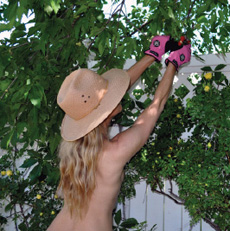
Naturists enjoy performing all sorts of tasks around the house free from the confines of clothing.
What do you have to hide, if you al already naked?

Utah’s one of the best states for being an independent naturist,” claims Ed Stimpson. Independent naturist? Sounds like it could be a new green movement political party, but what Stimpson, former CEO of the Utah Naturists Club, is talking about is being alone and in nature…naturally. Naturally, asin naked. Also referred to as nudists, naturists are people who prefer to spend time in the buff whether alone or hanging out, so to speak, with friends. For those who don’t understand why anyone might want to disrobe publicly, Ed has one word: freedom. Freedom? Like the freedom of feeling the sun and wind on your skin? No, freedom as in the freedom of not being judged, especially women, who often spend their lives and a fortune trying to look like women portrayed in magazines.” For Ed, that feeling of freedom is “being able to just enjoy being a person as if you were a child. If you’ve never done it, go do it!” Naturists share the common value of accepting people as they are, warts and all. “Naturism is a mindset,” says Tex, a Utah transplant (from guess where) and lifelong naturist. “We’re taught to be embarrassed about ourselves. Sure, we all have challenges, but so often people are fighting their own little battle of perceptions of themselves. Naturism is about accepting your humble humanity. When you’re naked, what’s there to hide?”

“Clothing,” Tex expounds, “serves two purposes. It’s for protection and pretension.” He adds with a chuckle, “If God had intended for us to run around naked, we’d be born that way.”Like any other pastime, there’s a time and place for naturism. Utah has no formal resort or privately-owned recreational area where naturists can shed their clothes and attitudes about body image. There are opportunities for the clothes-free crowd to engage in socializing au naturel. Alas,the sign for Beaver Creek Nudist Ranch in Samak is simply an expresson of
local humor. No such facility exists. Naturist organizations are present in Utah and members represent a diversity of age, gender, marital status and religion. Tex is very clear though about dispelling misconceptions regarding social nudity. “These are not sex clubs or swingers clubs.” Misbehavior will be recognized and behavior that implies a certain intention is grounds for removal from a club, or for being asked to leave a private social event, because yes, naturists do get together for parties at people’s homes. Just as any like-minded group chooses to get together to share food and conversation, naturists gather at people’s homes to do what people do at parties, only without clothes.
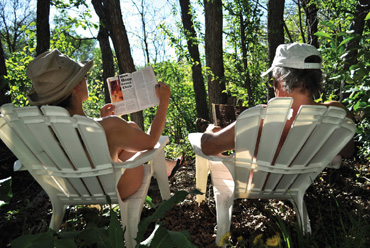
Naturists, not be be confused with nudists or swingers are not meeting for perverted reasons.

“If you are someone who likes the freedom of being naked, there’s potential for people to misjudge your intentions,” Tex explains, “so it’s a pleasure to be in an environment where everyone’s just as comfortable socializing as you are.” Legally, Attorney Andrew Mc-Cullough explains, people may gather in a clothes-free environment as long as, and this is the legal term, a “casual passerby” is not witness to nudity. “You avoid being in public where you can be seen,” he elucidates. “What I tell naturists is to look around. Make sure you’re not where there are other people.” On public lands the same reasonable rule applies.

“The fact that a place is public is not relevant,” McCullough continues. “What is, is whether or not the public can see you.” But if you do choose to be naked somewhere that is also frequented by the clothing compulsive, a situation that arises, for example, at unimproved hot springs, McCullough advises that you cover yourself so as not to offend. “The textiles,” as naturists call them, “have the say. You don’t get to say, that you were there first so they just have to deal with it.”
“People have different comfort zones,” Ed shares, “but if they can get out of that, they’re
hooked!” §

,


Join our newsletter.
Stay informed.


  • Whiskey, Bullets & a Buried Town: Archaeologists Reveal Alta’s Wild Past

    Before Alta was known for powder days and lift lines, it was a silver mining town clinging to the side of a narrow canyon. In the late 1800s, men lived at 8,000 feet, went underground each day, and endured winters that regularly buried buildings in snow. This past summer, that mining town resurfaced — literally — during construction at the Alta Ski Area.

    To understand what Alta really looked like, you don’t begin with legend. You begin with its trash — and this time, that happened almost by accident.

    Alta Ski Area was installing underground water reservoirs to support snowmaking. Because the project sits on Uinta-Wasatch-Cache National Forest land, an archaeologist was required to monitor the excavation. No one expected the trench to produce much.

    But, It did.

    Artifacts began surfacing almost immediately. Enough that the Forest Service contacted the Utah State Historic Preservation Office for help. Lexi Little, who coordinates the Utah Cultural Site Stewardship Program, helped mobilize nearly 30 volunteers to assist with what quickly became a focused two-week excavation.

    Winter deadlines were approaching. The pipes for the reservoirs had to go in the ground. There wasn’t time for a slow, extended dig.

    “It was two weeks of digging in the dirt and helping figure out exactly what we were looking at,” Little said.

    Most of the people screening soil weren’t professional archaeologists. They were trained stewards from around Utah — part of a statewide volunteer network that now approaches 500 people. They poured dirt through shaker screens, scanning for fragments that could piece together a town long buried.

    “Archaeology is human trash,” Little explained. “Archaeologists are very into trash.”

    Alta had left plenty behind.

    https://youtu.be/hzIHzx3OGoo?si=dKcl2CEz-t6FZzYw

    Victorian-style ceramics appeared first — the kind typically used in hotels. Medicine bottles followed. Ink bottles. Hand-blown glass. A porcelain doll’s foot surfaced from the soil, a small detail that shifted the mental image of the town. Families were here. Children were here. This wasn’t only a camp of miners.

    The bottles helped establish time. Manufacturing details — whether glass was hand-blown or mold-made, whether a maker’s mark appeared on the base — allowed archaeologists to date many of the artifacts to the 1870s through the 1890s, when Alta was booming as a silver mining town.

    “That gives you that range of dates for when Alta was really booming,” Little said.

    One reusable soda bottle clearly stamped “Salt Lake City” connected the canyon to the valley economy below.

    Then something unusual rolled out of a dirt pile.

    A corked bottle. Intact. Liquid still inside.

    Continue reading and support independent Utah journalism with a purchase of Utah Stories (Digital + Print) or 3 month free trial (Digital).


  • How Horses Help Kids Heal: Inside Utah’s Equine Therapy World

    Kelty Johnson trains horses for a living, but her deeper work happens in the quiet space between animal and human. On the Utah Stories podcast, she explains how equine therapy helps children regulate emotions, build confidence, and reconnect through presence rather than pressure.


  • Angela Brown: The Woman Behind SLUG Magazine and Craft Lake City

    Angela Brown is the publisher and owner of SLUG Magazine, one of the city’s longest-running independent publications and a central voice in Utah’s alternative arts and music scene. She is also the founder of Craft Lake City, a nonprofit that has grown into one of the state’s largest platforms for local makers and creative entrepreneurs.


  • Can Utahns Still Afford to Have Kids?

    When families cannot afford homes near their jobs, the daily math becomes brutal. Commutes stretch longer. Childcare costs pile up. Mortgages consume more of a household’s income. The result is what economists call “house-poor” families—people who technically own a home but have almost nothing left over to live on.

    The obvious question is: why isn’t this being fixed?