
Editors Picks

Salt Lake Top Chefs Partner With Local Farmers

How local farms and chefs are partnering to satisfy foodies’ demands for quality in Salt Lake City.

|


Utah and Idaho were once the largest producer of sugar beets in the United States.

Utah and Idaho were once the largest sugar producers in the United States. As the global marketplace became increasingly efficient, Utah and Idaho Sugar (U&I) could no longer compete with imported C&H Sugar‘s much more efficient operations in Hawaii. (I had no clue of this fact, until I began doing research on why Sugar House was named such -which is an interesting story.)

As went sugar, more food items followed and became commoditized in the United States and all over the world: eggs, beef, poultry, produce and sadly even beer and chocolate. A commodity item is any ingredient or item, which has no discernible characteristics from the same item produced elsewhere. It would be hard to taste the difference between beet sugar and cane sugar, because both are granularized removing everything besides the sucrose. But this is not the case for unprocessed commodity items such as produce, meat, beer and chocolate.

Today, food that isn’t produced under a corporate-mega-factory model in the same manner as glue and IPods is now fetching a higher price than similar items produced in factory farms. More consumers are insisting on buying their food from local providers, and patronizing restaurants who go to great lengths to support local farms and quality ingredients. Essentially consumers want to know the story behind what they are eating.

Indicative of this trend is not only the closing of Walmart stores and record losses, but also the amazing popularity of the new $12.00 magazine called Lucky Peach, it’s a quarterly food journal that is all about the localvore food movement and the growing American foodie obsession with quality ingredients and the joy of preparing great food. From the 2012 Winter issue:

Any restaurant owner who decides they are going to buy their meat from the same company that supplies their bleach and mop heads, has something seriously  wrong in their head. not an exact quote
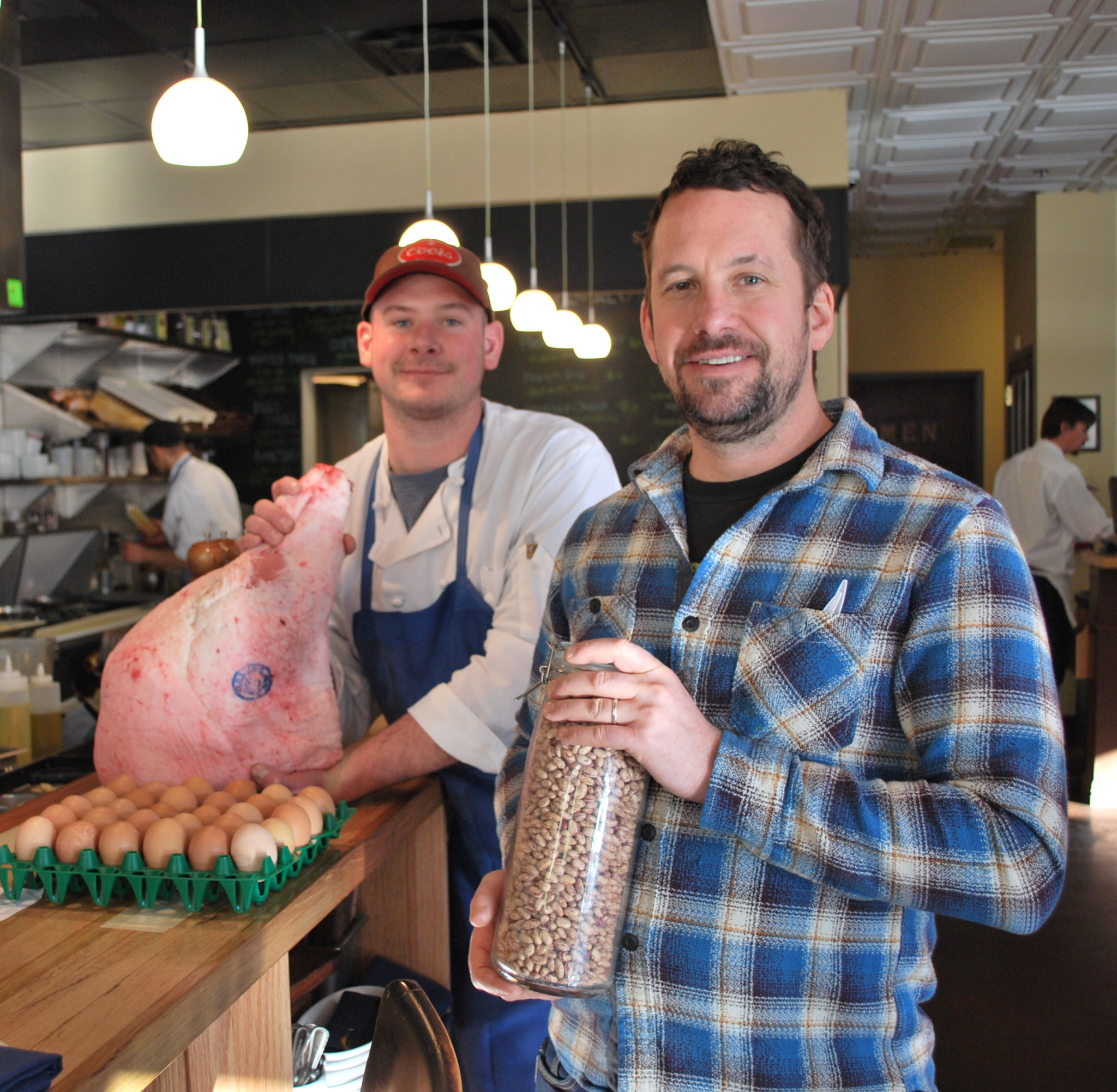
Executive Chef Jamison Frank with Owner Ryan Louder of Copper Onion on 111 East Broadway. Favorite indredients: Burkshire/Duroc pig, Red Sex links eggs and Durham beans from Twin Falls Idaho

This hardcore emphasis on using ingredients from local providers is causing a shake-up in Salt Lake City’s restaurant marketplace. In a few restaurants, their commitment is placing giant distributors like Sysco on the sidelines and sometimes cutting out the distributor and middle-man altogether; some chefs and restaurant owners are going so far as to build relationships directly with farmers,  to raise crops and livestock specifically for their restaurant.

The Copper Onion

Ryan Louder opened the Copper Onion in downtown Salt Lake City in March 2011. The crowds flock to Copper Onion for their wonderful brunch, amazing pork chops, burgers, fish and fresh soups.

“I get my eggs and pork from Christiansen Farm [out of Vernon, Utah]. I know the man who is feeding my chickens and my pigs, and I can trust that he knows what he is doing,” says Louder. Farmer Hans Christian Christiansen graduated top of his class in agriculture science from BYU Idaho and his passion extends to the point where he visits his customers once a week in Salt Lake City. Christiansen’s web site now accepts orders directly from the public.

Copper Onion recently invested in purchasing hen houses and chicks for Christiansen to raise hens specifically for Copper Onion’s egg demands. “We go through about 220 dozen eggs per week. We felt like we wanted to have the better eggs and we decided that having our own hens was the best solution. These eggs are very deep, dark, yellow and delicious.” says Executive Chef Jamison Frank. Through careful selection, the chefs at Copper Onion found the chickens that produced the best eggs were Red Sex links and they purchased 500 chicks for Christiansen to raise exclusively for Copper Onion. Frank expects to get about 60-75 dozen eggs a week from their hens once they are full grown.

The same choosiness applies to Louder and Frank’s selection of pigs. These men know their pigs. A large oil painting of a pig adorns the Copper Onion’s front wall. The Burkshire/Duroc pig, they decided, yields the perfect desired combination of fat content and flavor, and they trust their local farmer, Hans Christiansen, will raise the quality pigs that will produce the significant difference required for their signature pork dishes.

ZY Wine and Cheese
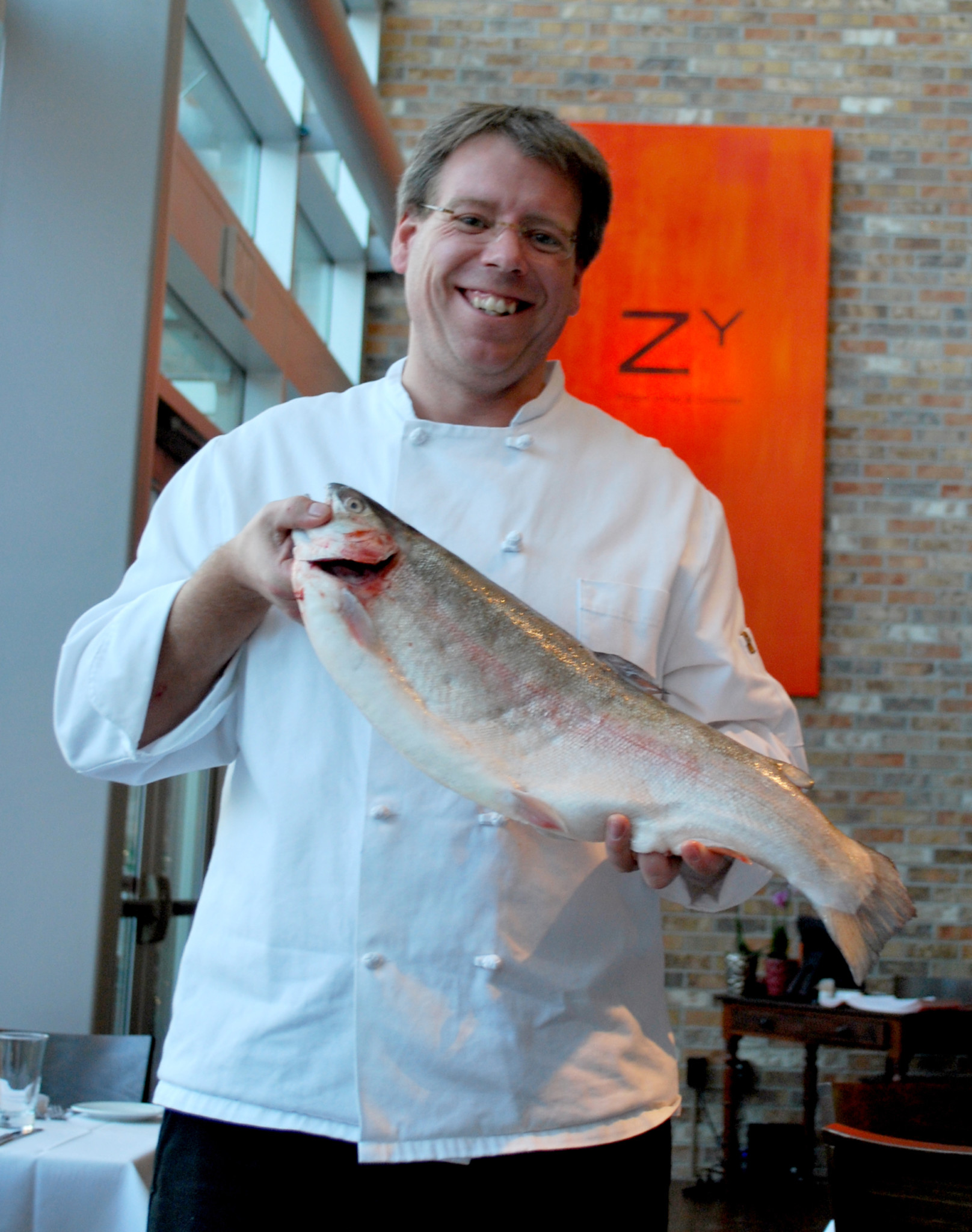
ZY Head Chef Mathew Lake. Favorite ingredients: Oregon Steelehead trout, Beehive Cheese Company's Teahive, Nieman Ranch short ribs

Head Chef and owner of ZY Wine and Cheese Mathew Lake has a similar affinity for local providers. When asked about his favorite ingredients, he raves about Beehive Cheese’s latest award winning variety. “Its called Teahive, and I’m just in love with it. I think I like it even more than their Barely Buzzed cheese.” Lake adds that Utah is no longer a little league producer of fine products. Companies like Beehive Cheese and Creminelli Sausage are big suppliers, whose products are distributed all around the U.S.
Besides cheese, Chef Lake adds that another of his favorite ingredients is 13-pound Steelhead Trout, caught off the coast of Northern Oregon. He says the fillets are beautiful and the flavor is rich without being as oily as salmon.
Asked why he decided to relocate from New York to Salt Lake City to start his restaurant, Lake explains “My restaurant is jam packed with quality local food items that I first saw at he local Farmers Market. Some people thought I was crazy to open a fine dining restaurant during the recession, but I felt confident that the demand was there.” It looks like Lake was right, his first six months in business have been successful.

Omar’s Rawtopia

Omar’s Rawtopia Chef Adrian Raigne. Favorite ingredients: fresh tumeric, fresh, organic young coconut, Braggs unflitered apple cider vinegar.

Omar’s Rawtopia in Sugar House has realized incredible growth and success despite their niche offerings: raw, vegan salads, sandwiches and wraps with a Middle Eastern flair.
Omar Abou-Ismail learned how to prepare raw, organic food when his father was ill, and in so doing, developed a passion for using only raw ingredients to create meals. Chef Adrian Raigne prepares the food daily while Omar develops recipes.  Raigne says that his favorite ingredient currently is turmeric. “It’s just so delicious in so many different foods and it has many beneficial properties for your health.” Second, is young coconut which  they buy from a supplier who can provide the freshness they need to use the coconut properly. Third on the list is Bragg’s organic, unfiltered apple cider vinegar. Raigne addes “Omar raises a lot of the ingredients in his huge backyard garden. He composes all of the scraps from the restaurant back into his garden. He grown huge tomato plants and all sorts of greens in the summer.”
The localvore food movement is having a very positive impact on local farms. As urbanites come to respect their local farmers more, they are considering the impact that suburban sprawl and poor land use is having on their farmer’s ability to produce the food they demand. For more on this read Utah Stories’ extensive series of articles on farmer’s market artisans and vendors

, ,


Join our newsletter.
Stay informed.


  • Utah Fits All Scholarship Applications Open Through April 30 for K–12 Students

    Utah families have more learning paths than ever and, increasingly, more ways to make those paths affordable. This spring, the Utah Fits All Scholarship opened  for new family applications on April 1, and the application window stays open for one month. The program is a public K–12 scholarship that provides $4,000 to $8,000 per student,…


  • Left in a Box as a Baby: Trauma, Alcoholism, and Addiction

    A man abandoned as a baby builds a structured life in law enforcement, but unresolved trauma and alcoholism slowly begin to unravel it. His story raises a harder question about how change actually happens.


  • The $7 Million Recruit: How NIL Changed College Athletics Forever

    In 2012, Jabari Parker, a top high school prospect and member of the Church of Jesus Christ of Latter-day Saints, was facing his biggest decision to that point in his life: where to play college basketball. 

    Fans of BYU athletics hoped and perhaps prayed that Parker would pick the school owned by the church he was raised in. BYU was listed as one of his final choices. But he ultimately chose to spend his college years at Duke before attempting a career in the NBA. BYU fans were disappointed, but no one was truly surprised. Duke over BYU was the best choice for a young prospect in 2012. 

    A.J. Dybantsa.

    What changed between 2012 and 2024 when A.J. Dybantsa, the number one high school prospect, chose BYU over every other school? The answer is roughly $7 million dollars. That is what Dybantsa is reportedly making to play basketball at BYU. 

    The deal was supported by Utah Jazz owner Ryan Smith, who met multiple times with the Dybantsa family in multiple attempts to bring the young player to Provo. 

    According to Smith, he had no financial role in bringing Dybantsa to BYU, but the influence of Utah’s most famous billionaire acting as a “booster” or unofficial recruiter certainly swayed the decision.

    Prior to 2021, boosters acting as recruiters was taboo to the NCAA governing body. It was called improper recruiting. But in 2021, California began the modern era of NIL, or the ability of a college athlete to benefit from their name, image, or likeness, when they passed the “Fair Pay to Play Act.” 

    This new law gave college athletes in California the ability to benefit from their NIL, something that was banned in the rest of the country to that point. The NCAA saw that this law would create an unfair advantage for California schools that could now give young athletes the chance to make money off their talent and image while still in college. 

    The NCAA knew they needed to do something quickly, so they rushed through a policy that opened up NIL to all college athletes in the country, and it has been expanding and evolving over the last four years. 

    Grant Duff, who has coached at the University of Utah, Weber State University, and is now the defensive coordinator for Idaho State University, says, “The best part of NIL is that athletes have an opportunity to make good money. The downside comes with the free-for-all that money causes.”

    Dybantsa confers with BYU Head coach, Kevin Young.

    One of the biggest current examples of what a school can do when the boosters are willing to pay for success is Texas Tech University. From 2020-2024, Texas Tech had 34 wins, which works out to 6.8 wins per year with a low of 4 wins and high of 8. Then Texas Tech’s boosters got involved, led by Cody Campbell, an oil industry businessman and Chairman of the Texas Tech board. The football program was given 28 million dollars for NIL with a simple message attached to the large pile of money: Win. And win now. And win they did. 

    By signing NIL deals with athletes in the transfer portal, Texas Tech went from a middle-of-the-pack school in their conference to one of the top 12 teams in the country. They didn’t just win games in 2025, they made many of their opponents look like they didn’t belong on the same field, including the University of Utah and BYU twice. That is what money can buy.

    Continue reading and support independent Utah journalism with a purchase of Utah Stories (Digital + Print) or 3 month free trial (Digital).


  • Cottonwood Heights Corruption Allegations: A Case That Never Reached a Courtroom

    A year ago, we here at Utah Stories recorded a podcast episode that we never published. We were revisiting corruption allegations from ten years ago. We decided not to publish the video, so it sat there on YouTube for nearly 12 months.

    Then somehow the video was published. How? We are not sure, but once it got out there, the comments came pouring in.

    Dozens of viewers, then hundreds, supported the video with their comments on our examination of allegations of police misconduct in Cottonwood Heights. The video recounts how the Police Department was reported by business owners as focusing enforcement on customers of the former Canyon Inn bar. These allegations did not result in a publicly documented, full investigation by Utah’s Justice Department nor the FBI (at least to our knowledge). So why rehash the past?

    We believe the story of The Canyon Inn (and other area business owners) vs. CHPD and Cottonwood Heights Mayor Kelvin Cullimore raises questions about what can happen when allegations surface and do not move forward through a formal legal process with state or federal oversight.

    In 2012, Cottonwood Heights business owners at the mouth of the canyons began publicly objecting to police activity whereby up to seven cruisers were pulling over 711 and Canyon Inn bar customers on their busiest evenings.

    According to those accounts, drivers leaving the bar were frequently pulled over by police and were given DUI tickets, sometimes even after passing a sobriety examination. The volume and concentration of those stops led residents and business owners to complain about the “heavy-handed treatment” of CHPD toward motorists, especially in and around the Canyon Inn and neighboring 711, and eventually the Porcupine Pub.

    Customers responded in predictable ways. Some chose not to return and avoid the area. Others went to different establishments. Over time, the owner of the Canyon Inn, Jim Stojack, stated that his revenue declined by 70% and that he believed police activity near his business was the main contributing factor.

    Utah Stories reported on these concerns by conducting interviews; gathering video documentation provided by those involved; and making public records requests. Through our GRAMA requests, we reviewed DUI citations issued by the Cottonwood Heights Police Department and examined how those cases were resolved in Holladay Justice Court. During that period, we observed a higher number based on our review of DUI cases dismissed in court due to lack of evidence compared to other jurisdictions. One DUI attorney, Tyler Ayers, went on record saying that CHPD was issuing a high volume of DUI citations that were later dismissed.

    That observation raised questions about how cases were being documented and prosecuted. It did not, on its own, establish intent or misconduct, but it became part of a broader set of concerns raised by multiple sources.

    Continue reading and support independent Utah journalism with a purchase of Utah Stories (Digital + Print) or 3 month free trial (Digital).