November brought us the “Holy War,” but the rivalry between Utah’s two biggest universities continues off the field. Find out how each school stacks up in their various academic departments.
by Colby Frazier
Hallowed college sports rivalries, rich with generations of joy, disappointment, obsession and sometimes hate, blanket the American landscape.
Any proper sports fan can rattle off a casual list of the great rivalries: Michigan/Ohio State, USC/UCLA, Texas/Oklahoma, Alabama/Auburn. No doubt, there are fans attached to all of these teams whose love for their respective squad is matched in intensity only in hate for their rival.
So it goes in the Beehive State between the Utah Utes and the BYU Cougars.
Fancied as the “Holy War,” the yearly match-up splits Zion down the middle: a mob of beer-swilling wild men and women on one side, versus a group of rabidly passionate, but clean cut and sober, saints on the other rusbank.net. At least that’s the way many people like to see it.
 The religious undertones, real or imagined, that punctuate the rivalry are hard to ignore. And with nothing less than the legitimacy, real or imagined, of a major world religion on the line, things can understandably get heated.
Past players from both schools have graciously spouted off in infamy to illustrate these points. In 2007, after catching a clutch pass to help lead his team to victory, BYU tight end Austin Collie remarked, to the utter horror of every Utah fan, Mormon or non-Mormon, living and dead, “I wouldn’t say it was lucky. . . Obviously, when you’re doing what’s right on and off the field, I think the Lord steps in and plays a part in it. Magic happens.”
Great Utah quarterback Alex Smith, after being immersed in the rivalry, told ESPN: “I really hate them. Playing in the game helped me understand. They are the most arrogant people. It’s the whole church and state thing. They’re the ‘good kids.’ We’re the ‘bad kids’”
But the intensity that saturates the Holy War inevitably spills over to the schools at large. As a BYU fan pleasantly speeds his Hyundai Elantra down I-15 through Pleasant Grove, bound for an Orem townhouse filled with children, he might spill out a forbidden word or two if he hears a University of Utah professor quoted on NPR’s Science Friday program. Not necessarily because he disagrees with Darwin’s theory of evolution, but because of all the great universities in the world, the interviewer tapped Utah.
The same can be said for Utah fans when BYU gets praise for, well, anything. Regardless of the University of Utah’s recent win, here are some statistics that fans and non-fans can chew on the entire year.
After all, it’s not really who has the best football team that matters. The larger question—one that can’t easily be digested in an afternoon of jaw-breaking football—is who has the better school overall. The emotional stakes of the rivalry are indeed high, and the depths to which it can to sink are indeed low, as illustrated by a recent BYU graduate.
“I don’t like Utah,” former Cougar quarterback Max Hall opined after beating the Utes in 2009. “In fact, I hate them. I hate everything about them. I hate their program, their fans. I hate everything. . . I think the whole university and their fans and the organization is classless.”
Consider the gauntlet thrown down.
Utah and BYU Rivalry by the Numbers
.
 While BYU emphasizes undergraduate studies, offering 190 bachelor’s degrees, Utah has made its mark as a research institution, offering 95 degrees at the graduate level. Student wise, BYU takes the cake with 32,857 students to Utah’s 30,819. The Y trails in graduate students with 3,098 to Utah’s 7,448
Utah and BYU undergraduate Tuition Comparison
 Undergraduate Tuition: At Utah, the price tag is segregated by place of origin. Utahans pay $2,645. Everyone else must pony up $8,313. At BYU, it pays to convert. Mormons pay $2,110 for a BYU education, regardless of where they come from. Non-Mormons, which make up a mere 1.3% of the BYU population, pay $4,420.
U.S. News and World Report put BYU at No. 75 and Utah at No. 129. The magazine based its figures on, among other things, retention and graduation rates and strength of faculty.
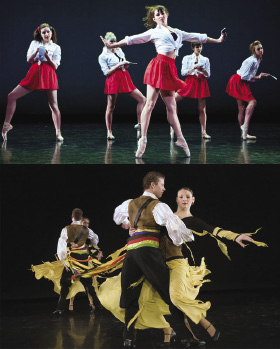 So you think you can dance? Founded in 1951, the University of Utah’s Department of Ballet was one of the nation’s first and offers a bachelor’s and master’s degree in ballet. Brigham Young’s ballroom dance company has claimed 27 consecutive U.S. National Formation Dance Championships.
When it comes to research, Utah, with its sprawling research park and medical school, takes the cake. In 2009-2010, Utah raked in $450.6 million in research grants and awards.
 Meanwhile, BYU is a perennial powerhouse when it comes to one ranking, The Princeton Review’s list of the most “Stone Cold Sober” schools. In 2010, BYU took top prize for the 13th consecutive year.
Last but not least, of the LDS Church’s current crop of apostles, four received undergraduate degrees from the University of Utah, including sitting president Thomas S. Monson. The same number also received degrees from BYU. The tiebreaker, though, goes to the late and much beloved Mormon president Gordon B. Hinckley, who was a Ute.