Amazing Places: A local adventurer reflects on the secret expeditions of the East High Tunnel Club
by Rich Stowell
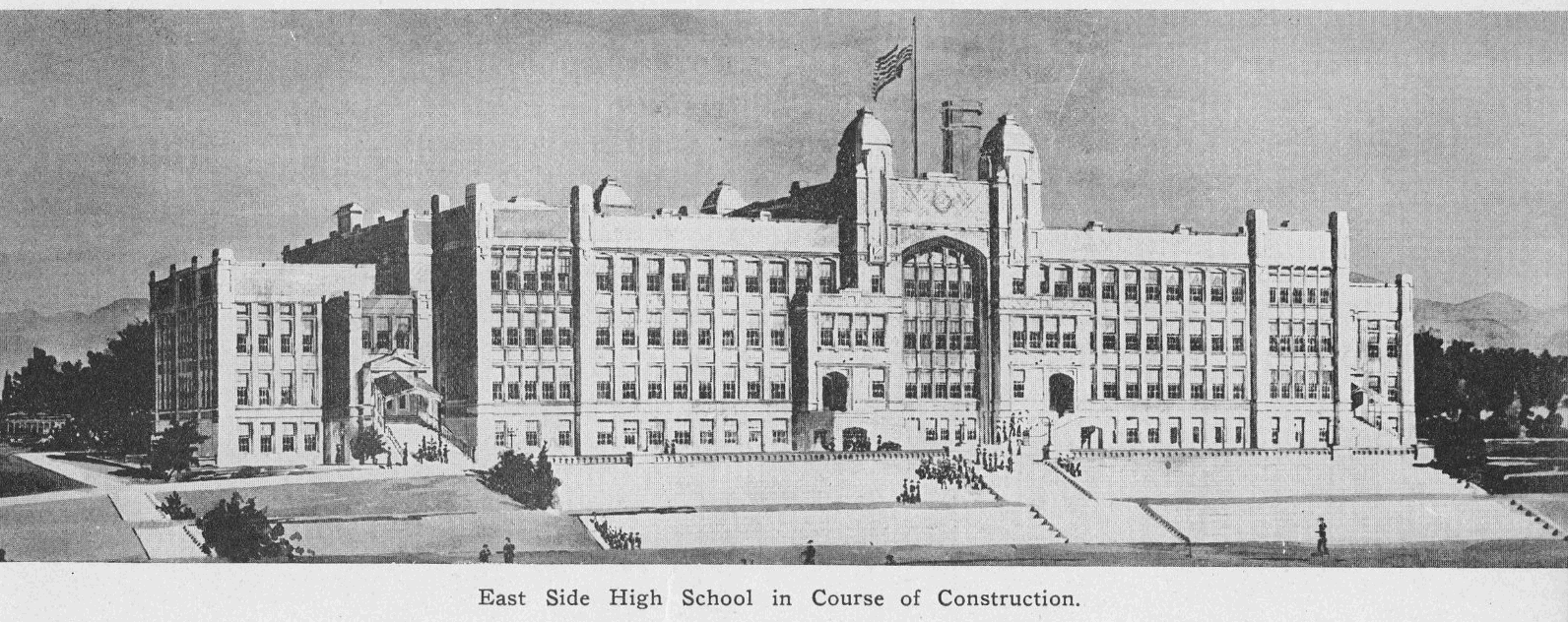
One of Salt Lake City’s most recognizable landmarks has been gone for nearly 15 years, but its memories live on in hearts of thousands of graduates from Salt Lake High School East, built in 1914.
 In the fall of 1990, East was a school in transition, as represented by a group of boys who began their high school careers as freshman that year. The one interest that kept them together was the pursuit of finding the swimming pool in the basement of their grand old schoolhouse.
That fall they formed the “East High Tunnel Club.”
It began with a rumor, promoted in part by Principal Kay Peterson. Many students claimed to have knowledge of the pool, but it was more than likely an entertaining bit of urban lore. The six frosh were too unsophisticated to know any better, and they set out to prove its authenticity.
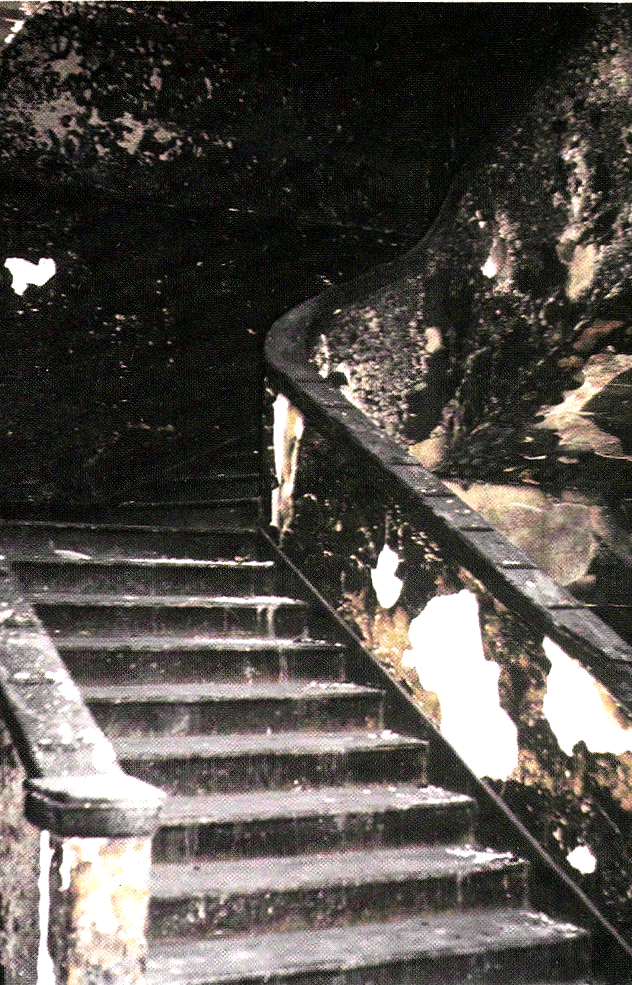
Their first milestone was the discovery of burned-out stairwells. No secret to most seasoned people on campus, the four unused, sealed off sets of stairs motivated the young men, who quickly figured out how to gain access to the few doors that led to them.
An arsonist’s fire in 1972 gutted much of the main building, leaving the marble stairs a sooty mess. Modern fire codes required the school district to construct a stairwell on the exterior of the building, which could be closed off to prevent flames from spiraling upward.
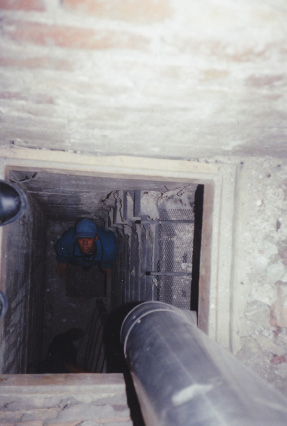
For the members of the Tunnel Club, the stairs were a link to the past, and a passage to their ultimate aim—a hole blasted in the concrete at the bottom of one set of stairs led to a network of tunnels under the main building and in the science wing, which had been added in 1964.
By their sophomore year, the tunnelers had discovered passages and caverns in the ancient structure that most students never imagined. However, the fabled pool remained elusive. Secrecy, at this point, was paramount, even though they had registered the club with the school. The stated aim was to “explore the caves in and around the Salt Lake Valley.”
School hours afforded little time for Tunnel Club activities, so members began breaking into their school at night. Keys were acquired surreptitiously; two students began to master the art of lock picking; and routes were planned to avoid nighttime motion detecting sensors.
Tunnel Clubbers became experts navigating the subterranean corridors, and they continued to find things that amazed them, hoping to get nearer to the swimming pool with each mission.
Of course secrets, to high schoolers, are no good unless one can share them, so the Tunnel Club began inviting classmates on their midnight expeditions. Crowds composed of 20 or more would gather, including student government leaders, upperclassmen, and kids from the most elite of the community.
By their junior year, the pragmatic implications of breaking into the school became clearer. Before the ubiquity of computer systems in classrooms, simple paper gradebooks contained records that could determine academic futures. The situation and its possibilities were not lost on the students.
On one occasion, students in the choir had signed up for bus assignments for an out-of-town trip. After class one day, a girl had crossed out the name of a tunneler to give herself a more favorable bus with her friends. Breaking in one night to the choir room, the Tunnel Club members discovered the switch and rectified it, putting the offending girl on the third bus, with none of her friends.
It was also apparent that the Tunnel Club had quite a bit of social cachet, and members were known to take dates there to impress them. It seemed to work.
Nighttime outings revealed old fallout shelters, secret passageways to parts of the building long ago gone into disuse, and clever observation points into classrooms through grates and vents.

By their junior year, the ring of Tunnel Club confederates was huge. Some 30 students had gained unauthorized entry into the school at some point. School officials soon suspected something was amiss and installed a motion-sensing, infrared camera in one of the underground thoroughfares. Culprits were caught on video tape in clear view, and the ring was finally exposed. Perpetrators included students at the highest levels of student government, athletics, and academic honors.
After that, the Tunnel Club ceased official operations. But the original six continued to make forays into the school, their eye on their original objective—the swimming pool. Time was running out, and they still hadn’t met their goal. During their senior year, in the spring of 1994, demolition crews began knocking down the walls that hid so much.
By 1996, all parts of the school built before 1975 had been razed, and any firm evidence of the swimming pool ever existing with it. The boys have all moved on—one is a teacher, another a chief accountant for a well known online sales firm. There is a software engineer for a leading developer, and a US Special Forces Soldier. Some of their kids will be entering high school soon.
They all still have vivid and fond memories as members of the East High Tunnel Club, when they learned a lot about friendship, themselves, and the historic, noble building where they all went to school. §
Editor’s Note: Utah Stories does not condone nor recommend that high school students search for tunnels under their gymnasium and form clubs to that effect.*
*Unless you don’t get hurt and can get away it—then it’s totally fine.