Local Spotlight

Five Utah Hot Springs Reviewed

If you’re looking for a departure from your customary pastimes, consider taking in some of Utah’s geothermal mineral waters.

|


Where to go and what to avoid in finding the best geothermal natural spa treatments

by Paige Wiren

If you’re looking for a departure from your customary pastimes, consider taking in some of Utah’s geothermal mineral waters. Offered here is a taste of the flavor of accessible non-commercial and commercial soaking experiences along the greater Wasatch Front.

Ogden River Springs

A path leads from the roadway shoulder at the mouth of Ogden Canyon down to two hose-fed, rock tubs built alongside Ogden River in a surprisingly lovely setting, given its proximity to the road. The river provides not only a peaceful rushing sound (drowning out the sound of canyon traffic), but also offers a cold plunge opportunity. Buzz from locals is that you need to be on creepy-people alert if you choose to visit after dark.
 

Stinky Springs

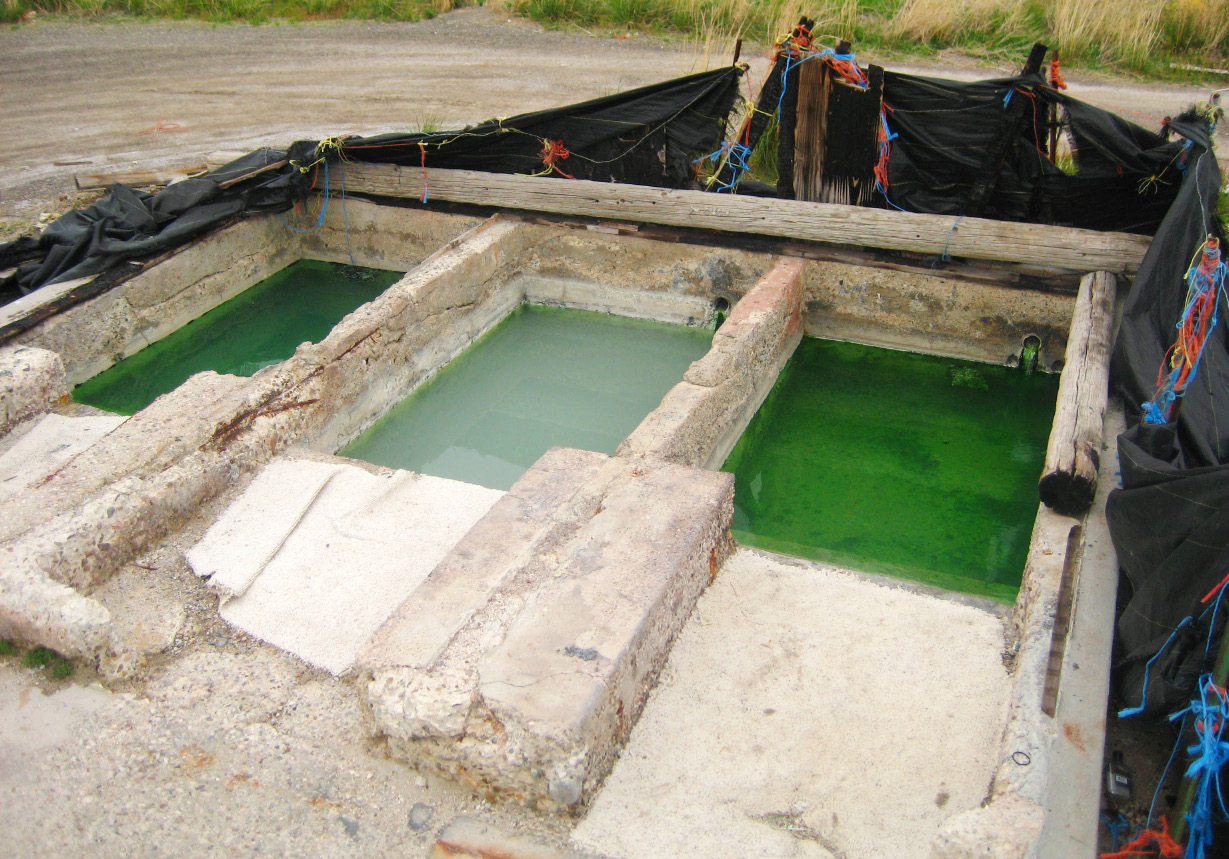
This destination, noted in Hot Springs of the Southwest, can be nixed from any itinerary. Eight-ish miles west of the I-15 Corrine exit, what was once a reputable soaking opportunity now looks like a post-Apocalyptic Hollywood movie set, complete with blood-thirsty mosquitoes. The noxious level of sulfur rising out of the pathetic and forlorn rectangular concrete tubs compounds the overall repugnant experience.

Diamond Fork Hot Springs

Hike and then soak at these sulfurous springs. After ascending some 2.5 forested, creek-side miles, the trail opens to the thrilling sight of a significant waterfall. Three sets of simply constructed, deliciously hot soaking pools border Fifth Water Creek by the falls. Here you will encounter a diverse range of public regulars, from Boy Scouts to the Burning Man crowd. Soaking in the buff, though not officially-sanctioned is, in this magical forest setting, still an option exercised by some naturists.

Midway Local Springs

Located just outside Midway proper, very hot piped-in water flows through a relatively long, clear, shallow, gravel-bottomed pool with dipping access on one side, and dense thickets of willows and cattails along the other. This soak is a quick and easy, right-off-the-road, natural experience; though depending on the eco-consciousness of previous visitors, the surroundings can feel bucolic and pristine, or lamentably unsophisticated.
 

crystal springs

Crystal Hot Springs

Six bucks gains you entrance to a year-round public soaking and swimming facility, a destination popular with families, locals and those seemingly afflicted. The on-location presence of both hot and cold springs yields various, regulated temperatures in different pools and tubs. The lodge building houses old fangled lockers and changing rooms. Similar to a conventional public pool facility, the vibe here is fun-with-rules.

The Homestead Crater in Midway

What looks like a 55-foot high, earthen igloo is actually the accumulated result of thousands of years of deposited limestone covering a 65-foot deep pool; a mineral-rich pool so blue and warm it’s hard to imagine you’re not in the Caribbean. Swimming, or soaking for a casual, pre-reserved hour, is open to the paying public. Expect to share your out-of-the-ordinary swim with scuba classes.

Zermatt Resort “Geo-thermal Hot Pot”

There’s potential for disappointment between the Zermatt’s website geo-thermal page presentation and the actual experience. $10 buys you a reserved, 30-minute time slot of bobbing (life jacket required) in a tepid crater spring that resembles a giant barnacle top around which resort developers have built the mini-golf course. The superlative staff treats you like a celebrity; the soak, however, is B-rate.


Midway Crater

Mystic Hot Springs

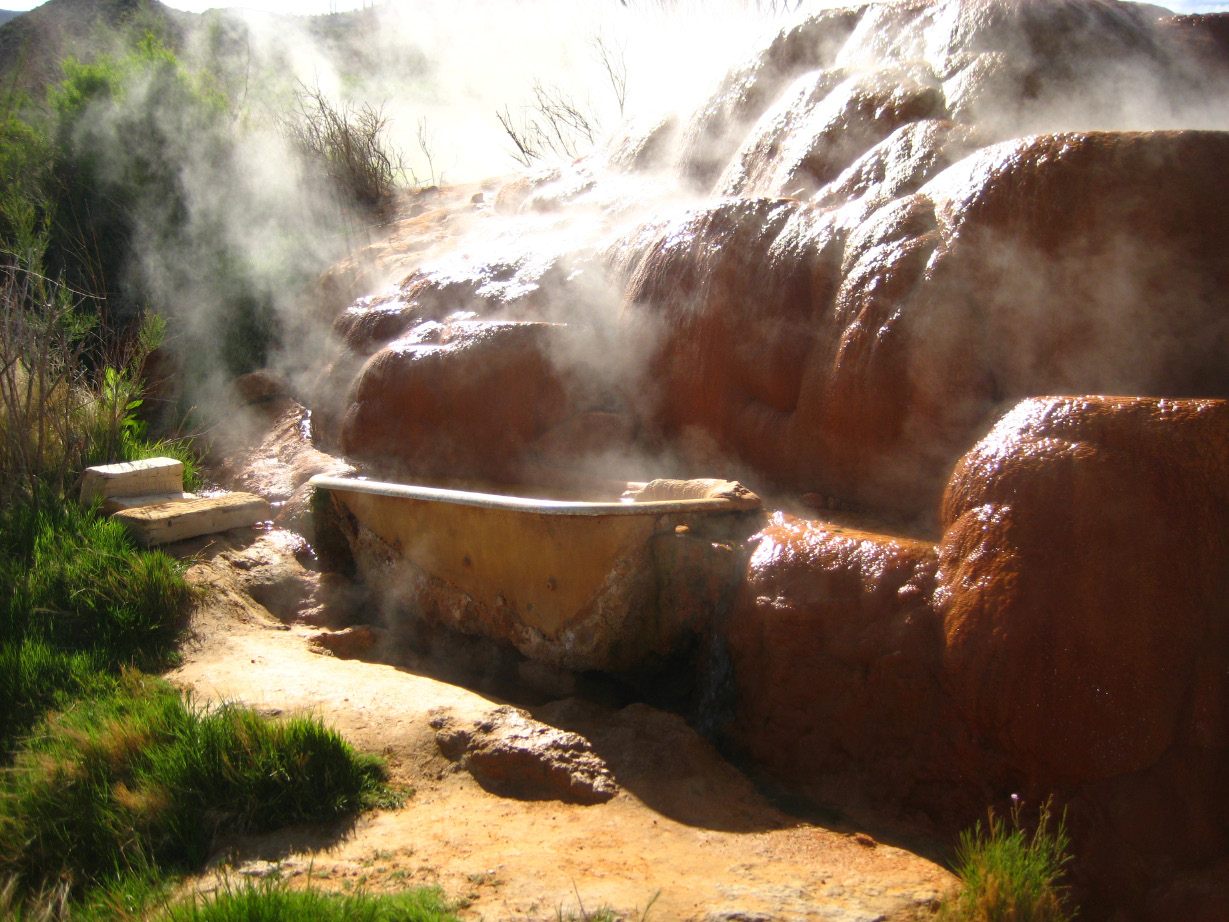
Soak away urban pretense at this unaffected and roughly tame Monroe, Utah property. Bathe in steaming mineral water and spend the night in an authentic pioneer cabin, a converted school bus, or your own tent. Owner/artist Mike Ginsburg’s pragmatically liberal, creative vision attracts international as well as homegrown customers to come relax at any hour of the day in either the spacious, communal soaking reservoir or in one of the strategically placed, hillside claw-foot bathtubs.


, , ,


Join our newsletter.
Stay informed.


  • Artist Kate Kilpatrick Brings Utah’s History to Life Through Murals

    “I think we’re all interconnected; as individuals as well as societies,” Kilpatrick notes. Her work showcases those connections exuberantly, and whatever scale she’s working on, you can bet that in terms of energy and spirit, she’s painting large.


  • Utah Youth Ice Climbers Win World Championships Thanks to Millcreek Common Wall

    Utah is home to two new World Champion youth ice climbers, and the ice climbing wall at Millcreek Common is getting credit for helping them win. 


  • Why Most People Stay Stuck in Business and What It Takes to Move Forward

    Every so often, you meet an immigrant who came here with almost nothing and managed to build something exceptional.

    Prakash Shah is the kind of man who has spent enough time around risk that he no longer treats it like an interruption.

    Today, he works in business brokerage and advisory, helping owners sell companies, helping buyers decide whether they should step in, and, when the fit is right, helping connect those buyers with private equity. He works in a world of valuations, leverage, due diligence, and hard questions that most people would rather postpone. He also operates in Utah real estate and has built a career around seeing value before it is obvious to everyone else. That is who he is now. What makes him interesting is how early that instinct started to form, and how little his life resembles the way most Americans are raised to think about comfort, career, and security.

    He grew up in Nepal in a boarding school system that would feel severe to many Americans. He was an only child, yet he saw his parents only twice a year for twelve straight years, until high school graduation. He lived inside routine. He shared space with boys from different social classes and different family circumstances. The school was structured enough that money did not buy you any special standing once you were inside. Everyone followed the same rules. Everyone was subject to the same discipline. In his case, it was an army school. Everything was measured. Everything was scheduled. In that kind of environment, you do not build your life around preference. You build it around adaptation.

    That contrast matters.

    A lot of American children are raised to search for what fits them. What are you passionate about? What do you enjoy? What feels right? Those are not bad questions, but they can create a habit of waiting for life to align itself before action begins. Prakash learned something else much earlier. He learned that life often does not align itself first. You enter the room as it is, you deal with the people in it, and you figure out how to function without making your comfort the center of every decision. He said that one of the biggest lessons from those years was tolerance, the ability to live with people from all walks of life and genuinely learn to get along with them. That is not a soft value. In business, it turns into resilience. In negotiation, it turns into patience. In career terms, it turns into range.

    When he came to the United States over 25 years ago, he did not arrive with the kind of runway that allows for a prolonged identity search. He came with two suitcases and enough money for one semester. He went to Hunter College in New York City, then to NYIT near Central Park, studying media and then media and technology management. He also studied psychology. Those details matter because they show something about his mind. He was interested in people before he built a career around deals. Even then, what attracted him was not technical prestige. It was understanding motives, behavior, and how people reveal themselves.

    But New York is merciless toward vague ambition. It demands payment in rent, transit, food, and time.

    Prakash worked constantly. He took multiple jobs. He paid tuition, paid rent, and skipped most of what Americans imagine as college life. There were no romantic years of drifting from café to concert to self-discovery. He talked about not having the luxury of dates, travel, or finding himself. He was working. Even laundry was not a small detail. In New York, he pointed out, you do not just throw clothes in a machine at home. You haul them to the laundromat, count quarters, and measure what is necessary. He also described distraction in a way that most native-born Americans probably do not think about. For immigrants, distraction is not always pleasure. Sometimes distraction is the constant pressure of competing needs. Tuition or rent. Food or savings. A better coat or another month of making do. He was not romanticizing the struggle. He was describing the arithmetic of it.

    That arithmetic did not make him cautious. If anything, it did the opposite.

    While in college, he had the option of safer analytical work. Instead, he took a sales job with Time Warner Cable that sent him into the South Bronx from 6 p.m. to 10 p.m. to knock on doors. He is not a physically imposing man. He knew exactly what kind of neighborhoods he was walking into. He described apartment buildings where people kept pit bulls, where tension was normal, where one mistake in tone or timing could end a conversation immediately. For most people, that kind of job would have been something to survive and forget. For him, it became a school in human behavior. “It’s not about talking… it’s about listening,” he said.

    One story from that period says almost everything about how he operates. He knocked on a door one night around 8:45 and found himself facing a huge man with a gun on the table, pit bulls nearby, and a half-eaten pizza in front of him. It had all the ingredients of a very bad scene.

    Continue reading and support independent Utah journalism with a purchase of Utah Stories (Digital + Print) or 3 month free trial (Digital).


  • Ancient Pyramid Discovered in Sugar House Park, Salt Lake City

    A Salt Lake City resident says he may have uncovered what he believes to be a buried structure beneath a well-known hill in Sugar House Park, raising questions that have drawn both curiosity and skepticism.