

For about five months each year, Utah weather favors outdoor dining, but Salt Lake City restaurateurs must pay annual fees so their customers can enjoy that option.
Salt Lake City charges annual fees for restaurants that use public sidewalks or other city-owned space for outdoor dining, with permanent installations subject to a formula tied to property values. Utah’s Division of Alcoholic Beverage Services also requires permits for alcohol sales in those temporary spaces.
The wild card in this mix comes from property values that fluctuate with the real estate market. In Utah, land values have shot up due to surging population (driving demand) and significant housing shortages (shrinking supply).
Stretched Thin
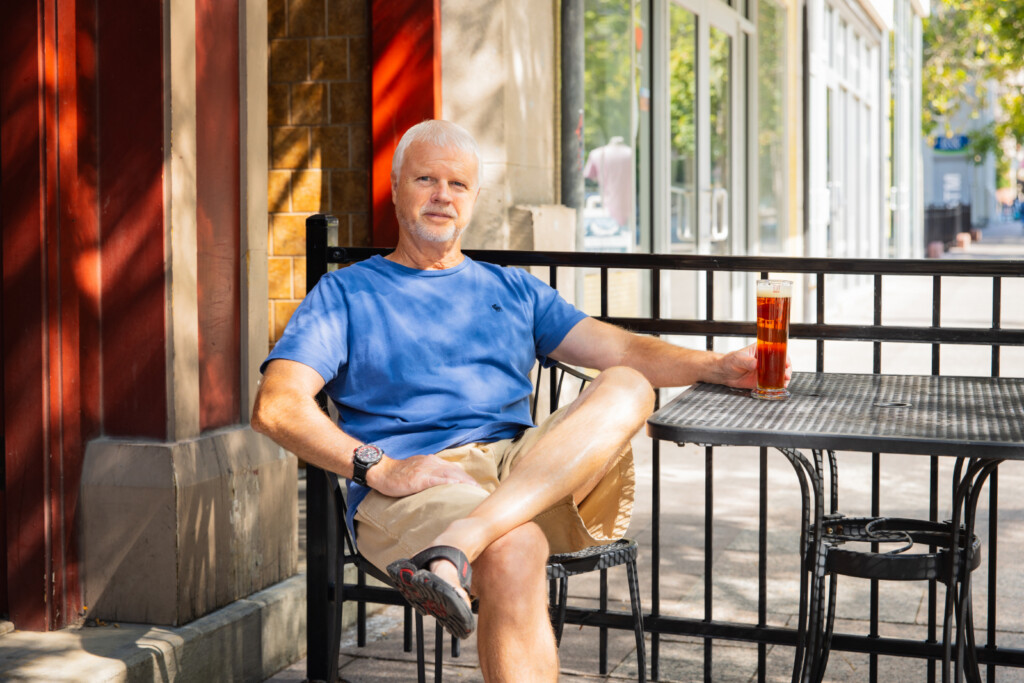
The Beerhive Pub at 128 S Main occupies space in a historic building that dates back to 1889. Owner Del Vance opened the bar and eatery in 2009. For years, the outdoor fee for his four tables resting on public space hovered around $600 to $700, he said.
“And then this year they come out and tell me that it’s going to go up to $2,000 — and we haven’t extended the size of the patio or increased seating or anything,” Vance said.
Vance asked the city how they justified that dramatic increase. The answer he got was that the property value of the sidewalk had gone up.
“When you’re talking to a bureaucrat, all they talk about is, well, the sidewalk is more valuable now,” Vance said, “so we need to pay more money for it, even though it’s the same sidewalk that we’ve been using for 20 years.”
Profit margins for restaurants have shrunk in the current economy, so adapting to the spike in fees has not been easy.
“Either you have to cut some of your costs, which, when you’re purchasing food and alcohol, you can’t do. You don’t set that price,” Vance said. “So you have to increase the price on that . . . or just operate at a smaller profit margin and hope that your costs don’t keep going up.”
A couple of blocks south, at 325 S Main Street, sits the White Horse Spirits & Kitchen. Since 2017, Jason LeCates has co-owned the iconic pub that offers high-end menu options along with a broad selection of bourbons and whiskeys.
LeCates and his partners are no strangers to hardship. As members of the Bourbon Group, they owned and operated five Salt Lake City pubs. But two — Whiskey Street and White Horse — went up in flames in August 2025, with Whiskey Street sustaining the most damage. White Horse reopened in January 2026.
In its current configuration, White Horse features a smaller outdoor dining space with two outdoor tables, whereas before the fire, it had room for six.
“It had to be attached to the building,” LeCates said of the new layout. “They tried their best to allow us to grandfather the old patio in, but then it was determined that it wasn’t in compliance with our bar license.”
Their current annual charge for the two-table layout is about $1,200 or $15 per square foot, LeCates said, acknowledging that they have seen a fee increase.
But LeCates felt the fee is worth paying in order “to have that little extra space.”
“We like to contribute to the downtown. Having some outdoor dining helps the street have some energy, so we’re happy to help contribute a little bit to that,” he said.
Right now, their biggest challenge, he said, comes in the form of rising food and drink expenses, and LeCates worries that passing those costs on to the consumer would price some of them out.
“As the cost of goods have gone up, we’re trying to reduce our profits a little bit so that people don’t get too discouraged and feel like they can’t afford to go out to eat,” LeCates said.
The City’s Stance
Sofia Jeremias manages communications for Salt Lake City’s Community & Neighborhoods department. By email, she conveyed the City’s response to several questions.
Jeremias said that state law gives cities the authority to manage public property, with the goal of delivering the “highest and best economic return to the City.”
“We are not aware of a time when the City did not charge for the use of the public right of way, except in cases where there is a clear public benefit,” she said.
For businesses that have fixed elements — such as fencing, railings or tables bolted to the ground — the City requires a revocable permit or lease for the public space they occupy.
That annual fee varies according to the public land’s assessed value, and gets converted to cost per square foot of the outdoor dining space.
“That amount is then multiplied by 8% to calculate the annual fee,” Jeremias said. A 3% escalation fee is typically tacked on, along with insurance and indemnification requirements.
Revenue from these fees flows to the City’s general fund to help pay for department operations and personnel expenses, Jeremias said.
Are They Burdensome?
Melva Sine is the longtime leader of the Utah Restaurant Association, a non-profit trade organization that advocates for the state’s food service and hospitality industry.
“Restaurants should be able to offer outdoor patio services,” Sine said, acknowledging that it sometimes means taking advantage of a wide public sidewalk to do so. “We feel like everyone should be treated equally, and they should have access to having these additional seats and spacing available to them.” But Sine questions whether the City’s fees are justified. “It seems like they should already be paying that when they’re paying their taxes, right?” Sine said.
She also relates to the meager 2 to 4 percent profit margins that most eateries experience after taxes. “It’s a very intense business . . . we’re losing restaurants that we’ve known for a myriad of years,” Sine said. “And so, I think we have to consider what we can do to help our restaurants.”
Sine described restaurants as the “backbone” of Utah’s economy, serving as the fourth largest economic engine in the state.
“It’s expensive to buy chairs and tables and whatnot” for outdoor dining, Sine said. “You don’t need to add a fee on top of that if I’m going to want to use outdoor dining or space on a public sidewalk.”
Of course, sidewalk width must be taken into account.
“We certainly don’t want to inhibit pedestrians walking on the street,” Sine said. “But at the same time, if we have streets that could accommodate that and restaurants want to pursue that, they should be able to . . . without having to pay additional fees.”
Feature Image: Del Vance, owner of Beerhive Pub, on his patio. Photo by Dung Hoang.
