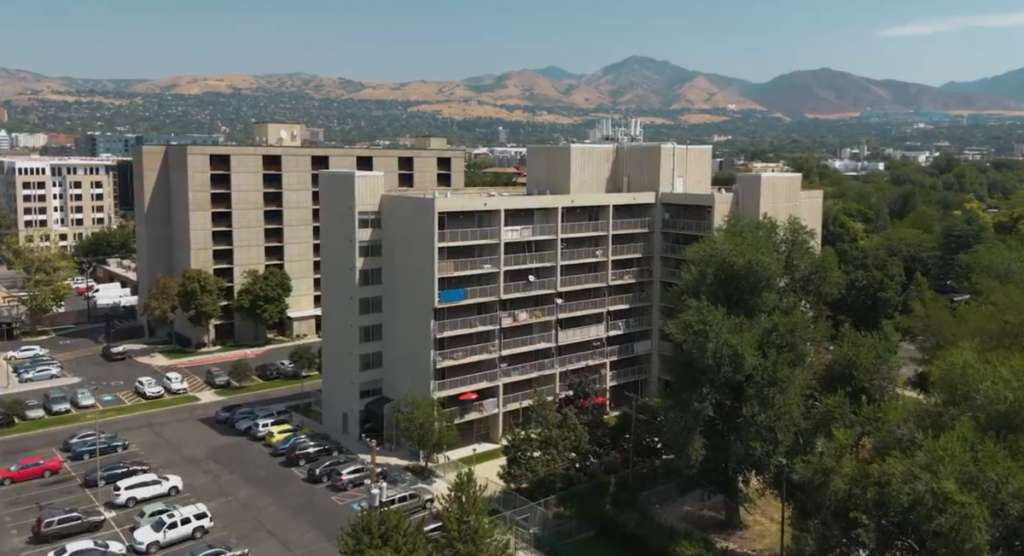
In March 2025, Phillips Plaza’s longtime building manager, Kris, retired. She was replaced by Daniella Delgado, who began managing the downtown Salt Lake City senior housing complex on April 1, 2025.
Tenants soon complained that they were unable to meet with Delgado or that their concerns were not being addressed. And the concerns were significant: tenants said the building went without hot water for an extended period during the winter, wellness checks on residents recovering from surgery or suffering from illnesses were discontinued, and maintenance issues went unaddressed.
Shortly thereafter, Mike Martinez, the longtime maintenance man, retired.
Tenants appealed to Delgado’s direct supervisor at the Housing Authority of Salt Lake City (HASLC), Tasha Nelson, regarding what they described as Delgado’s lack of responsiveness. Residents say their appeals produced little or no action.
Residents also alleged that Delgado would close her blinds and lock her office door during business hours. One resident told Utah Stories that Delgado was witnessed leaving a bar during hours when she was supposed to be working.
On May 9, Phyllis Harries sent a petition to the HASLC Board of Directors signed by 35 tenants requesting that the new manager be removed and replaced.
Phillips Plaza resident Susan Bigelow then sent numerous emails to upper management and the HASLC Board warning about serious safety concerns, including the discontinuation of wellness checks—even for tenants suffering from debilitating illnesses. Bigelow also reported that “street people were entering into the building to use the bathrooms and hang out.”
Another tenant, Robert Gordon, told Utah Stories that homeless people using drugs were sleeping in the building’s fire escapes.
Emails reviewed by Utah Stories show that HASLC CEO Dan Nackerman repeatedly told Bigelow to “give Daniella a chance” and said that many of the residents’ complaints had not been corroborated or substantiated.
On June 27, 2025, Bigelow sent another email to the HASLC Board of Directors. Among the concerns she listed was: “Allowing street people to use the bathroom.”
Additional concerns arose when residents alleged that Delgado was allowing people they described as her “cousins” to enter the building, use its bathrooms and “hang out.” Some tenants told Utah Stories they came to believe that Delgado was more concerned about helping unauthorized visitors than addressing the needs of residents.
One Phillips Plaza resident also alleged that drug deals began taking place inside the building and that Delgado was involved in a personal relationship with a resident whom tenants accused of dealing drugs. That resident, whom tenants identified as Mark, was eventually evicted for drug-related violations, according to residents interviewed by Utah Stories.
Ralph Hofmann, a 72-year-old senior whom several residents described as having limited intellectual capacity, moved into Phillips Plaza around November of 2025.
Several months after Hofmann moved in, Bentley Scow—a convicted felon who had recently been released from prison under court supervision—began staying in Hofmann’s apartment as an unauthorized tenant. According to subsequent police records, Hofmann and Scow were reportedly involved in a sexual or romantic relationship.
Utah Stories verified that all residents residing at Phillips Plaza are required to be included on the lease and undergo a background-screening process. Residents say Scow was never added to Hofmann’s lease and was nevertheless able to use Hofmann’s key fob to freely enter and leave the building.
Residents told Utah Stories that Scow was actively using spice and described him as “mean and scary.” Tenants increasingly suspected that Scow was taking money from Hofmann and physically abusing him.
Hofmann began asking other tenants to loan him five dollars and started collecting extra “treats” when they were available. One of Hofmann’s closest friends became concerned that his physical condition was deteriorating.
Bruises began appearing on Hofmann’s face, according to residents. As his appearance and health deteriorated, one friend began purchasing groceries for Hofmann and Scow.
Phyllis Harries said she made a final appeal to Delgado:
“You need to get that man out of here. We are scared of him, and he can’t be in here!” Harries said as usual nothing was done.
Several tenants also told Utah Stories that Delgado told them: “I’m here for the building, and I’m not here for the tenants.”
![Susan Bigalow [right] and Phillis Harries (left), residents at Phillips Plaza. in Salt Lake City.](https://utahstories.com/wp-content/uploads/2026/09/Susan-Bigalow-right-and-Phillis-Harries-at-Phillips-Plaza-489x400.png)
On May 20, Utah Stories conducted on-camera interviews with several Phillips Plaza tenants about their safety concerns and the discontinuation of wellness checks. Residents also complained about Delgado’s decision to take keys away from tenants who organized activities including hot dog nights and bingo nights and managed access to the computer room.
That same day, Utah Stories spoke with HASLC supervisor Tasha Nelson, who told us she would get back to us regarding the concerns.
Five days later, Ralph Hofmann was murdered.
In the early morning hours of May 25, Bentley Scow killed Hofmann using what police described as “blunt force and asphyxiation.” One neighbor said he had previously heard loud screaming and yelling coming from the apartment but had become accustomed to hearing the two men fighting.
According to police, Scow punched Hofmann in the head multiple times, strangled him with his forearm and ultimately used an electrical cord. Police said the killing took place over a period of hours.
After Hofmann was dead, Scow attempted to dispose of his body. Hofmann’s body was eventually transported away from Phillips Plaza and discovered near 1700 South and 300 East.
Scow was later detained in connection with an alleged shoplifting incident and confessed to killing Hofmann, according to police records.
The arrest affidavit contains a particularly chilling account of Scow’s statements to detectives:
“Mr. Scow said that this was his first murder and it was a rush.”
The affidavit further states that Scow described in detail how long it took Hofmann to die, telling investigators that the process took hours.
Local news organizations extensively reported Hofmann’s murder and Scow’s confession. But what received far less attention was the location where the events leading to Hofmann’s death occurred—and the months of safety complaints Phillips Plaza residents say preceded the killing.
A few days before the murder, Delgado had been transferred from Phillips Plaza to nearby Romney Plaza, another HASLC property. She began managing Romney Plaza after switching positions with its previous manager.
Residents at Romney Plaza subsequently raised new complaints. These included serious allegations that drug trafficking was occurring inside the building and that one apartment was being used in connection with methamphetamine activity.
Tenant association manager Nancy Andersen told Utah Stories that residents became increasingly concerned about suspected drug activity inside the facility. Andersen said residents believed methamphetamine was allegedly being used or produced in one apartment and reported that pets in neighboring apartments became ill.
These allegations have not been independently confirmed by law enforcement.
Today, Daniella Delgado no longer works at Romney Plaza. According to HASLC, Delgado has been placed on administrative leave.
Outstanding Questions
- Why did HASLC fail to adequately respond to safety concerns brought to its attention by Susan Bigelow, Phyllis Harries and other residents through emails and a petition bearing 35 tenant signatures?
- Why did HASLC continue to employ and transfer a building manager after residents repeatedly complained about her handling of safety and tenant concerns?
- Why was Bentley Scow able to stay in Ralph Hofmann’s apartment without being added to the lease or subjected to the screening process required of residents?
- Why was Scow, a convicted felon who was under court supervision, apparently able to stay in a vulnerable senior’s apartment without intervention from building management or HASLC?
- Why, after months of documented complaints and the eventual murder of a Phillips Plaza resident, was the building manager transferred to another property housing vulnerable residents rather than removed from management duties?
- Why did HASLC wait until after Hofmann’s murder to hire security officers, despite residents repeatedly warning that unauthorized people were entering Phillips Plaza?
- What did HASLC know about Ralph Hofmann’s vulnerability? Several tenants told Utah Stories that Hofmann had limited intellectual capacity. Who, if anyone, was responsible for monitoring his welfare? And what action was taken when residents reported that another man was staying in his apartment and allegedly abusing him?
- Why have residents reported living through the summer with temperatures approaching 90 degrees inside their apartments rather than having the building’s central air-conditioning system replaced or adequately repaired?