When we at Utah Stories started talking to people on the streets in Salt Lake City, We thought we had a general sense of how those stories went. One assumes there’s a predictable pattern. A bad break here, a bad decision there, and eventually it leads to where they are. Homeless, some of them involved in criminal activities.
But the more people you talk to, the less that holds up.
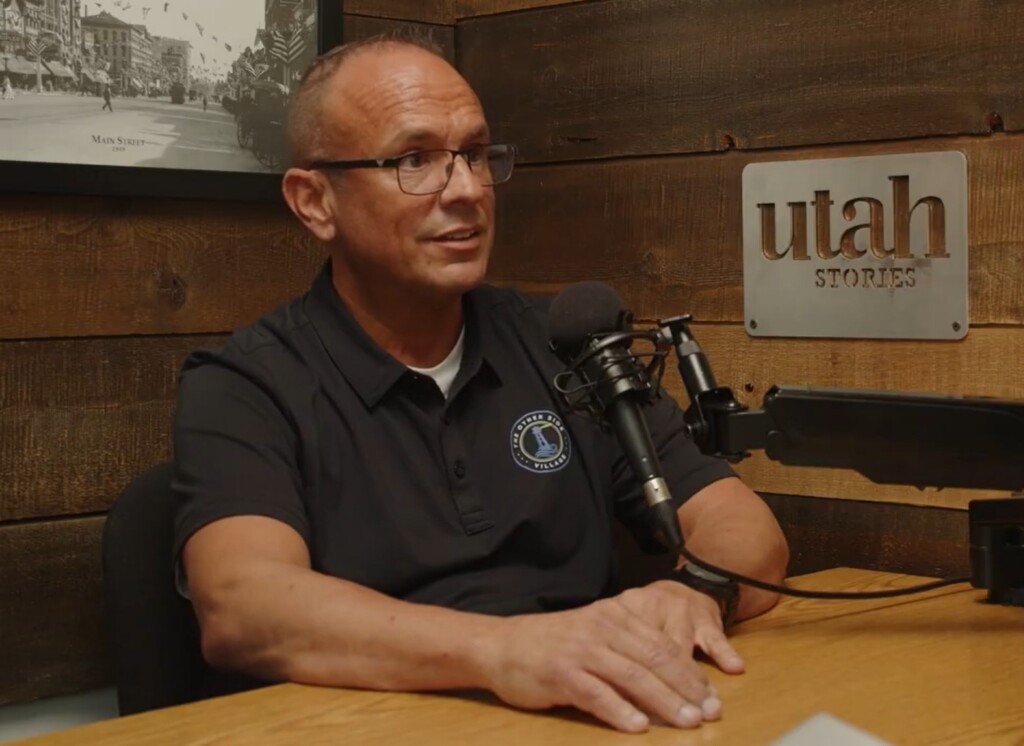
Some of the stories don’t fit that model at all. Jason Little is one of those.
He told us, “I was raised in Utah. My grandparents raised me. My grandfather was a retired major in the Air Force. My grandmother worked at the Pentagon. I had structure. I had everything I needed.”
And then, almost in the same breath, he said, “Two months old, my birth mother put me in a produce box and left me on their porch.”
You can have structure, discipline, a good home, and still carry a feeling of abandonment. He said it pretty plainly. “I fell into a whole lot of resentment about not being wanted… not being worth anything.”
What’s interesting is that none of that showed up in a way people would flag. He was not acting out or getting in trouble. He went to school, played football, went to Dixie College, studied criminal justice and business. By most standards, he was doing great.
He ended up in law enforcement, working dispatch for about ten years in southern Utah. It’s one of those very important jobs that doesn’t get much attention. He was the one answering the calls when something had already gone wrong.
He said, “I’m empathetic. I could calm people down. I could talk them through things.”
But then he added, “I would go home and I wouldn’t talk. I just shut down.”
He was taking those calls every day, and at some point, he just stopped processing what he was hearing.
He realized that was a problem and tried to get help.
“I went through the Employee Assistance Program,” he said. “And they told me if I kept going, it could make me a liability.”
So he stopped.
“I didn’t talk to anybody. I didn’t even talk to my wife.”
Eventually, he left that life. Left the job, left the marriage, got an apartment, tried to start over.
“I thought if I left everything, my life would be better.”
It didn’t work out that way.
That’s when the drinking really started. At first, it was manageable. Beer, routine, something to take the edge off. But it escalated.
“I could drink a full bottle of vodka and get up at six in the morning and go to work,” he told me. “I was a high-functioning alcoholic.”
That phrase comes up a lot. High-functioning. It almost sounds like a compliment, but it usually just means the problem hasn’t caught up to the consequences yet.
Then he met someone.
“She was my best friend,” he said. “It was the first time I’d ever been completely vulnerable with anybody.”
Not a small thing for someone who had spent years shutting down.
He talked about opening up, actually talking about what he had seen, what he had been carrying. And it sounded like, for the first time, he wasn’t doing it alone.
Then she was killed.
“She was on her way back from Salt Lake,” he said. “A shuttle bus blew a stop sign… they went underneath it and killed her.”
And that’s where everything shifted.
“That’s when I turned it up,” he said. “I started drinking day and night. I had a bottle in the car.”
He didn’t try to soften it. “I was choosing alcohol over my kids.”
What followed was what you’d expect at that point. Arrests. DUIs. Incidents that kept escalating. He described making threats while intoxicated, getting into situations he normally would not.
“I knew it,” he said. “But I didn’t care.”
He not only was making bad decisions, but had reached a point where it didn’t matter to him anymore.
What’s also interesting is how the system responded.
“They’d slap me on the hand,” he said. “Pay a fine. Do better.”
He told me he actually asked for help. Asked for some kind of program.
“Looking back,” he said, “I don’t even know if I would’ve taken it seriously. But I was asking.”
Nothing changed until the consequences became unavoidable.
“They told me, ‘You’re going to prison.’”
That’s when The Other Side Academy came into the picture. Not because he had researched it or wanted it, but because it was an alternative.
“I didn’t know what I was getting into,” he said. “I had no clue.”
And even then, he didn’t think he had a problem.
“I still had a desire to drink. I still didn’t believe I was the issue.”
The first few months there were rough.
“The hardest part was becoming vulnerable again,” he said. “The last time I did that, I lost my best friend.”
That’s not something that just gets pushed through.
He described thinking about leaving. Not just walking away from the program, but ending things entirely.
“I thought about walking down to the FrontRunner and stepping out in front of it,” he said. “As long as I died sober, I was okay.”
What changed things wasn’t a single moment or some realization that suddenly made everything clear.
“It was people,” he said. “They wouldn’t leave me alone.”
He laughed a little when he said it, but he meant it.
“They’d pull me into a room. ‘You’re not okay.’ I’d say I was fine. They’d say, ‘No you’re not. Let’s talk.’”
Over and over again.
“I didn’t want to. I resisted. But they kept doing it.”
At some point, something shifted.
“I started embracing it,” he said. “I thought, maybe I can do this.”
And then he said something that gets to the core of why it worked.
“I started helping other people.”
“It wasn’t about me anymore.”
This is something that comes up a lot in recovery circles. He went through the program, graduated, started working, and eventually came back to work as a coach at The Other Side Village.
“I love it,” he said. “Being able to show up, give back, help people live successful, healthy lives.”
We asked him what was different about that environment, because when you walk through it, there is something noticeably different.
“It’s accountability,” he said. “If you see me doing something wrong, tell me. Don’t shy away.”
That’s not something you see much of anymore. Most people avoid those conversations.
“That’s where the growth is,” he said. “That’s where the love is.”
We talked a little about the bigger picture. Why more people seem to be struggling. Why homelessness and addiction keep increasing.
His answer was simple. There are no short-term fixes or temporary solutions.
“Long-term therapeutic communities,” he said. “Whole person change.”
And then he added something that probably matters just as much.
“The person has to want it. And the place has to genuinely want to help.”
There’s a tendency to look at stories like his and focus on the ending. The recovery, the stability, the fact that things worked out.
But the part that stayed with me wasn’t just where he ended up. It was how long he operated before anything actually interrupted the pattern.
He had structure, a career, and relationships. And still, everything unraveled.
Not all at once but gradually.
Which raises the question of how many people are somewhere along that same path, just not at the point where it’s visible yet.