In 1947, the very first year the University of Utah hosted an official ski team, Coach Sverre Engen led the Utes to victory in a national tournament. Three of his skiers — Dick Movitz, Jack Reddish, and Dev Jennings — went on to represent the US in the 1948 Olympic Games.
And so it began. In 2022, the Utah Ski Team won the U’s History Maker Award in recognition for extraordinary accomplishments in winter sports. Utes represent 84 individual champions, 35 Olympians, and innumerable Hall of Famers, All-Americans, and Academic All-Americans. As a team, they’ve won 16 National Championships, including the last four consecutive titles. Their fans hope to see them do it again on March 6-9 at the NCAA Tournament in Steamboat Springs, Colorado.
From the beginning, the team’s tremendous success has come from great coaching.
Here are a few highlights:
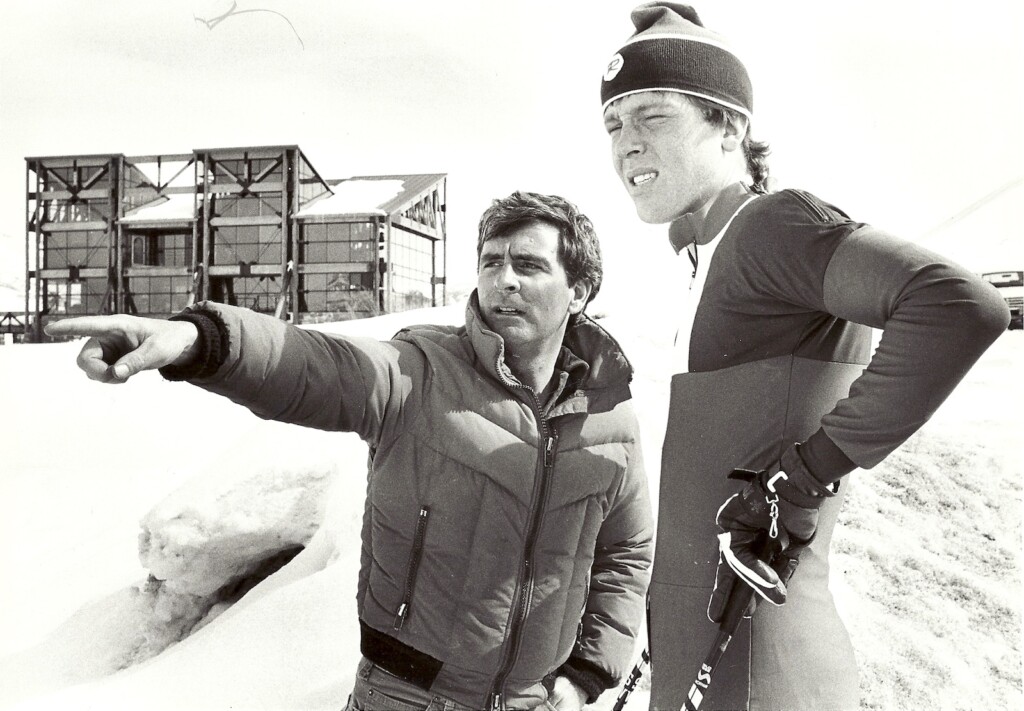
Pat Miller
Coach Miller graduated from Fort Lewis College in 1970, where he was an All-American Nordic skier. He came to the Utah Ski Team as an assistant in 1974 and served for 25 years. According to the Fort Lewis College Hall of Fame, “Miller was instrumental in building Utah into the premier skiing program in the NCAA.”
Under Coach Miller, the Utes won 10 National Championships, 46 athletes were named individual National Champions, 251 were All-Americans, and 10 became members of Olympic teams.
Notable individuals during this time include alpine skiers Anke Friedrich and Christl Hager. Friedrich won both the slalom and giant slalom in 1990. Hager won the giant slalom three years running (‘94, ‘95, and ‘97).
When asked what made him such a good coach, Miller’s disposition inevitably gets mentioned. “I think when you characterize his capabilities and his expertise as a coach, it starts with his personality,” says Dr. Greg Thompson, Emeritus Associate Dean for Special Collections at J. Willard Marriott Library. Thompson skied with Miller on the Ft. Lewis College team and the two had offices near one another at the U. When thinking of Miller’s coaching days, Thompson adds, “There was an awful lot of spirit.”
Miller’s huge personality as a head coach didn’t impinge on his coaching staff. He was known to let the alpine and Nordic coaches run their own departments.
Miller was inducted into five sports Halls of Fame including the Alf Engen Ski Museum Hall of Fame in 2008. He passed away in 2013 of a sudden illness.
Kevin Sweeney
Coach Sweeney is the original student athlete. He graduated cum laude from the University of New Hampshire in 1985, and twice represented the US at the World Cup. Sweeney was an assistant coach for Pat Miller from 91-99 and was named head coach in the year 2000. He served this term for five years and returned as head coach in 2010. He led the Utes to two National Championships (03, 17). Sweeney now lives in Norway.
Under his tutelage, Martin Bergström was a three-time National Champion in both freestyle and classic cross country skiing.
Barbara Yamada, affectionately called the “ski team mom,” witnessed Sweeney in action. “He’s just a really good person and he treated his athletes and everybody around him very personably,” she says. “It’s a family, it’s a team effort, and it’s a family feeling,” and she says Sweeney made it feel that way.
Fredrik Landstedt
Coach Landstedt is a native of Sweden, but competed for the University of New Mexico, where he was an All-American and became a Nordic coach. Before coming to the U, he coached two other American universities to National Championship titles.
Landstedt was named Utah’s head coach in 2018. Under his direction, the Utes won four consecutive National Championships (‘19, ‘21, ‘22, ‘23). Landstedt won the U’s Don Reddish award three times as the leader of an Olympic sport to have had the most successful season.
Notable skiers under Landstedt include Madison Hoffman, who won both the slalom and giant slalom in 2023. She was the first women’s double alpine NCAA champion since 2019 and the first Ute to win both at the NCAA level since Anke Friedrich. Sydney Palmer-Leger (‘21) and Novie McCabe were named National Women’s Nordic Skier of the Year (‘22).
In 2022, 12 of the skiers in the Beijing Olympics were current and former Utah Ski team athletes, 10 of which trained under Landstedt. An additional ski alumnus attended as a coach.
When asked why Utah’s skiers have been so successful, Landstedt mentions camaraderie. “Skiing is a little different because you have both alpine and nordic, and you also mix men and women, so there are four parts to the team,” he says. “To be a very strong team, you need to glue these four parts together and create a great environment where everyone gives 100%.”
Landstedt’s European background is often cited as a reason he’s excellent at international recruiting. He has also been supported by a consistent coaching staff since his arrival.
Academic All-Americans
By and large, competitive skiers are focused on individual success, and this applies to academics as well as athletics. Electrical and mechanical engineering, biology, and master’s level finance are among the majors being pursued by ski team members. These subjects require an intense level of study, but Utah skiers get top grades in the hardest subjects while putting in 20 hours of training a week.
The Utah Ski Teams consistently have among the highest GPAs at the U. At the end of the 2022 season, 21 Utes were named to the All-Academic team.
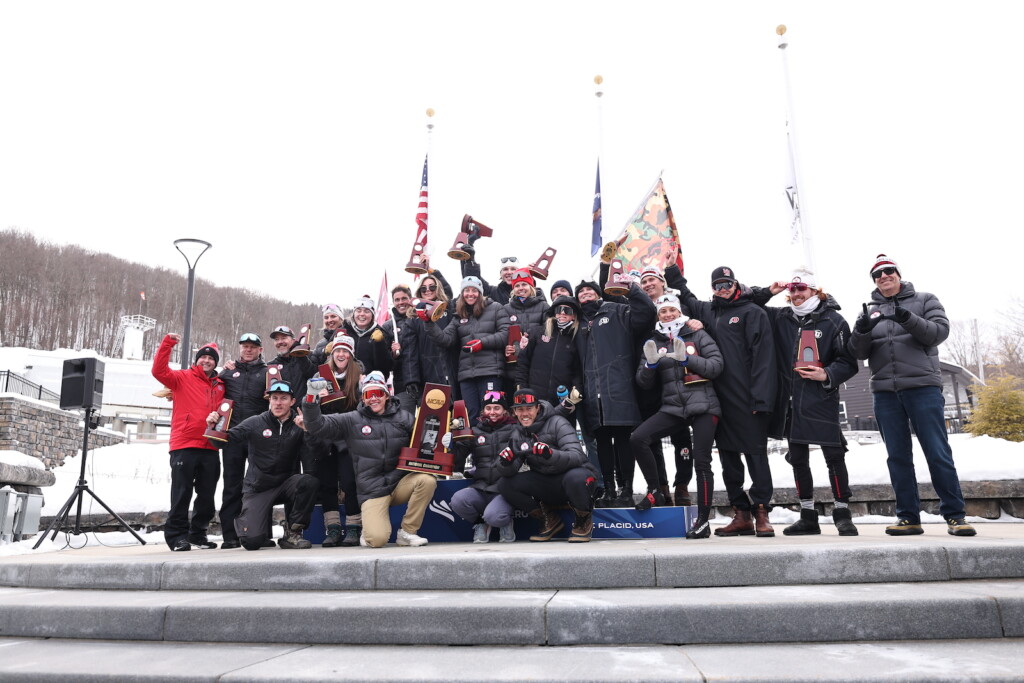
Feature Image: The University of Utah Ski Team celebrates its fourth straight NCAA Championship on March 11, 2023 in Lake Placid, New York. Photo courtesy of NCAA Photos via Getty Images.