Go Local

Enjoy Winter in Moab

Moab is booming during the summer months, but there are winter charms to discover as well. With trails that are less crowded and a different kind of beauty, Moab is worth a winter visit.

|


Moab is busiest in the summer when kids are out of school and can join families on visits to national parks, and when activities like whitewater rafting, mountain biking, and extreme sports like skydiving are at their most appealing. In winter, things slow down. There are fewer visitors and events in town, and some hotels, restaurants and tourist attractions close for a few weeks.

But the winter season has its own charms: the trails are less crowded, and the occasional snowfall highlights the dramatic colors and contours of the landscape.
“We typically close for December and January,” said Megan Fryer, owner of Rustic Inn in downtown Moab, adding that she and her staff take advantage of the time off and the reduced crowds to visit the national parks. 

Visitors wishing to avoid high-season crowds will often book at Rustic Inn in late November or February. That timeframe is also appealing for travelers on a budget. Room rates are lower during those times of year, Fryer said. (She encourages people to book directly with the hotel for a discount and to avoid paying fees to an intermediary booking site.) Many repeat guests enjoy the slower pace and the unique aesthetic of Moab in the winter.

“The skies really do glow here in December,” Fryer said. Photographers often visit in late fall and early winter to catch the most dramatic sunrises. Winter’s cooler temperatures may also be friendlier to travelers who want to hike with their dogs.
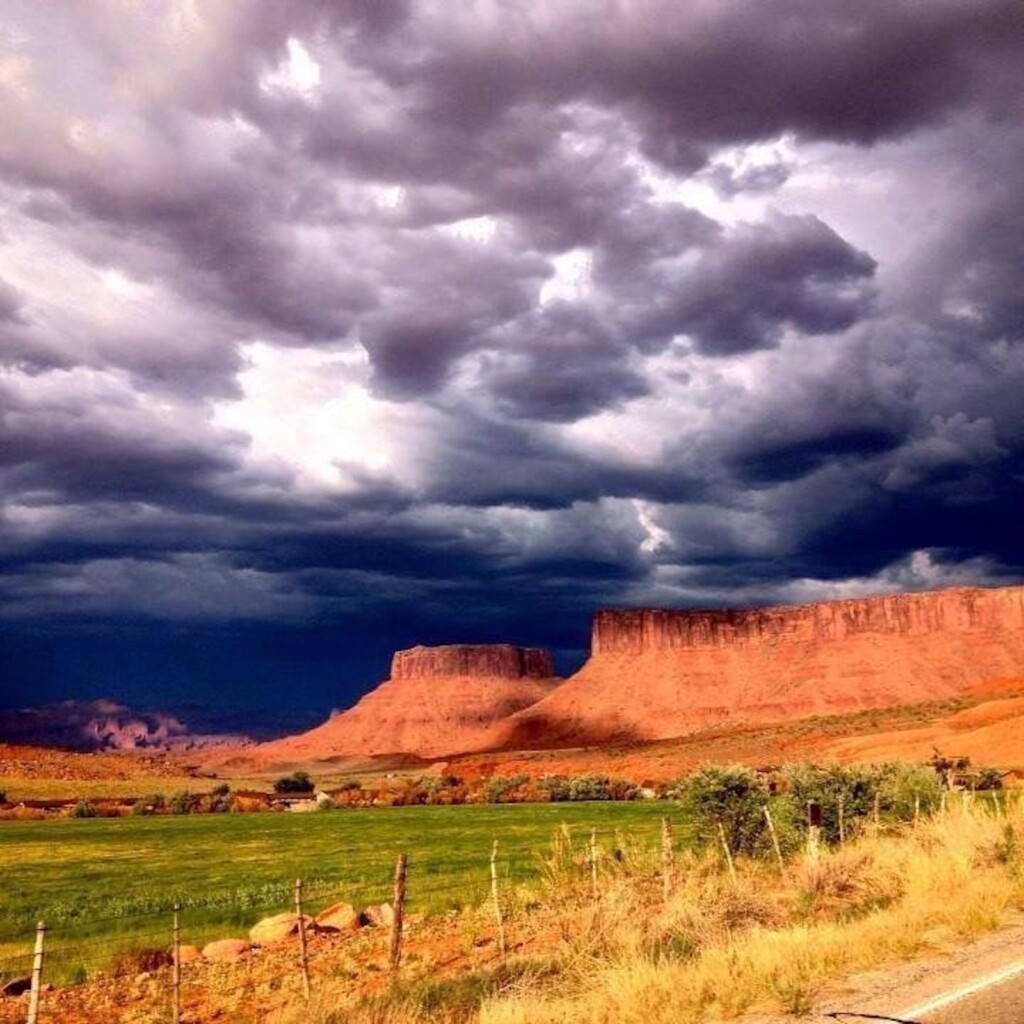
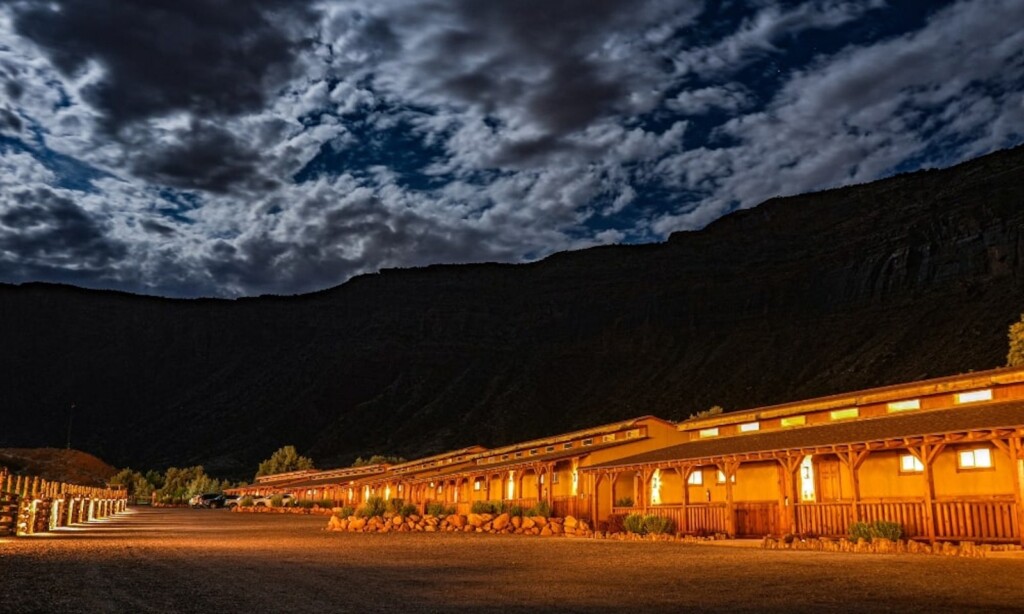
Photo courtesy of Red Cliffs Lodge.

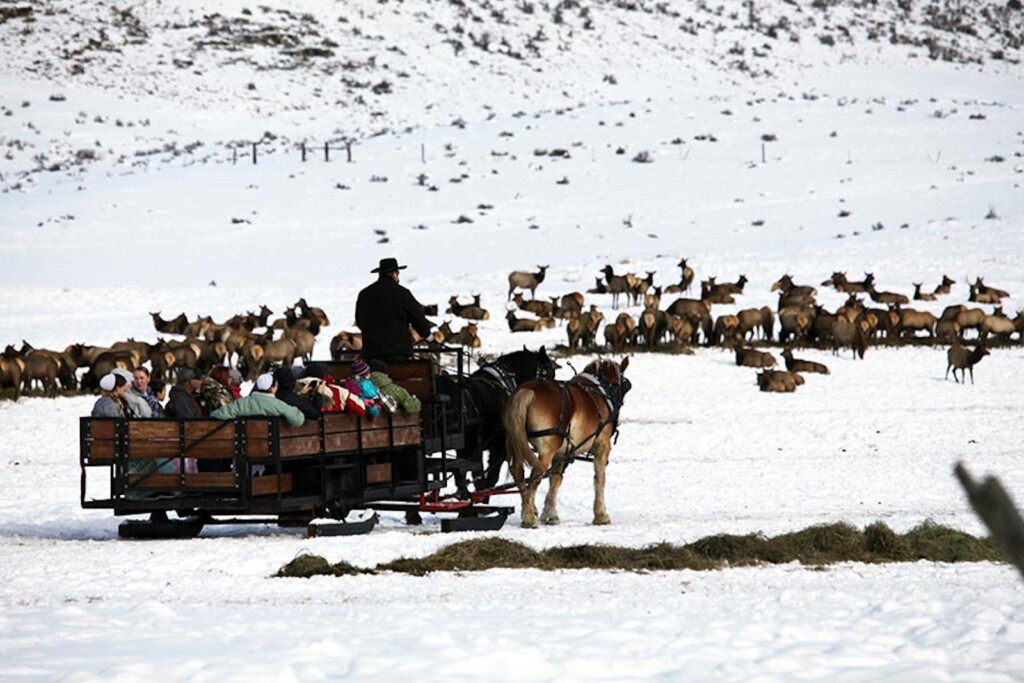
Brian Hunnings, general manager of Red Cliffs Lodge outside Moab, said some visitors prefer the winter season because of the abundant opportunities to see wildlife. Hunnings himself saw a mountain lion near the lodge in mid-November. It was late at night and he was taking his dogs out — “they have the smallest bladders in the world,” he joked — and he saw the lion’s green eyes glowing in the light of his headlamp. Hunnings backed respectfully away from the area, ending the encounter without drama.

Red Cliffs Lodge sits along the Colorado River outside of Moab, and the river corridor attracts birds and animals. Hunnings said bald eagles are a frequent winter sighting. Some of Red Cliff Lodge’s most loyal repeat guests are bird watchers and animal enthusiasts who come to observe nature in the serenity of winter.

Red Cliffs Lodge also offers activities for guests both on- and off-site year-round, including in winter.

“We have tons of stuff you can do,” Hunnings said. Many tours and activities lend themselves more to the warmer seasons, but there are special winter activities open both to guests (usually complementary with a stay) and the public (usually for a fee).

On Saturdays in December, the lodge hosts craft sessions, such as candle-making or wreath-making, with lunch included. There’s also a breakfast with Santa Claus, where children can meet the man in red and receive a small gift — if they’re on the nice list, of course.

“Our holiday elves make that happen,” Hunnings said.

The lodge restaurant, The Cowboy Grill, has special holiday meals: a Thanksgiving buffet and a Christmas brunch. And on New Year’s Eve, Red Cliffs hosts a party that includes fireworks at midnight.
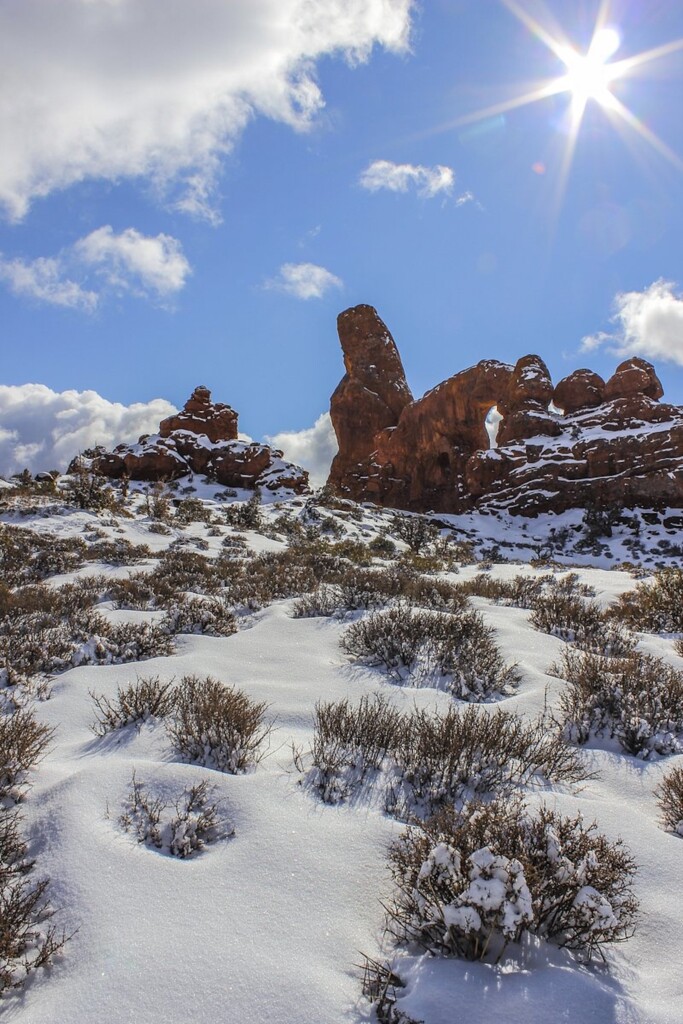
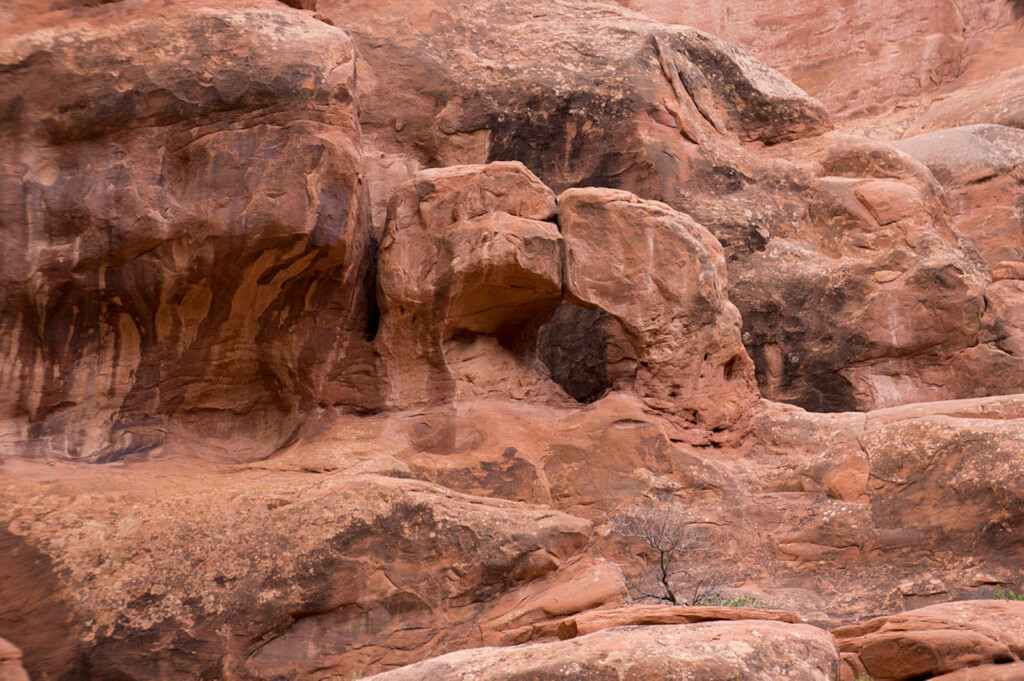
Arches National Park in winter.

Other activities available year-round include yoga, sound baths, and various art and craft classes. There’s an on-site film museum tracing the rich history of movie-making in the Moab area. The lodge also arranges tours like hiking and horseback riding. Some are best suited to the high season, but some, such as drives with the on-site Bronco Off-Roadeo, are good options to get out and see the landscape in winter. Motorized tours take visitors to many iconic views and features around Moab.

Parks near Moab — Arches and Canyonlands national parks and Dead Horse Point State Park — are open in winter and usually see fewer visitors in the cooler months. There are fewer interpretive programs, and visitor center hours may be shortened. Also, road and trail conditions might be perilous if there’s ice or snow. But, as the Arches National Park website says, winter “is a peaceful time, without the crowds or scorching heat that can plague summertime visits.”

Feature Image courtesy of Red Cliffs Lodge.

,


Join our newsletter.
Stay informed.


  • Inside Moab’s Political Divide: Land, Tourism, and the Future of Grand County, Utah

    In the late 1950s, Edward Abbey took a job as a park ranger at Arches National Monument, just outside Moab. What he found there, and what he watched happen to it, would shape the rest of his life. Roads were being cut into the canyon country. Cars were replacing foot traffic. The National Park Service, in the name of accessibility, was engineering a kind of industrialization of the wilderness he’d come to love. Abbey wrote about it in Desert Solitaire, published in 1968, and the anger in that book wasn’t abstract. It came from watching something specific be changed by people who either didn’t understand what they had or didn’t care.

    Grand County has long been the most reliably left-leaning county in the state, a fact that puts it in sharp contrast to nearly everything around it. To understand how that happened, and where things stand now, I spoke with longtime residents and politicians who’ve watched it from the inside, people who’ve served in local government and lived through the shifts firsthand.

    Robert Greenberg.

    Bob Greenberg came from New York in 1976, took a job at the community mental health center, and never left. He went on to chair the Grand County Democratic Party and serve on the county council. When he arrived, he said, “the Democratic Party was said to be able to meet in a phone booth” — and even then, its members were a contradictory bunch. Yellow Dog Democrats from the oil patch were fiscally conservative but surprisingly open socially, allowing different demographics to feel safe moving to the county. 

    “The town fathers were desperate to have new people come to town,” Greenberg recalls. “They just didn’t want the people who actually showed up. They wanted some other people.”

    What followed was a demographic shift nobody planned. The people who filled the gap left by the bust were river guides, federal agency workers, artists, and eventually waves of outdoor recreationists discovering that southeastern Utah was among the most spectacular landscapes on earth. Tourism ended up being the only economic development avenue that actually worked. Manufacturing never had the labor force or market access, sewing factories came and went. The people the tourist economy attracted tended to be younger, more outdoor-oriented, and more liberal.

    Kevin Walker.

    Kevin Walker, a former Grand County commissioner who moved here in 1990 for the landscape, puts the county’s diversity in context. “Moab [is] a pretty diverse place since, I think, at least the 1950s with the uranium mining boom,” he says. “So it’s not a typical Southern Utah town.” 

    Part of what makes Grand County distinct is self-reinforcing. Federal agencies like the Park Service, the Forest Service, the BLM, have large presences here and pull in a different demographic than surrounding counties. People looking to live in Southern Utah with certain values gravitate toward the place where those values already have a foothold. Over time, that critical mass has made Grand County what it is politically, while neighboring counties went in very different directions.

    The defining conflict in Grand County has always been over land.

    In the 1970s and 80s, it was extraction versus preservation in the starkest terms. County commissioners floated toxic waste incinerators. A plan emerged to site a high-level nuclear waste repository at the entrance to Canyonlands National Park. 

    “It really, really galvanized environmentalists everywhere, but particularly in Grand County,” Greenberg says. Activists put up signs at the park entrance, watched them get chainsawed down, and came back with steel reinforcement. That stubborn, physical, unglamorous persistence became part of the local political character.

    Continue reading and support independent Utah journalism with a purchase of Utah Stories (Digital + Print) or 3 month free trial (Digital).


  • The Perfect Girls’ Day in Park City: Brunch, Shopping, Spas & Nightlife

    After a week of work, grocery shopping, meal prep, driving the kids around, housework and last minute emergencies, a day of bonding and fun with our BFF’s is just what the doctor ordered. Fortunately, one of the best getaways is just a short drive away to Park City.


  • Can Utah Farms Survive the Corporate Food System?

    Local farms and restaurants battle similar economic pressures as they struggle to survive in a tight economy where slim profit margins and increased labor costs and conditions are often beyond their control.


  • Moab Trail Closures: The Fight Over Public Land Access and Off-Roading

    Trail closures threaten livelihoods and slowly limit access to ordinary families, says Dave Hellman, owner of Xtreme 4×4 Tours in Moab. Wilderness advocates argue that stronger protections are necessary to preserve fragile landscapes. As lawsuits reshape trail access across southern Utah, Moab increasingly sits at the center of a growing conflict over who public lands are really for.