

SUGAR HOUSE — Intense growth and development in this sought-after Salt Lake City community have rendered its longstanding liquor store on Ashton Avenue difficult to reach by car.
While the Utah Department of Alcoholic Beverage Services plans to build a shiny replacement store in a new high-density, mixed-use development on 21st South, that project will not materialize for at least 24 to 36 months.
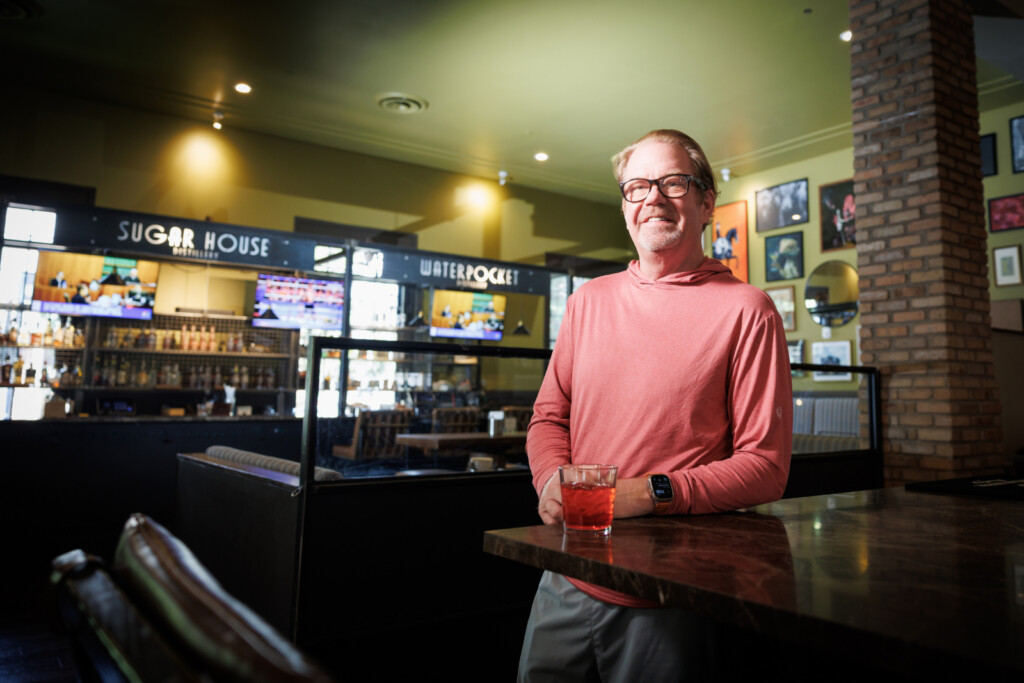
In the meantime, customers like Andrew Noyes continue to frequent the quaint Ashton Avenue location.
Noyes said he prefers to get to the Ashton Avenue location on foot because “I live in Sugar House so it’s easy for me.”
In fact, Noyes said he doesn’t even consider using his car to run that errand.
“Not right now because it’s kind of impossible,” he grinned.
Noyes noted that he was unaware that a replacement store was in the works, but said the new site near 9th East and 21st South will be even closer to his home.
The Big Plan
The Sugar Town project has cleared the necessary hurdles with Salt Lake City planners to proceed with its ambitious plans to transform the old Snelgrove property.
According to the Sugar House Community Council website, the Sugar Town project will dramatically transform that block between 800 and 900 E on 21st South.
The new development will feature 319 residential units — including 53 rent-restricted studios, 39 micro apartments, 191 one-bedroom and 36 two-bedroom units.
The project allows for 393 parking stalls that will accommodate residents and still leave 87 slots available for public use.
The proposed DABS liquor store will occupy 12,500 square feet at ground level, but target dates for when the old Sugar House store will close and the new one can come online still remain in question.

In transition
Tucked away on Ashton Avenue, the old liquor store sports opaque glass blocks instead of windows. And inside, rows of vintage wood shelves provide cubicles for boxed wines.
Adjacent to the store’s small parking lot, construction crews recently tackled various road and building projects, which snarled vehicle traffic in and out of the area.
Even so, DABS 2022 retail numbers indicated a surprising nine percent uptick at this location with $14,199,203 in sales — ranking it 10th among the state’s top-selling liquor stores.
Michelle Schmitt, DABS spokeswoman, said that there’s currently no date for the Ashton Avenue store to shut down.
“That will happen in concert with a new store opening, so it will be a replacement store,” Schmitt said. “We are hoping that [the new store] will open in 2025, but that’s as close as I can get at this point.”
Construction of the new liquor store hinges on Sugar Town’s progress.
“We would certainly appreciate any construction or building project to move as efficiently and quickly as possible,” Schmitt said. “But right now we’re proceeding with the process as we can and are really looking forward to what the store will be to better service this area.”
A new liquor store in east Sandy provides a glimpse of what the Sugar House store will offer. Schmitt described it as very modern and shopper-friendly.
“It’s really trying to improve the shopper experience, both for average customers that go in looking for whatever products they want to take back to their home, but also for the businesses that use the stores to be able to get products that they resell at their restaurants or bars,” Schmitt said.
While the timeline for the big move from old to new remains in flux, Utah’s DABS looks forward to occupying its piece of Sugar Town.
“Sugar House is growing so rapidly,” Schmitt said. “We’re excited to be a part of that momentum in the community.”
Timeline in flux
Unfortunately, the Sugar Town development is temporarily stalled, according to Alex Stoddard, an architect with Midvale-based Architect Belgique who is working on the project.
“We’ve gone through the whole permitting process (with the city) and basically done all the steps other than pulling the building permit,” Stoddard said. “But it’s currently on hold for financial reasons. We’re trying to figure out the cost of the building and how to make it work.
Rising interest rates, in large part, caused the need to revisit the numbers and seek out new investors.
“The project isn’t dead,” Stoddard said, “but we don’t have a construction start date as of right now.”
The best he can project at this point is that construction could begin by spring 2024. But he cautioned that Sugar Town construction will not be quick.
“If the construction started today, I don’t know if the liquor store could be in by 2025,” Stoddard said. “It’s going to take probably more than two years to build.”