Utah Stories

How Park City Survived the Great Fire of 1898

In 1898 a fire spread through the buildings on Main Street in Park City. Residents rebuilt and restored this historic area.

|


At 4am, gunshots rang through the dark night, as local townsfolk awoke to a most terrifying sight. A large fire had erupted at the top of Main Street, and the American Hotel was engulfed in uncontrollable flames. Park City’s Sheriff, Thomas Walden, had sounded the alarm with three successive shots, and the whistle at the Marsac Mill quickly notified the nearby mining campsite and homesteaders.

The date was Sunday, June 19, 1898, and with strong winds blowing from the east, the fire quickly spread from building to building and house to house. Since its population surge a decade earlier, Park City had been bustling with men, women, children, and families. The silver, lead, and zinc discovered in the nearby mountains had driven hundreds of prospectors, miners, and camp followers to the small Utah settlement. This influx had raised the city’s population to over 10,000 residents—equivalent to 2020 census numbers. The boom town included boarding houses, saloons, theaters, and stables. 

Most of the hastily built structures were made of easily combustible pine. The flames quickly descended upon the crowded buildings and danced easily through the streets. As Parkites scrambled to save what they could, nine-year-old Edna Sutton wrote in her diary, “When we looked out of the window, we saw it was a big fire and not very far off … It kept coming nearer … and folks kept running by and saying one building after another was going.”

The volunteer fire department tried desperately to squash the inferno but their attempts were futile. Within seven hours, three quarters of the town had burned to ashes, causing over one million dollars in damages. The fire, which was the worst in Utah history, burned for several days and left the mining camp demolished. Main Street, where 200 businesses and dwellings had once stood, was nothing but a few lonely walls and stones. 

While thankfully, no human lives were lost, numerous animals perished and at least 500 residents were left homeless. One of the most heartbreaking of the losses was the three-month-old Opera House that had been constructed after the local community collected $30,000 in donations for its establishment. Additionally, The Park Record — the city’s weekly newspaper — had burned completely to the ground, destroying all of its editions, archives, and equipment. 

The spark had started at the American Hotel but the cause was never quite determined. Newspapers at the time suggested coal oil from the hotel’s kitchen stove triggered the blaze. However, the hotel proprietor thought it was more likely that a drunken guest may have kicked over a lamp.

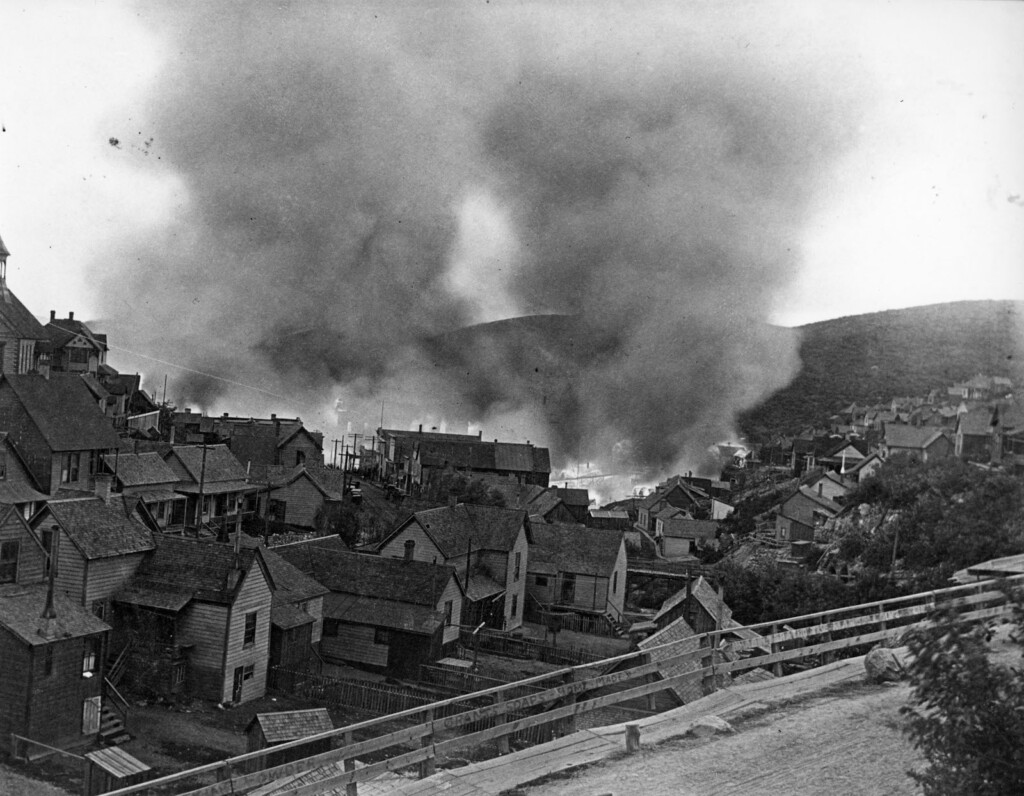
The remains of one of the buildings on Park City Main Street. The photo courtesy Park City Museum.
The remains of one of the buildings on Park City’s Main Street.

After the devastation, some of the residents, including the town’s small Chinese community, packed up and left Utah forever. However, most of the miners, townsfolk, and families stayed in the community and vowed to keep going. With grit and gumption, they began the difficult process of cleanup and rebuilding. 

Despite, or maybe due to many naysayers and skeptics, Park City was rebuilt and fully functioning within a year and half! City Hall and the popular George Wanning Saloon were among the first to be reconstructed. A theater replaced the Opera House and The Park Record continued to print its pages.

Although smaller fires plagued the rugged mountain settlement every few decades, none were as catastrophic as “The great fire of 1898.” With the mines continually producing silver and other precious ores, the town continued to grow. It stayed busy and thriving through the Great Depression and WWII. Then in the late 1950s, mineral prices dropped drastically low. Miners and their families began to move away and businesses began to close. It looked like Park City may become another forgotten ghost town.

Fortunately though, the strength and tenacity from the prior century had been passed onto a new generation of Parkites. The remaining residents bonded together with the United Park City Mines Company (UPCMC) and came up with an ingenious plan. Through pure will and determination, the townsfolk and the UPMC turned the struggling mining mountain into a functioning ski resort.

On December 21, 1963, Treasure Mountains — known today as Park City Mountain Resort — opened for skiers. Park City officially went from mining town to tourist town. Slowly, the population began to creep back up, businesses returned, and life came back to the area.

Then in 1973, déjà vu struck. Flames were spotted shooting high on Main Street! Fortunately though, and largely due to the newly formed Park City Fire Protection District, the blaze was quickly distinguished and only half a city block was burned. As in 1898, the townsfolk came together to start the restoration process. Although this time, plans for rebuilding sparked a conversation regarding the town’s legacy and preserving the historic character of Park City.

What should the town look like moving forward? Most of the residents hoped to maintain the culture and lifestyle of the area’s mining activity and early ski industry. This would mean that all rehabilitations, restorations and reconstructions must preserve the unique character of the town. Consequently, codes and regulations were implemented to preserve the city for future generations. In 1979, Park City’s Old Town district was officially listed on the National Register of Historic Places, which ensured its architectural and historical integrity.

It’s impossible to say whether another disastrous inferno or economic recession will befall the town. But it can be argued that if a catastrophe does strike, Parkites will once again persevere because the grit and gumption displayed during “the great fire” still burns strong in Park City’s veins.

Images are property of Park City Museum. Used with permission.

Feature Image is of the fire burning Park City’s Main Street in 1898, destroying most of the hastily built structures.

, ,

Join our newsletter.
Stay informed.


  • Utah Fits All Scholarship Applications Open Through April 30 for K–12 Students

    Utah families have more learning paths than ever and, increasingly, more ways to make those paths affordable. This spring, the Utah Fits All Scholarship opened  for new family applications on April 1, and the application window stays open for one month. The program is a public K–12 scholarship that provides $4,000 to $8,000 per student,…


  • Left in a Box as a Baby: Trauma, Alcoholism, and Addiction

    A man abandoned as a baby builds a structured life in law enforcement, but unresolved trauma and alcoholism slowly begin to unravel it. His story raises a harder question about how change actually happens.


  • The $7 Million Recruit: How NIL Changed College Athletics Forever

    In 2012, Jabari Parker, a top high school prospect and member of the Church of Jesus Christ of Latter-day Saints, was facing his biggest decision to that point in his life: where to play college basketball. 

    Fans of BYU athletics hoped and perhaps prayed that Parker would pick the school owned by the church he was raised in. BYU was listed as one of his final choices. But he ultimately chose to spend his college years at Duke before attempting a career in the NBA. BYU fans were disappointed, but no one was truly surprised. Duke over BYU was the best choice for a young prospect in 2012. 

    A.J. Dybantsa.

    What changed between 2012 and 2024 when A.J. Dybantsa, the number one high school prospect, chose BYU over every other school? The answer is roughly $7 million dollars. That is what Dybantsa is reportedly making to play basketball at BYU. 

    The deal was supported by Utah Jazz owner Ryan Smith, who met multiple times with the Dybantsa family in multiple attempts to bring the young player to Provo. 

    According to Smith, he had no financial role in bringing Dybantsa to BYU, but the influence of Utah’s most famous billionaire acting as a “booster” or unofficial recruiter certainly swayed the decision.

    Prior to 2021, boosters acting as recruiters was taboo to the NCAA governing body. It was called improper recruiting. But in 2021, California began the modern era of NIL, or the ability of a college athlete to benefit from their name, image, or likeness, when they passed the “Fair Pay to Play Act.” 

    This new law gave college athletes in California the ability to benefit from their NIL, something that was banned in the rest of the country to that point. The NCAA saw that this law would create an unfair advantage for California schools that could now give young athletes the chance to make money off their talent and image while still in college. 

    The NCAA knew they needed to do something quickly, so they rushed through a policy that opened up NIL to all college athletes in the country, and it has been expanding and evolving over the last four years. 

    Grant Duff, who has coached at the University of Utah, Weber State University, and is now the defensive coordinator for Idaho State University, says, “The best part of NIL is that athletes have an opportunity to make good money. The downside comes with the free-for-all that money causes.”

    Dybantsa confers with BYU Head coach, Kevin Young.

    One of the biggest current examples of what a school can do when the boosters are willing to pay for success is Texas Tech University. From 2020-2024, Texas Tech had 34 wins, which works out to 6.8 wins per year with a low of 4 wins and high of 8. Then Texas Tech’s boosters got involved, led by Cody Campbell, an oil industry businessman and Chairman of the Texas Tech board. The football program was given 28 million dollars for NIL with a simple message attached to the large pile of money: Win. And win now. And win they did. 

    By signing NIL deals with athletes in the transfer portal, Texas Tech went from a middle-of-the-pack school in their conference to one of the top 12 teams in the country. They didn’t just win games in 2025, they made many of their opponents look like they didn’t belong on the same field, including the University of Utah and BYU twice. That is what money can buy.

    Continue reading and support independent Utah journalism with a purchase of Utah Stories (Digital + Print) or 3 month free trial (Digital).


  • Cottonwood Heights Corruption Allegations: A Case That Never Reached a Courtroom

    A year ago, we here at Utah Stories recorded a podcast episode that we never published. We were revisiting corruption allegations from ten years ago. We decided not to publish the video, so it sat there on YouTube for nearly 12 months.

    Then somehow the video was published. How? We are not sure, but once it got out there, the comments came pouring in.

    Dozens of viewers, then hundreds, supported the video with their comments on our examination of allegations of police misconduct in Cottonwood Heights. The video recounts how the Police Department was reported by business owners as focusing enforcement on customers of the former Canyon Inn bar. These allegations did not result in a publicly documented, full investigation by Utah’s Justice Department nor the FBI (at least to our knowledge). So why rehash the past?

    We believe the story of The Canyon Inn (and other area business owners) vs. CHPD and Cottonwood Heights Mayor Kelvin Cullimore raises questions about what can happen when allegations surface and do not move forward through a formal legal process with state or federal oversight.

    In 2012, Cottonwood Heights business owners at the mouth of the canyons began publicly objecting to police activity whereby up to seven cruisers were pulling over 711 and Canyon Inn bar customers on their busiest evenings.

    According to those accounts, drivers leaving the bar were frequently pulled over by police and were given DUI tickets, sometimes even after passing a sobriety examination. The volume and concentration of those stops led residents and business owners to complain about the “heavy-handed treatment” of CHPD toward motorists, especially in and around the Canyon Inn and neighboring 711, and eventually the Porcupine Pub.

    Customers responded in predictable ways. Some chose not to return and avoid the area. Others went to different establishments. Over time, the owner of the Canyon Inn, Jim Stojack, stated that his revenue declined by 70% and that he believed police activity near his business was the main contributing factor.

    Utah Stories reported on these concerns by conducting interviews; gathering video documentation provided by those involved; and making public records requests. Through our GRAMA requests, we reviewed DUI citations issued by the Cottonwood Heights Police Department and examined how those cases were resolved in Holladay Justice Court. During that period, we observed a higher number based on our review of DUI cases dismissed in court due to lack of evidence compared to other jurisdictions. One DUI attorney, Tyler Ayers, went on record saying that CHPD was issuing a high volume of DUI citations that were later dismissed.

    That observation raised questions about how cases were being documented and prosecuted. It did not, on its own, establish intent or misconduct, but it became part of a broader set of concerns raised by multiple sources.

    Continue reading and support independent Utah journalism with a purchase of Utah Stories (Digital + Print) or 3 month free trial (Digital).