The gondola passed UDOT’s approval process. So what does that mean for you and me?
Apparently, Utahns who are into our canyons, hiking, the backcountry and pristine rivers and lakes, i.e., “the public”, are seriously lacking in brainpower. Those who love unobstructed views of evergreens, granite cliff walls and waterfall escarpments just aren’t getting it. Maybe they need to watch the Gondolaworks.com videos a few more times and they will start to clue in that Little Cottonwood Canyon needs a gondola, damnit!
A short chat with a developer/politician who is spearheading the gondola project, Chris McCandless, and I began to understand the frustration he and his cronies are having with these environmental morons, whose opinions don’t really matter anyway.
“Do you ski with your kids?” McCandless inquired of me.
“I thought I was asking the questions, but yes, I skied at Snowbird with one of my kids, one day last winter.”
“Well, don’t you want it to be possible for you and grandkids one day to go skiing?”
“Sure,” I replied.
“This gondola will make this possible. It will make it possible for you and everyone else to continue to enjoy the canyon without it being a place only for tourists and rich people.”
“So the gondola, with huge towers, steel and concrete will ‘save’ Little Cottonwood Canyon?”
“Yeah, as the population grows, traffic will only get worse, and eventually, average Utahns won’t be able to go skiing.”
“But I hardly go skiing now, not because of traffic, but because the lift ticket price is $160. It’s just too expensive to justify around $300 bucks with lunch and gas to go skiing for a day.”
“The gondola will keep skiing available for average Utahns,” McCandless said.
“But I think far more ‘average Utahns’ are going to the backcountry now than the resorts, because the resorts are too expensive, and what the gondola will do is destroy the backcountry, where more Utahns want to do their skiing now.”
“Ha, Ha! That’s not true. Very few people ski in the backcountry compared to those who ski at the resorts. And it won’t destroy the backcountry.”
“Those 23 towers with 30-foot diameter bases all plopped into the backcountry through the canyon won’t destroy the backcountry experience?”
“No, most of [the towers] will be just off the main road.”
“The gondola could cost $1 billion when all is said and done. How is that going to help average Utahns who just want to be able to take their kids somewhere on the weekends, who don’t have $300 to spend?”
McCandless said he was about to go into a very important meeting and he couldn’t really talk any longer, but he assured me that the gondola, whether it is built while he is still alive, or after I am gone, will make the canyons better for everyone.
I suppose we should all just trust him? I guess the developers who operate our organizations, such as Visit Salt Lake City (as he does), and who own land around the gondola (as he does), and who pull the strings with their cronies in UDOT, and elsewhere, know better than all of us. Can we assume that the 89% of negative comments the Wasatch Front Regional Council has received concerning the gondola are lacking in real awareness, understanding and brainpower?
According to John Gleason, Public Relations Director at UDOT, “One of the top reasons a gondola has been proposed is the threat of avalanche danger.”
From our perspective, what is happening is extreme corruption and collusion among our developer/politician/elites. Despite the fact that most people in the place where the gondola will reside do not want it there, we have several major corporate entities, along with developers, who have abundant power, to sway the decision makers at UDOT. The Austrian-based Doppelmayr Gruppe moved its corporate headquarters to Utah in anticipation of securing this gondola project. Does that mean the gondola is a slam-dunk?
Carl Fisher, Executive Director of Save Our Canyons, and Dan McCool, Emeritus Professor at the University of Utah, both believe that the gondola isn’t a traffic reduction strategy. McCool believes that it may be a lift ticket sales strategy instead. Fisher also stated that “UDOT most likely won’t close the canyon road, and by adding a gondola, instead of a traffic reduction, the canyon would likely see a 30% increase in visitors, inducing additional traffic into the canyon.”
The EIS (Environmental Impact Statement) is what most Utah developers/politicians hang their hat on to defend their decision to move forward with the gondola. This was a very expensive way in which they could proclaim that Little Cottonwood has too many avalanches, too much traffic, and that a gondola is the only viable solution. But our major question is: a solution to what?
When all you possess in your toolbox is a hammer, everything looks like a nail. When the only tools developers hold in their toolboxes are trains, wider roads or gondolas, they only see their own tools as the only solutions.
There are far more viable tools, including reserving parking spaces; carpooling apps and better bus hubs.
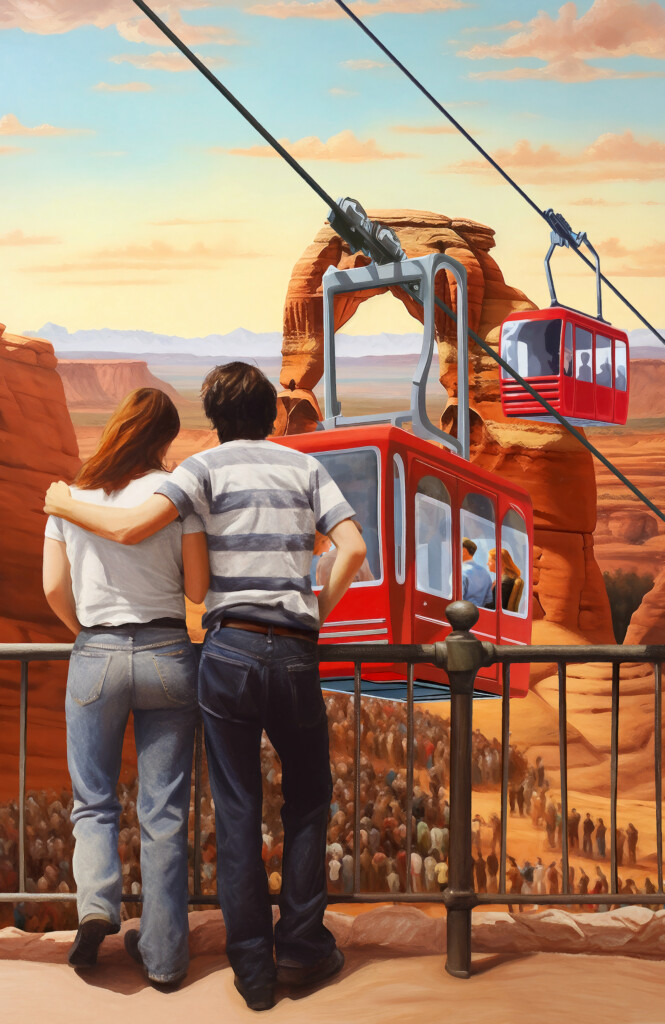
Utah’s greedy developers/politicians could examine National Parks who don’t consider environmental destroying “tools” as viable options. We made the point that Arches National Park would never consider a gondola to Delicate Arch, despite the huge amount of visitor traffic that wants to see it. This is because they understand a gondola would destroy the area and the experience.
Putting the longest gondola in the world up Little Cottonwood Canyon would destroy the experience for everyone who doesn’t want to pay the fees for lift tickets, parking, and a gondola ride. It’s time our “leaders” begin to listen to the people they supposedly serve. It’s time the elites stop concluding that we are idiots and that they know better than us. Let’s not find out the hard way. Let’s stop this gondola fiasco by eliminating it as a possibility before it’s too late.
Illustration by Dung Hoang. Additional reporting by Nicole Anderson.