Community Events

Honoring the 2,945 Fallen Utah Veterans with West Valley City Veterans Memorial

On November 11, 2021, Veterans Day, the city of West Valley unveiled a brand-new tribute, a memorial to the 2,945 fallen Utah veterans. 

|


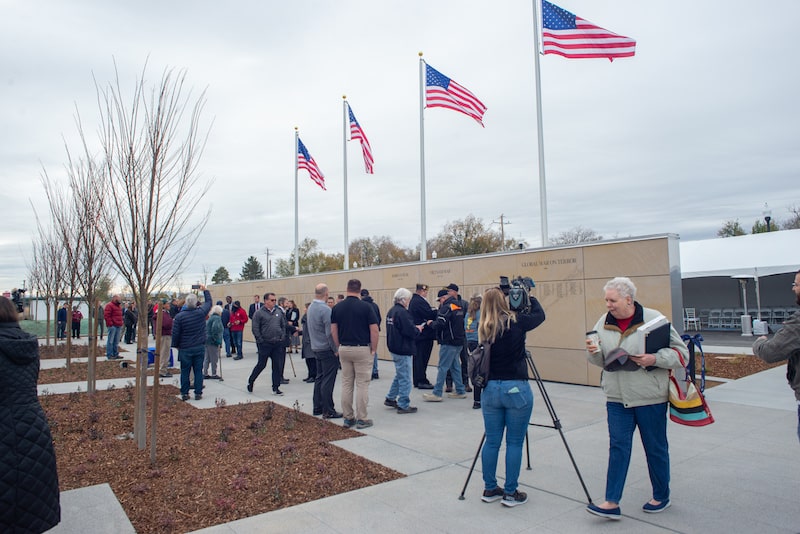
At the opening of the new West Valley City Utah Veterans Memorial. Photos by Mike Jones.


On November 11, 2021, Veterans Day, the city of West Valley unveiled something quite extraordinary. A brand-new tribute, a memorial to the 2,945 fallen Utah veterans. 

The Utah Veterans Memorial was the passion project of West Valley city mayor Ron Bigelow who has worked for many years to see this project come to life. Much time was donated by everyone involved, “everyone had some skin on the table when it came to this project.” Said Thomas Brennan who is a principal at EDA and led the design team that designed the memorial. 

In his speech Mayor Bigelow acknowledged the veterans who donated to see this project come to fruition. Many Utah veterans were in attendance along with Congressmen Burgess Owens and Chris Stewart, who is himself a veteran. 
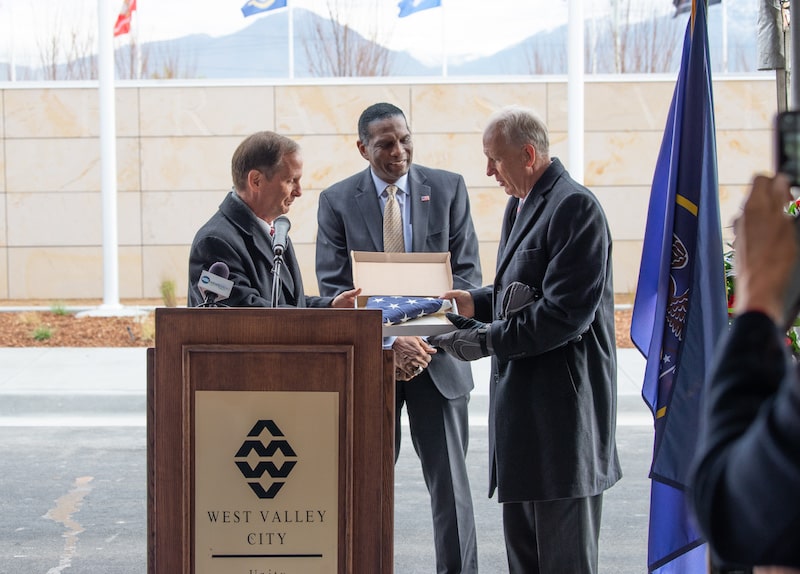
Congressmen Chris Stewart and Burgess Owens present an American flag that once flew at our nation’s capital to Mayor Ron Bigelow of West Valley City.

Chris Stewart said, “Families serve in the military. For every soldier in Afghanistan or Iraq, there is someone at home who is worrying about them and praying for them.” 

Among the veterans in attendance was Ken Gillespie, a veteran of the 68th air rescue, as a medic with the Marine Corps. He did three tours in Vietnam. “I just heard about the memorial  this morning on the news, and I thought, what a great idea, it’s about time. It’s going to be a wonderful place to remember and relax and cry. I’ve got two good friends up on that wall. I am glad they are recognized. This makes me feel really good as a veteran.” 
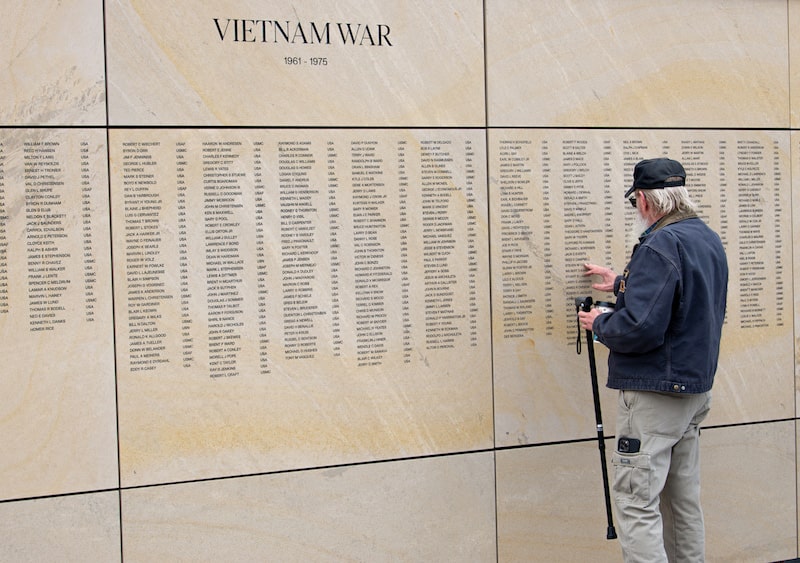
Vietnam vet, Ken Gillespie, finds names of his friends on the wall.

May this forever be a place where families who have served in the military can gather to remember, relax, and perhaps even cry. 

The memorial is going to expand over time, but for now it includes: 

  • Memorial Wall with names of 2,945 Veterans
  • 3 acres and 14,100SF of plaza dedicated to the memorial
  • The Memorial Wall is 75 feet wide, 8 feet high and over a foot thick.  
  • Five American flags at the entry – each of these flags were originally flown at our Nation’s Capital in Washington DC.  Pathway will also be lined with flags representing each military branch
  • All Utah-focused sourced materials such as quartzite sandstone from Browns Canyon Quarry. Which was also used to build the West Valley City police department.
  • The 29 benches throughout the grounds of the Memorial represent the 29 counties in Utah
  • The sandstone monolith at the center is formed in the shape of Utah with cutouts representing the Great Salt Lake and Utah Lake with sides carved to show the Slot Canyon and the canyon’s runoff flow.
  • Stormwater management practices – working with Granger-Hunter Improvement District to keep much of the rainwater retained on site for watering the landscape which include native plants adaptable to this area of the state.

The memorial is located at 3234 S. Cultural Center, Drive in West Valley city.

Subscribe to Utah Stories weekly newsletter and get our stories directly to your inbox

* indicates required


, , ,


Join our newsletter.
Stay informed.


  • Priced Out of Summer Fun? These Activities Cost Almost Nothing

    As summer approaches, many of us start looking for new ways to be active. Whether you’re emerging from a cozy winter of hibernation, or searching for a replacement for skiing and snowboarding, there are inexpensive and accessible ways to get outside, get active, and make the most of summer. 


  • The Utah Bombings That Exposed One of America’s Greatest Forgers

    On an ordinary October morning in 1985, downtown Salt Lake City was shattered by a blast that killed businessman and document collector Steve Christensen. Hours later, a second bomb tore through a quiet Holladay neighborhood, killing Kathy Sheets, the wife of Christensen’s former business partner. The next day saw a third explosion. This one was in a car near Temple Square that nearly killed rare-documents dealer Mark Hofmann. 

    Rumors swirled instantly, tying the attacks to money, religion, and shadowy early-Mormon documents Christensen had recently acquired. For days, Utah held its breath. What unfolded was stranger and darker than fiction. The bombs weren’t the work of religious extremists or enemies of the Church of Jesus Christ of Latter-day Saints, but instead, the doings of Mark Hofmann himself. Hofmann was a nerdy, soft-spoken dealer who had secretly become one of the most skilled document forgers in American history. 

    His creations were so convincing that they reshaped historical narratives, fooling scholars, collectors, and church leaders. When the lies began to close in, the bombs became his final, desperate attempt to keep his world from collapsing.

    Hofmann had been fabricating Mormon and American historical documents for years. He was a prodigy of deception, sourcing period paper, mixing inks that cracked just right, and mimicking handwriting with obsessive precision. Most of all, he knew how to read people. Utah in the 1970s and ’80s was a collector’s paradise. As bookseller Ken Sanders told Salt Lake Magazine, it was “a consciousness shift,” a recognition that rare Utah history was a treasure worth pursuing. It was also, he notes, fertile ground for affinity fraud.

    Nothing captured that vulnerability more than the Salamander Letter, a supposed 1830s correspondence which claimed Joseph Smith encountered a magical white salamander rather than an angel. The document shook Latter-day Saint circles. Church leaders, worried about its implications, quietly purchased it along with other materials Hofmann dangled before them. Many reasoned that if the church was willing to buy it, then it must be authentic and true, and Hofmann understood that psychology perfectly.

    Continue reading and support independent Utah journalism with a purchase of Utah Stories (Digital + Print) or 3 month free trial (Digital).


  • Did Utah Leaders Already Sell Out Tremonton to Big Tech?

    When Kevin O’Leary appeared on Fox Business and casually announced that Utah would soon become home to what could be the largest AI data center project in the world, many Utahns had the same reaction:

    Wait… this was already approved?


  • The Armenian DNA Mystery No One Can Explain

    Joulhayan described ancient remains discovered near the Aras River, near Mount Ararat, where researchers reportedly compared ancient genetic samples with modern Armenians and found remarkable continuity stretching back thousands of years.
    “How could that be?” he asked. “Mongolians attacked. Turks. Persians. Romans. Greeks. Armenian DNA should have changed.”