Development Projects

Living Without Cars in Moab, Utah

A community of residents in Moab, Utah lives without a street and instead lives on pathways not wide enough for cars.

|


Photos by Richard Markosian.

Moab’s Millcreek Parkway: A Story for Locals Only

While vacationing in Moab last month, we found another example of how Grand County residents take ownership of their community. Moabites pride themselves on thinking differently and living deliberately with the notion that closer contact with nature should not entail driving to a destination, but that nature should be integrated into their lifestyle.

The Mill Creek trail has become an artery for the integration of community, nature and growing organic community food. It’s a case study for what can be done when enough “stakeholders” come together who want to create a special place for walkers to experience nature.

We stayed at the Rustic Inn, which has a parking lot that feeds into the Mill Creek trail. On our first evening in town, we walked east to the school and were greeted by signs reading, “Sensory and Snack Garden”, inviting visitors to “taste, touch and smell.” The garden offered fresh, tall kale, corn and tomatoes. The large, flourishing vegetables demonstrate that the gardeners take their work seriously and know what they are doing.

Further east, we walk under giant cottonwoods and silverleaf poplars beside Mill Creek. On our left is a dirt road with park benches. On our right is an asphalt trail for bikers. We see walkers, bikers, and a few homeless people and day campers.
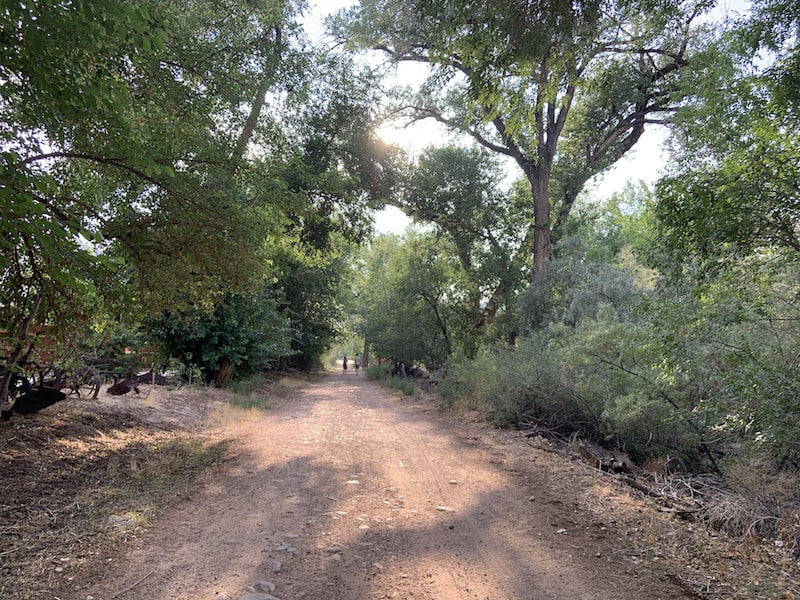
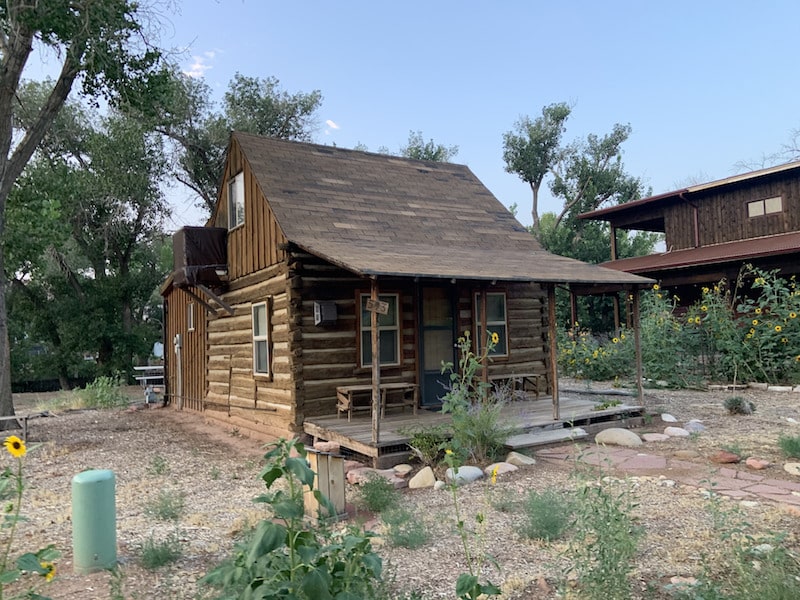
The trail continues through another cottonwood grove to a bridge to the park, but also a community of residents who live without a street, and instead live on pathways not wide enough for cars. There are no garages in front of homes, no curb and gutters, just a five-foot wide path. This allows space for bigger herb and flower gardens, orchards and desert plants. It’s so quiet that the sound of the Mill Creek stream becomes dominant.

The homes are on small lots, but it doesn’t feel small. Dwellings range from small cabins to modern two-stories, but most are under 1,500 square feet. Still, nothing about this community feels “small”. In fact, the landscape feels expansive. The front porches face the small walkways and the back porches facing Mill Creek offer a 360-degree-view of nature. There is a community parking garage for residents’ belongings and cars.

We visit the parks and off-shoots and explore them all. On our second visit I see a resident who has her electric bicycle loaded with groceries. Kids who live here can easily walk down the path to Grand County High School and never encounter an intersection with cars. I realize that they want to keep this all a secret, but Salt Lake City residents should see how it can be done!

The trail further north leads to a big park with picnic tables and grass. The school is surrounded by fields and grass. We followed the trail down into town our last evening and it led to the Moab Community Outdoor Theater, where there are food trucks and live music from a country folk band.

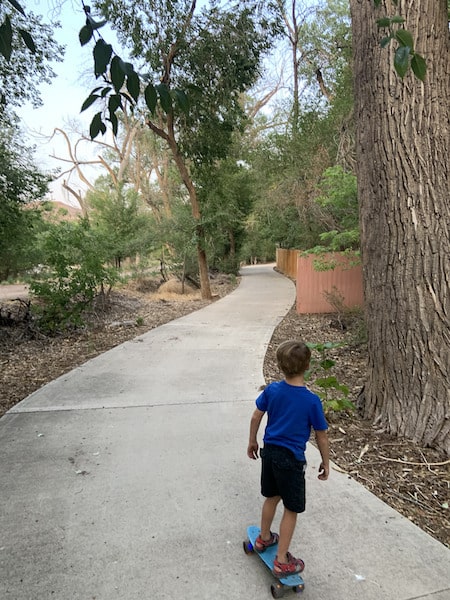
During our two days in Moab, we decided to take a vacation from our car. What’s wrong with hanging around town and walking around? Our six-year-old aspiring Tony Hawk on his skateboard loved it. We didn’t really miss Arches National Park crowds. We did Moab like the locals.
According to Moab Sun News, 18 Moab residents have formed Mill Creek Community Collaborative, where Moab’s Mill Creek stakeholders are working to preserve the trails (about six miles with all spurs included) as well as the waterfall at the far north of Mill Creek called Powerdam. They are ensuring that the booming tourism population keeps quiet (passing a noise ordinance on UTVs) and maintains the trails and vegetation. From what we can see, they are doing an excellent job.

Another conservation group called Rim to Rim Restoration has worked to ensure that the Mill Creek trail keeps all of its indiginious species of plants to attract wildlife. Their efforts certainly seem to be working as we saw many deer, who didn’t seem to mind people sharing the path. Moab locals are indeed doing some great work.

Whatever you do, don’t share this story with tourists. Local efforts are designed to “keep the amenities and trail a secret.”

Subscribe to Utah Stories weekly newsletter and get our stories directly to your inbox

* indicates required


, ,


Join our newsletter.
Stay informed.


  • Inside Moab’s Political Divide: Land, Tourism, and the Future of Grand County, Utah

    In the late 1950s, Edward Abbey took a job as a park ranger at Arches National Monument, just outside Moab. What he found there, and what he watched happen to it, would shape the rest of his life. Roads were being cut into the canyon country. Cars were replacing foot traffic. The National Park Service, in the name of accessibility, was engineering a kind of industrialization of the wilderness he’d come to love. Abbey wrote about it in Desert Solitaire, published in 1968, and the anger in that book wasn’t abstract. It came from watching something specific be changed by people who either didn’t understand what they had or didn’t care.

    Grand County has long been the most reliably left-leaning county in the state, a fact that puts it in sharp contrast to nearly everything around it. To understand how that happened, and where things stand now, I spoke with longtime residents and politicians who’ve watched it from the inside, people who’ve served in local government and lived through the shifts firsthand.

    Robert Greenberg.

    Bob Greenberg came from New York in 1976, took a job at the community mental health center, and never left. He went on to chair the Grand County Democratic Party and serve on the county council. When he arrived, he said, “the Democratic Party was said to be able to meet in a phone booth” — and even then, its members were a contradictory bunch. Yellow Dog Democrats from the oil patch were fiscally conservative but surprisingly open socially, allowing different demographics to feel safe moving to the county. 

    “The town fathers were desperate to have new people come to town,” Greenberg recalls. “They just didn’t want the people who actually showed up. They wanted some other people.”

    What followed was a demographic shift nobody planned. The people who filled the gap left by the bust were river guides, federal agency workers, artists, and eventually waves of outdoor recreationists discovering that southeastern Utah was among the most spectacular landscapes on earth. Tourism ended up being the only economic development avenue that actually worked. Manufacturing never had the labor force or market access, sewing factories came and went. The people the tourist economy attracted tended to be younger, more outdoor-oriented, and more liberal.

    Kevin Walker.

    Kevin Walker, a former Grand County commissioner who moved here in 1990 for the landscape, puts the county’s diversity in context. “Moab [is] a pretty diverse place since, I think, at least the 1950s with the uranium mining boom,” he says. “So it’s not a typical Southern Utah town.” 

    Part of what makes Grand County distinct is self-reinforcing. Federal agencies like the Park Service, the Forest Service, the BLM, have large presences here and pull in a different demographic than surrounding counties. People looking to live in Southern Utah with certain values gravitate toward the place where those values already have a foothold. Over time, that critical mass has made Grand County what it is politically, while neighboring counties went in very different directions.

    The defining conflict in Grand County has always been over land.

    In the 1970s and 80s, it was extraction versus preservation in the starkest terms. County commissioners floated toxic waste incinerators. A plan emerged to site a high-level nuclear waste repository at the entrance to Canyonlands National Park. 

    “It really, really galvanized environmentalists everywhere, but particularly in Grand County,” Greenberg says. Activists put up signs at the park entrance, watched them get chainsawed down, and came back with steel reinforcement. That stubborn, physical, unglamorous persistence became part of the local political character.

    Continue reading and support independent Utah journalism with a purchase of Utah Stories (Digital + Print) or 3 month free trial (Digital).


  • Utah Archaeology Month 2026: Events, Sites, and 13,000 Years of History

    “Utah is filled with 13,000 years of human history,” explains archaeologist and State Historic Preservation Officer, Chris Merritt. “Every single artifact tells us something about the people that came before us, from the first Native Americans entering what we now call Utah to the remains of the uranium mining industry. Each layer of the past tells more of the story of who we are as Utahns.”


  • Ogden Utah: Boomtown, Bargain, or Utah’s Next Unaffordable City?

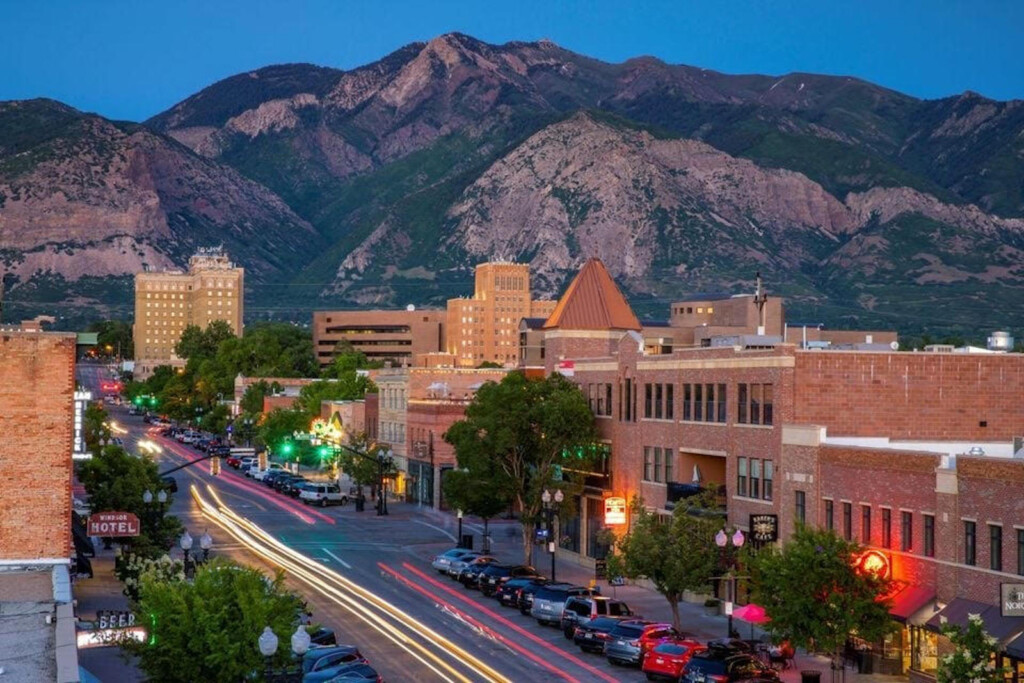
    With its reinvigorated downtown and close proximity to mountains and river pathways, this northern Utah city is enjoying a renaissance. Ogden’s stock of affordable housing — compared to other metros along the Wasatch Front — currently draws people in for a closer look. 


  • The End of an Era? FanX and the Salt Palace Closure

    For more than a decade, FanX has called the Salt Palace home. With the convention center set to close for a massive renovation, founder Dan Farr is preparing for a new chapter while planning one final celebration in its longtime venue.