The Road Work That Never Ends.
When will 3900 S in Millcreek be complete?
It only took 20 years to build the Great Pyramid at Giza, but many Millcreek and Holladay residents are wondering whether they’ll live long enough to see the completion of 3900 S between 2300 E and Wasatch Blvd. — a mere mile-and-a-half section of road. With only one lane in each direction, it’s not exactly the eighth wonder of the world, so why is it taking so long?
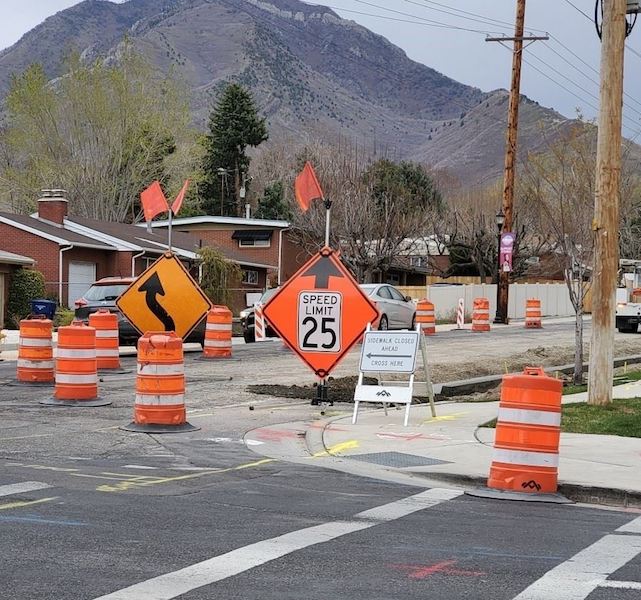
The project, now in its third year, has been a nightmare for residents and their cars. Lane closures, broken asphalt, loose gravel, trenches, flag persons, detours, steel plates, signs, residents’ garbage cans, and those ever–ubiquitous orange barrels have been raising motorists’ hackles and prematurely aging them and their vehicles for far too long. The road is a veritable minefield of potholes and other hazards, and drivers are encouraged to use alternate routes. But despite all the chaos, work seems to be progressing at a snail’s pace.
Full roadway reconstruction began in early 2021, although the project has been a navigational nightmare for drivers and residents since 2019 due to preparatory and utility work. Gas and water lines were upgraded, and Dominion Energy performed maintenance work on the natural gas line between 2300 East and Wasatch Boulevard.
According to the 3900 South Improvements Public Involvement Team, “ … other utility providers like Rocky Mountain Power, Comcast and CenturyLink were required to relocate their lines, poles and boxes before major roadwork could start. The construction schedule was lengthened to allow the utility companies adequate time to complete their work. Upgrading and relocating these utilities ahead of time will prevent the new roadway from being torn up again. This will ultimately save time and money for the cities and nearby residents.”
Because the boundary between Millcreek and Holladay runs right down the center of 3900 S, rumors persisted among residents that there was financial friction between the two cities regarding who would pay for what. Complicating matters, it was also rumored that there are federal funds involved as well.
The Public Involvement Team provided clarification, stating that, “Millcreek and Holladay are full project partners, beginning from the concept phase of the project to securing funding and determining design details through construction. The cities worked together to secure $8.7 million dollars in grant funding for the project — $4 million from the Federal Surface Transportation Program administered by the Wasatch Front Regional Council (WFRC) and the Utah Department of Transportation (UDOT) and $4.7 million awarded from the Salt Lake County Transportation Choice program. The cities are equally sharing the costs of the project, however, because of the multiple grant sources, there is essentially no cash participation required from either city.”
Additional questions and answers include the following:
What type of work is being done and why is it taking so long?
“Part of the reason construction seems to be taking additional time is because there were a few separate utility projects in the same area prior to the start of the cities’ 3900 South Reconstruction project. Those projects took place between 2020 and early 2021 and included a major waterline upgrade by Salt Lake City Public Utilities and a gas line upgrade by Dominion Energy.”
When did construction start and is there a deadline for completion?
“The 3900 South Reconstruction project started in February 2021 and is anticipated to be complete late 2021. However, construction schedules are dependent on several factors like weather, equipment, materials and crews. The construction schedule is subject to change.”
Who is the general contractor?
“Acme Construction is the general contractor.”
Is there any connection/kinship between the leadership of Millcreek City and/or Holladay City and the company doing the work?
“There are no known conflicts of interest. Multiple entities have partnered together to deliver the project, some of them include Millcreek, Holladay, UTA, UDOT, WFRC, ACME Construction and their subcontractors. A multi-municipal local government project of this size takes collaboration between all stakeholders. Millcreek and The City of Holladay are grateful for the patience their constituents have had to bring this much needed project to them at no cost.”
In addition to new asphalt pavement, the completed road will include several new safety and mobility features as part of the project:
- New sidewalk, curb and gutter
- New bike lanes
- Upgraded pedestrian signals at 3100 East, Birch Drive and Mercury Drive
- Improved drainage
- Enhanced Utah Transit Authority (UTA) bus stops
- Street lighting
Residents, drivers, and pedestrians alike look forward to the completion of this project with equal anticipation. Like the Great Pyramid, it’s sure to be worth the wait. U
Thanks to Brittany, with the 3900 South Improvements Public Involvement Team, for her kind assistance in providing information for this story.
For more information, contact the project team at (801) 509-6639 or 3900southproject@gmail.com.
Subscribe to Utah Stories weekly newsletter and get our stories directly to your inbox