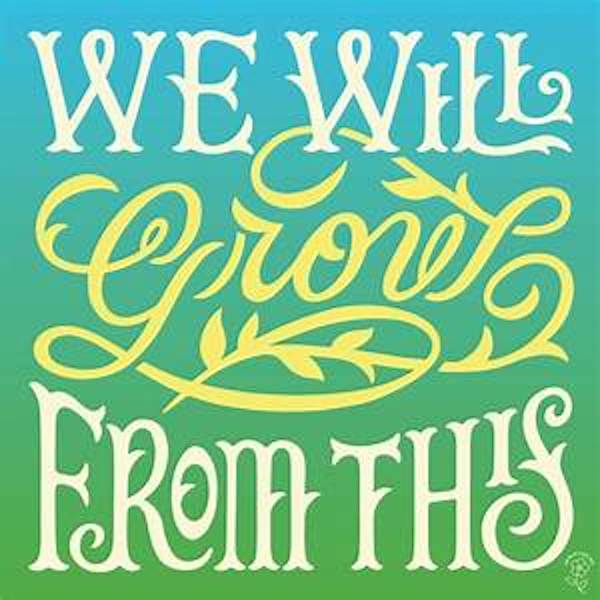
As I stood on the closed (for construction) sidewalk in Sugar House looking at the Art for Hope exhibit on the former Deseret Industries Building, I saw different interpretations of hope, encouragement, peace, and unity. Encouragement from “We Will Grow From This,” by Ann Chen; Colleen Marshall’s “Caped Healthcare Worker,” recognizing our healthcare workers as superheroes coming to our rescue; an offering of peace to the world with “Hands Releasing a Dove” by Aljay Fuimaono; and “‘Black Life Matters,’ ‘Love is Love,’ ‘Our Hearts are not for Sale,’ and ‘Speak Up,’” are the messages in Robyn Briggs’ art. These are just a sample of the art that spoke to me about the wild roller coaster ride of 2020.
Salt Lake City Redevelopment Agency’s, (SLCRDA) Art for Hope SLC is “a public art project inspired by the need to bolster community strength amidst current local, national, and global challenges,” according to their website.
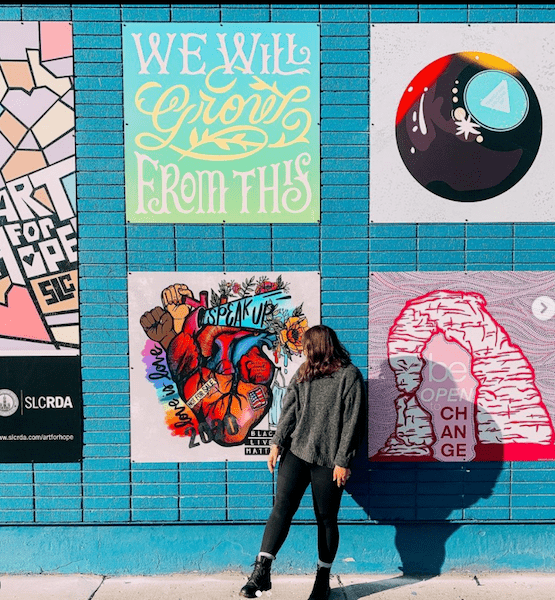
“One of Salt Lake City Mayor Erin Mendenhall’s year-one priorities was to bring public art to new places,” says Amanda Greenland, Communication and Outreach Manager at SLCRDA. “The Redevelopment Agency of Salt Lake City saw a unique opportunity to use our properties being readied for redevelopment as canvases for public art that would provide messages of hope, resilience, and unity.”
One of the goals of this project was to make it available to as many artists as possible in response to the pandemic. “The program was designed around multiple smaller commissions instead of one large commission that would benefit a single artist or a small number of artists,” says Greenland.
“It’s an honor to have my art displayed next to so many talented locals, and seeing the different perspectives that grew from the theme of resilience and unity,” says Ann Chen, Art for Hope artist. “Being part of this project also makes me feel heard and hopefully my art and message will make someone else feel the same way.”
Chen’s design, “We Will Grow From This”, is in hand-drawn lettering. Her message is a pledge for strength, progress, and resilience. “I used green, blue, and yellow to symbolize growth, compassion, and optimism,” says Chen. “My inspiration comes from the innovation over the obstacles surfaced by the pandemic, as well as the rising inequality amidst the devastating loss of lives.”
“I hope my art will bring a sense of unity and determination to repair and grow from this adversity through active participation in the progress of our country,” says Chen.
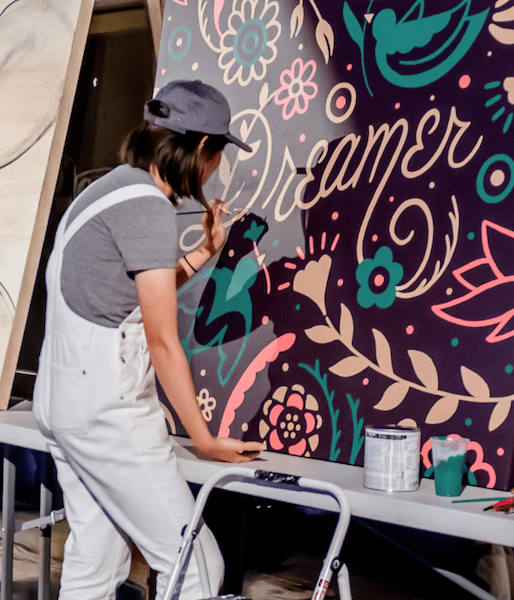
There is a diverse range of artists. Some were just starting their careers when the pandemic hit and others were already established artists who have contributed to the Salt Lake City public art scene. “You’ll see a variety of mediums including paintings, poetry, graphic design, and photography,” says Greenland. “Each work is positive and hopeful.”
The exhibit can be seen at 2234 South Highland Drive in Sugar House or the virtual gallery online
Subscribe to Utah Stories weekly newsletter and get our stories directly to your inbox