Utah Stories

Greenhouse Effect Celebrates 20 Years of Salt Lake Food and Culture

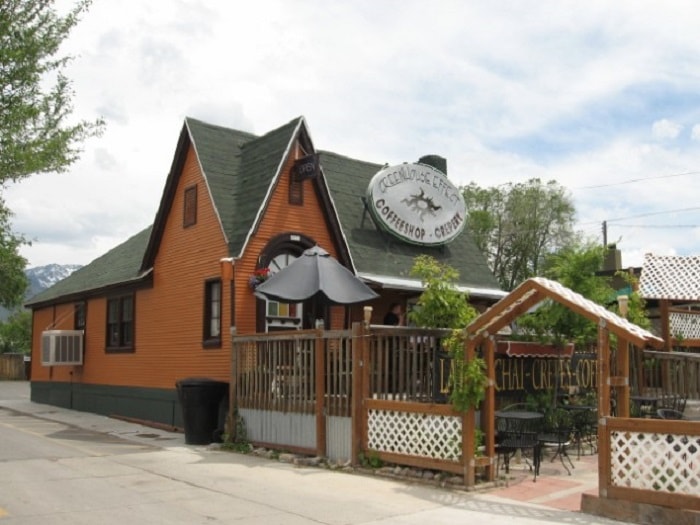
 The Greenhouse Effect Cafe (locally known as “Greenhouse”) stands in warm opposition to the sterile and imperialistic encroach of other coffee franchises. The mother-son team operates on a first-name basis with their customers: Maria and Jimmy Kosmas.

|


If you’re cruising down 9th East in Millcreek, you may inadvertently pass right on by one of the coziest coffee shops in Salt Lake City, Greenhouse Effect.

 You want slow-living and the nourishment of local art and culture? Come on in.

 The Greenhouse Effect Cafe (locally known as “Greenhouse”) stands in warm opposition to the sterile and imperialistic encroach of other coffee franchises. The mother-son team operates on a first-name basis with their customers: Maria and Jimmy Kosmas.

It all started twenty years ago with one long bar and a bit of drip coffee: zero frills.

“John Venezia and Joe Ballato partnered up, and they were the ones who bought it and lived in the back of this little house and used the front as the pouring station.” Jimmy recalls.

“They had several long picnic tables outside, and I started coming as a misfit teenager. After getting my undergraduate degree in psychology, I was sitting out on the benches and decided that I wanted to create a safe haven. I realized I wanted Greenhouse.”

In the early 2000’s, their unadorned patio was where you would see clouds of conversation and puffs of smoke any time of day or night. Most patrons were college students, some were young workers; all of them were welcome.

Jimmy said of buying it, “We’ve put a lot of love into it.” The community responded in kind, and that’s when the local art was hung and poetry readings were held. There are whispers of Jimmy and Maria helping out struggling souls in the city, too.


“Greenhouse was my safe space.” Colten Davis confesses over a mug of Chai, looking homey in a nook near a window and some well-loved board games. Davis moved to Utah from Wyoming and didn’t know a soul. He had just come out as gay and loved the city. He found safety in the comfort of the coffee shop.

Davis is not the only one. Lars Dahlquist was able to express himself in art, poetry and music every week for years. “Jimmy and Maria had an effect. Greenhouse holds space.”

Lars’ friend Samantha Nelson chimes in. “I started coming around 2012 and it was rowdy, crowded and emotional. That’s why we keep coming back–to not feel alone.”

Jimmy grows even softer. “I realized that I didn’t feel welcome in the world because I didn’t feel welcome in my own skin. I wanted to create that after I found it for myself.” Dahlquist, Davis, and Nelson are proof of just that.

Jimmy builds stages on the side; Greenhouse Effect is his lasting community stage.

Places like this seem to be the essential fabric of a town–topiary taller than you; a fresh hit of spices that kiss you when you open the squeaky door; a paintbrush daub of red hair on a delicate and graceful barista; local magazines and a well-loved haphazard library; a leather couch with the consistency of a puppy’s ear.

How many artists and writers have gathered at these wooden tables to trace the grain while confessing their love or loss? Or toasts to celebrating acceptance to graduate school or pieces curated into museums? How many embraces over steam occurred or applause heard under the one hundred year old roof of this little cafe?

Greenhouse has been making house coffee and sloppy love for twenty years; here’s to twenty more.

, , , , ,

Join our newsletter.
Stay informed.


  • Sugar House Restaurants on the Rise: New Spots Reshaping the Neighborhood

    Sugar House is in the middle of a full-scale dining shift. Over the past two years, new openings, relocations, and rebrands have reshaped the neighborhood, bringing everything from shabu-shabu and Thai curries to steakhouse cocktails, food-hall energy, and century-old LA flavors. These additions are changing how locals eat, gather, and think about Sugar House as a dining destination.

    To access this post, you must purchase Utah Stories (Digital + Print) or 3 month free trial (Digital).


  • What’s Behind the Buzz Around The Salted Roots?

    Salted Roots began as simple kitchen experiments and quickly grew into one of Utah’s most talked-about small-batch food brands. Founder Ivy Watrous has been cooking since childhood, blending bold flavors with careful technique. Today, her handcrafted salts and sugars are showing up in farmers markets, home kitchens, and even cocktail menus — each one shaped by personal stories, long hours, and a commitment to doing things the hard way when it matters.


  • Cold Case Ice Cream: Utah-Made Mystery

    Cold Case Ice Cream is delivering more than dessert. With high-butterfat, inclusion-packed flavors and a built-in mystery game inside every six-pack, the Utah-born company is gaining national attention and gearing up for major production growth.


  • Utah Craft Whiskey: How Barrels and Utah’s Climate Shape Flavor

    Utah’s craft whiskey scene is shaped by more than grain, yeast, and time. The state’s dry climate plays an unusually powerful role in how spirits age, intensifying the relationship between whiskey and the barrels that hold it.

    Low humidity accelerates evaporation during aging, often claiming 14–18 percent of a barrel’s contents as the “angel’s share.” Unlike more humid regions where alcohol evaporates faster, Utah barrels tend to lose more water, concentrating flavor and driving proof upward over time. That accelerated interaction pulls sugars, tannins, and spice from the wood more quickly, creating whiskeys that often taste older and more structured than their age statements suggest.

    To understand how Utah distillers are deliberately harnessing climate, char, and finishing barrels to shape flavor, two producers at the forefront of that experimentation — Sugar House Distillery and Spirits of the Wasatch — shared how barrel choices influence everything from sweetness and spice to texture and proof.

    *The remainder of this article is available to Utah Stories subscribers and includes in-depth reporting from Utah distillers on barrel selection, aging techniques, and experimental finishes.

    To access this post, you must purchase Utah Stories (Digital + Print) or 3 month free trial (Digital).