Community Relations

Top Hat Video: Get the Popcorn!

Even today, with Redbox everywhere and the ease of downloading movies from streaming services, Top Hat Video still sign up 10 new memberships every week.

|


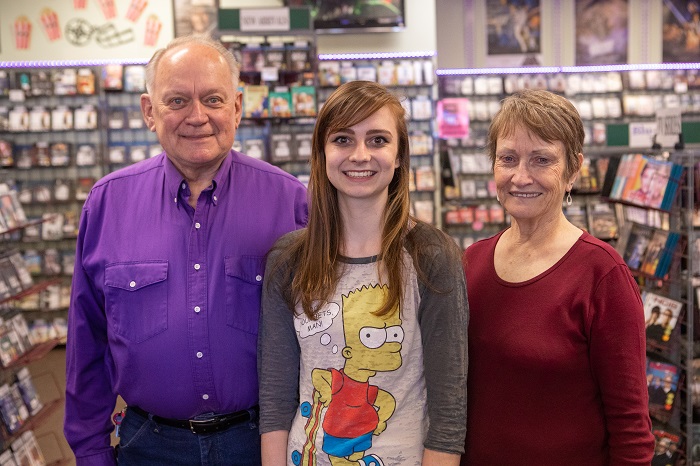
Lee and Lona Earl with Matti Earl in the Top Hat Video store in Bountiful. Photos by Bryan Butterfield: imageandfilm.com

In 1983, when every street corner had a video rental business, Lee and Lona Earl got in on the ground floor with a franchised Adventureland Video store. They started out at Five Points Mall in Bountiful and remained with Adventureland until that business closed.

They looked at options with Aardvark Video or Warner Video. They chose instead to venture out with a group of like-minded business people and started their own franchise with Top Hat Video. There were originally ten stores across the state. Now, of the 500 former Adventureland stores and the 10 original Top Hat stores, Lee and Lona have the last one standing.

“Redbox took a lot of video stores out, more so even than internet and downloading,” Lee said. As empty storefronts closed one after another, how did the Earl’s stay in business? A lot of it had to do with their background in restaurant management.

They brought along the marketing ideas they gleaned there, adapting concepts they learned such as a daily special and lots of variety.
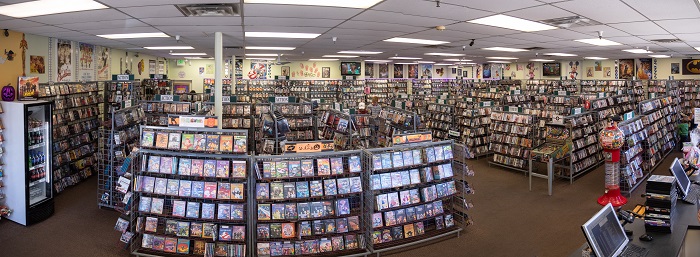
“Most video stores ordered multiple copies of new releases. Instead of ordering 100 of a title, we ordered 10 and focused on classic movies and a huge family section that other stores didn’t offer,” Lee said. The difference kept them going and kept them thriving.

Lona said, “It is like the Coke commercial that says ‘Just do you.’ That is what we do—what is good for us.”

Another difference is their employees. Rather than sitting behind the counter, their associates are friendly to everyone that comes in and they all get out and mingle with the customers. They actually assign employees to be on the floor and visit with people. It is a personal touch that leaves people thinking that all 18 employees are family.

They have people who have worked with them since high school, gone on to graduate college, started a career, and still want to work one or two days a week at Top Hat.

Even today, with Redbox everywhere and the ease of downloading movies from streaming services, they still sign up 10 new memberships every week. They have customers who came in as kids with their parents who now bring their own kids to rent a video.

A favorite of the customers are the end cap promotions the employees design. They can highlight an actor, director, or themes such as remakes, or anything from Shakespeare. Film students from local universities add a lot with their extensive knowledge of film and film trivia.

Customers still turn in requests for a favorite movie. With an inventory of 35,000 movies, they can take care of most requests, and will work to get anything they don’t already have in the store.

And what are the favorite movies of these movie lovers? Lee has a special love for Young Frankenstein and displays an autographed picture from the film in their family room. But, Lona said, “If we were going to heaven and could only take one movie, it would be Show Boat from 1951. We just love it.”

Top Hat Video is located at 521 W 2600 S, Bountiful. 801-292-2221. Visit their website

, ,


Join our newsletter.
Stay informed.


  • Can Utah Farms Survive the Corporate Food System?

    Local farms and restaurants battle similar economic pressures as they struggle to survive in a tight economy where slim profit margins and increased labor costs and conditions are often beyond their control.


  • The End of an Era? FanX and the Salt Palace Closure

    For more than a decade, FanX has called the Salt Palace home. With the convention center set to close for a massive renovation, founder Dan Farr is preparing for a new chapter while planning one final celebration in its longtime venue.


  • The Stratos Project and Corporate Power: Who Controls Utah’s Future?

    If we were all just consumers, Governor Cox, Mike Lee, Speaker Schultz, and Kevin O’Leary would have it easy. If we were just more concerned about money, jobs, and tech, and less concerned about raising our kids in communities (not in front of screens), culture, the environment, and water, those smart dudes would get exactly what they want — Stratos: a city of the future, buzzing with processors and transistors, making all of our AI dreams come true! 

    The world we could live in would be a dazzling, Mr. Wonderful kind of place. We would beat those pesky Chinese in the AI war; our AI robots could do all of our farming and ostensibly harvest the water we need for the Great Salt Lake out of thin air. But apparently, we just don’t get it. We haven’t yet reached the point predicted by Aldous Huxley’s vision in Brave New World, where we are completely distracted, dopamine-driven consumers who only need sex, drugs, and stuff to remain happy.

    Maybe Stratos will be an amazing marvel, and somehow, as Governor Cox claims, “. . . add more water to the Great Salt Lake.” But we aren’t sold. While this Stratos project has received considerable attention, it’s worth taking a step back to attempt to understand how corporate power appears to have usurped civic power.

    Civics is the practice of shaping our society through our collective voices and community involvement. Ask the residents in Tremonton, Utah how well that is working out for them. Can we still shape our world through our elected leaders? Does it matter who we vote for at the ballot box if organizations like UDOT, UTA, and MIDA can supersede our local government authority and citizen backlash? 

    The corporatization of our communities and the interests that impact our political leaders’ decision making processes are seen as far more of a concern than the average Utah resident’s concerns. Special interests and corporate power are shaping Utah’s future more than ever. 

    It’s worth asking: ‘How can we regain control over shaping Utah’s future in light of the growing power and billions that the technocrats now wield in shaping our world today?’ Amazon’s market cap exceeds the GDP of Canada. The “Magnificent Seven” tech stocks now have a greater market cap than the entire GDP of Europe ($23.6 trillion. EU countries have $19.3 trillion GDP). Will tech companies become their own nation-states and dominate their own chunks of various states? Will we become their subjects?

    There are two sides to this coin: We love Utah not just because we have the most outdoor wilderness playgrounds, but also because of Utah’s prosperity and job market. This is because Utah has become a tech hub. Our tech leadership has minted several billionaires and billion-dollar businesses. Utah offers a market and an educated workforce that more businesses and giant corporations want to be a part of. This is a benefit for even non-tech Utahns.

    The problem with this success is that as we dole out more money to attract more tech businesses, data centers, fulfillment centers, and big corporate retailers, it becomes more difficult to carve out our “sense of community.” As corporate sovereignty replaces local business sovereignty, we see that our voices and our votes matter less.

    Ask who our politicians work for, and nearly every Utahn believes they work far more for their corporate donors than they work for the average Utah citizen. So how do we best regain control over our communities?

    Continue reading and support independent Utah journalism with a purchase of Utah Stories (Digital + Print) or 3 month free trial (Digital).


  • The Art Floral: 75 Years as Salt Lake City’s Family-Owned Florist

    At 580 East 300 South in Salt Lake City, The Art Floral stands as one of downtown’s most enduring family businesses. In an era of overnight startups and short-lived storefronts, three-quarters of a century feels almost radical. Once inside, the air shifts, greenery mingles with fresh flowers, while tissue paper rustles, and shears snip rhythmically.