
“I left my heart in…”
We all know how that song lyric goes. But Salt Lake City crooners can take heart—there are songs that celebrate SLC as well.
Songwriter Doug Wintch added to the list when he wrote Salt Lake City in 2013. Wintch said he based his song on “a guy who used to sit at the bar down at D.B. Cooper’s and cry into his beer over a long lost high school sweetheart.
“I don’t remember it happening so much in recent years, but Salt Lake used to have these intense storms that would whip across the salt flats and the west desert before hitting town. The wind would kick particles of salt and dust up into the clouds, which would mix with the falling rain. By morning, the paint on your car or truck would be splattered where the ‘great big salty tears’ had fallen the night before.”
Wintch has been playing guitar and composing for the past 40 years. He remembers that “It took a good ten or twelve years to write the song, which I don’t recommend, but I didn’t know what I was doing … ha! I made up the first version in 1979. It survived a bunch of revisions and finally got recorded in 1993. It’s on my debut CD called Wooden Nickels.”
The tune includes the catchy lyrics:
It ain’t the place for everyone, except when it snows
It’s rainin’ great big salty tears tonight.
Wintch plays Salt Lake City at almost every show he performs, and says, “I intend to gig for as long as anyone will have me.” He does shows every month for the Heart & Soul organization, with his duo partner, Anke Summerhill.
By writing about Salt Lake City, Wintch joins a list of composers including the great Johnny Mercer, who in 1943 wrote, I Lost My Sugar In Salt Lake City.
Chanteuse Peggy Lee and pianist George Shearing popularized this song in the 1960s, just about the time the Beach Boys’ song Salt Lake City appeared on their Summer Days album.
Although surfing the Great Salt Lake left much to be desired, Brian Wilson and company were headliners at the Lagoon Amusement Park and sang to the crowds:
The guys and I dig a city called Salt Lake
It’s got the grooviest kids.
The city took a Country and Western turn when Hank Williams Jr. recorded Salt Lake City. Of course, there was a lost love involved. How could there not be? Williams sang:
I should pick up my things and go
But my heart keeps saying no
Some day she’ll come back to me and Salt Lake City.
A different take on the town was offered by the punk rock band The Dwarves when they wrote their raucous anti-anthem Salt Lake City. Their lyrics went:
There isn’t anything I wouldn’t do for you
Except for the one thing you want me to
I’m not going to Salt Lake City!
The reasons are varied as to why cities inspire songwriters. Maybe it’s a heartbreak. Maybe it’s a road trip. Had the team of Jerry Soller and Mike Lieber looked further west than Kansas City, they might have written:
Salt Lake City, Salt Lake City here I come
They’ve got some lime green Jell-O there
And I’m gonna get me some.
Look for upcoming performances by Wintch on his webpage and listen to his song on YouTube.
U. Utah Phillips—An Appreciation
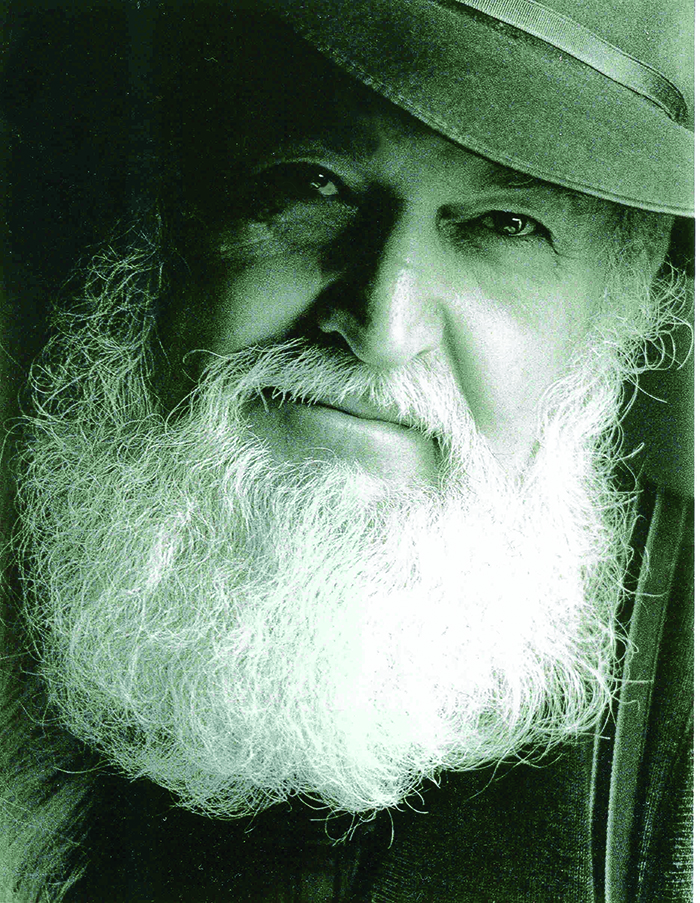 A person needs a lot of heart to take a state as a first name. U. Utah Phillips had such a heart. Born Bruce Duncan Phillips in Cleveland in 1935, Phillips combined a life of activism and music until his death in 2008.
After the family moved to SLC, Phillips attended East High School and served in the army for three years in the 1950s. Seeing the effects of a war-devastated Korea influenced his turn to social activism. He rode the rails, composed songs, and championed the Industrial Workers of the World (Wobblies).
His standing in the folk music community grew and he mentored Kate Wolf and Ani DiFranco, and wrote songs performed by Emmylou Harris and Tom Waits.
In later years he settled in Nevada City, CA, and helped found a homeless shelter called the Hospitality House. He attributed his musical success to his belief that “It is better to be liked than talented.”
To see more of Chris Bodily’s artwork visit his website.