Utah Chefs

Chef Anny Sooksri brings Thai Food to Murray and Midvale

Visit Chabaar, Beyond Thai in Midvale of Tea Rose Diner in Murray to try chef Anny Sooksri’s Kow Soi, or try it at home following her recipe.

|


OLYMPUS DIGITAL CAMERA
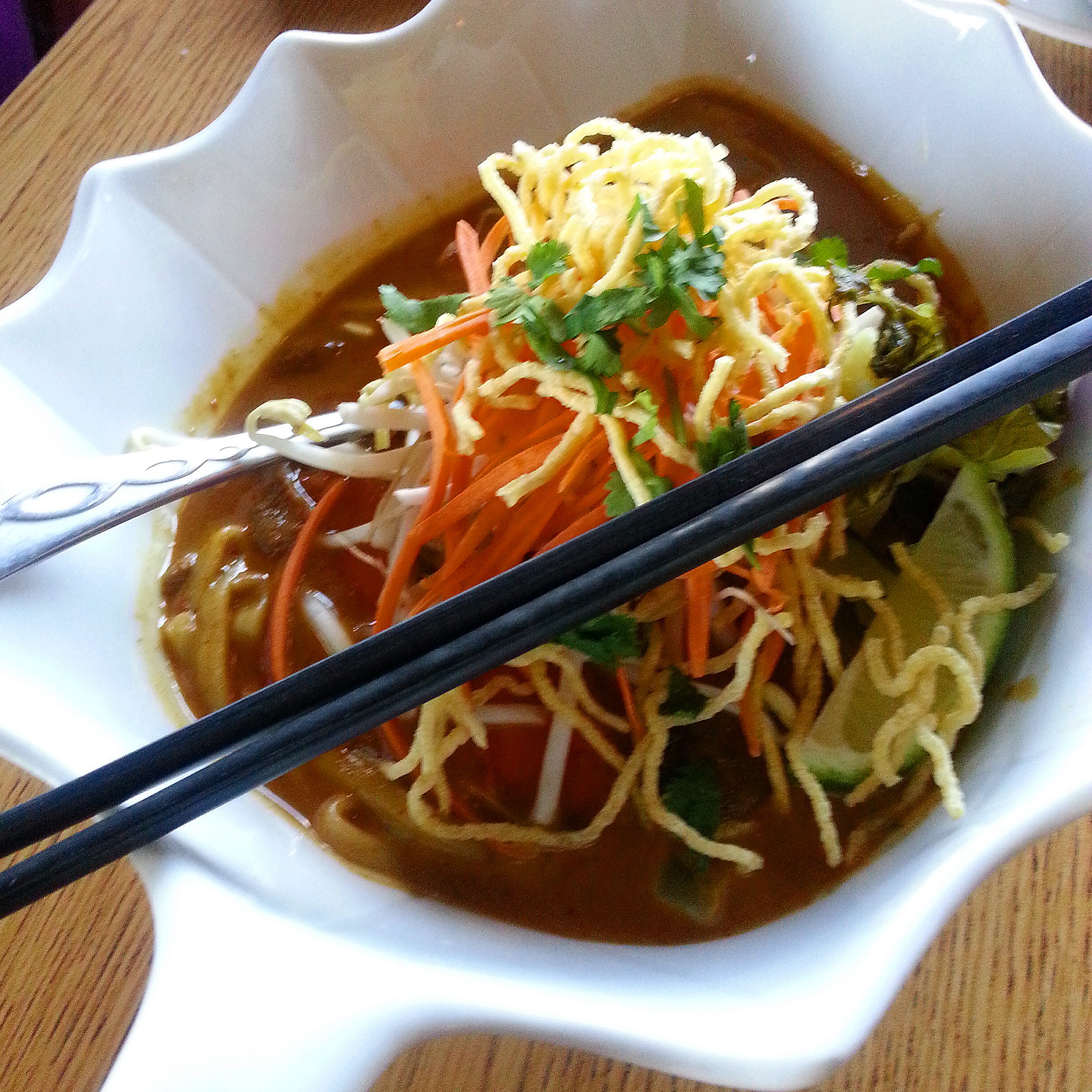
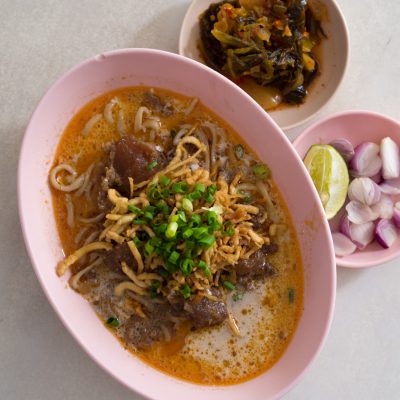
Kow Soi – Photos by Heather L. King

Chef Anny Sooksri’s energetic personality is matched only by her knowledge and passion for Thai cuisine. She is the chef and owner of three Thai restaurants in Salt Lake, including Chabaar, Beyond Thai in Midvale, and Tea Rose Diner in Murray.

Her signature dish served at Tea Rose and Chabaar is Kow Soi, an authentic curry dish from northern Thailand distinguished by the creamy coconut curry served over soft noodles and topped with crunchy noodles. The traditional protein of the dish is either skin-on chicken thigh or bone-in stewed beef.

Sooksri recalls her first introduction to Kow Soi when she was just 10 or 11-years-old. She was visiting her mother’s close friend in Chiang Mai one summer when she discovered “the creamy, crunchy and indescribable deliciousness of all those flavors. It’s like a party in your mouth,” she says.

After arriving in Utah, Sooksri was unable to find a Kow Soi similar to the one she ate growing up, so she set about creating it the way she remembered for her customers. “The chile paste is made with dry chile, ginger, salt, coriander, cilantro root, shallot, turmeric, black cardamom and curry powder, then cooked in coconut milk,” she says. The pungent, thick coconut gravy is served with your choice of meat (chicken, beef, pork, shrimp, fish or tofu) over egg noodles.

She continues, “In Thailand, they usually serve it with a side of diced shallot, pickled mustard greens and fried chile in oil. At Chabaar and Tea Rose Diner, we serve those on top plus bean sprouts.” Shredded carrot, red onion, basil and lime also accompany the dish.

Sooksri has further adapted the recipe for Kow Soi to suit her many vegan and vegetarian customers by omitting the traditional shrimp paste so everyone can enjoy her signature meal. She also grows her own cilantro to collect the root and use it in the curry paste as well as making the restaurants’ own probiotic pickled mustard greens. “As I stress to all my customers, probiotic fermented vegetables and herbs are very beneficial to our body. I want the best for me and my people, especially my customers.”

Find Sooksri’s Kow Soi at either Chabaar, Beyond Thai, 87 W 7200 S, Midvale or Tea Rose Diner, 65 E 5th Ave, Murray

Recipe for Kow Soi (2-4 servings)

For the curry paste:

5-6 big dried chiles

3 Asian shallots

3 cilantro roots

2 oz. ginger

2 fresh grated turmeric

Dry ingredients:

Black cardamom

Clove

Coriander

Sea salt

Curry powder

For the curry:

12 oz. diced beef for stew

1 cup coconut cream

2 cups coconut milk

2-3 large carrots

2 Tbsp. palm sugar

1 Tbsp. tamarind sauce

2 Tbsp. fish sauce or soy sauce

1 package of egg noodles

Oil for frying

For garnish:

Diced shallot or red onion

Fried dry chile

Bean sprouts

Shredded carrot

Cilantro

Lime

Instructions:

To make the curry paste, soak the dry chiles in water for 5 minutes. In the meantime, turn on a burner to medium heat, and put all dry ingredients into the pan without oil. Toast until it turns brown and has a nice aroma. Turn on another burner and place all the beef into a pot. Sear it on all sides then add coconut milk. Let it simmer until the beef is tender and can easily be seperated with a fork.

Put all the fresh ingredients for the curry paste into a blender, then add the toasted dry ingredients and blend until it turns into a fine paste. Spoon the paste and coconut cream into the beef and coconut pot, add carrot and bring to a boil. Season with palm sugar, fish sauce and tamarind sauce.  

Take half of the egg noodles and deep fry them until they are puffed and crispy. Fry a couple of dried chilies and set aside. Boil the remainder of the noodles in water until soft and place them in a serving bowl. Pour the curry over the noodles and garnish with the diced shallot, bean sprouts, shredded carrot, cilantro, lime and fried chili. Serve hot.

,


Join our newsletter.
Stay informed.


  • Whiskey, Bullets & a Buried Town: Archaeologists Reveal Alta’s Wild Past

    Before Alta was known for powder days and lift lines, it was a silver mining town clinging to the side of a narrow canyon. In the late 1800s, men lived at 8,000 feet, went underground each day, and endured winters that regularly buried buildings in snow. This past summer, that mining town resurfaced — literally — during construction at the Alta Ski Area.

    To understand what Alta really looked like, you don’t begin with legend. You begin with its trash — and this time, that happened almost by accident.

    Alta Ski Area was installing underground water reservoirs to support snowmaking. Because the project sits on Uinta-Wasatch-Cache National Forest land, an archaeologist was required to monitor the excavation. No one expected the trench to produce much.

    But, It did.

    Artifacts began surfacing almost immediately. Enough that the Forest Service contacted the Utah State Historic Preservation Office for help. Lexi Little, who coordinates the Utah Cultural Site Stewardship Program, helped mobilize nearly 30 volunteers to assist with what quickly became a focused two-week excavation.

    Winter deadlines were approaching. The pipes for the reservoirs had to go in the ground. There wasn’t time for a slow, extended dig.

    “It was two weeks of digging in the dirt and helping figure out exactly what we were looking at,” Little said.

    Most of the people screening soil weren’t professional archaeologists. They were trained stewards from around Utah — part of a statewide volunteer network that now approaches 500 people. They poured dirt through shaker screens, scanning for fragments that could piece together a town long buried.

    “Archaeology is human trash,” Little explained. “Archaeologists are very into trash.”

    Alta had left plenty behind.

    https://youtu.be/hzIHzx3OGoo?si=dKcl2CEz-t6FZzYw

    Victorian-style ceramics appeared first — the kind typically used in hotels. Medicine bottles followed. Ink bottles. Hand-blown glass. A porcelain doll’s foot surfaced from the soil, a small detail that shifted the mental image of the town. Families were here. Children were here. This wasn’t only a camp of miners.

    The bottles helped establish time. Manufacturing details — whether glass was hand-blown or mold-made, whether a maker’s mark appeared on the base — allowed archaeologists to date many of the artifacts to the 1870s through the 1890s, when Alta was booming as a silver mining town.

    “That gives you that range of dates for when Alta was really booming,” Little said.

    One reusable soda bottle clearly stamped “Salt Lake City” connected the canyon to the valley economy below.

    Then something unusual rolled out of a dirt pile.

    A corked bottle. Intact. Liquid still inside.

    Continue reading and support independent Utah journalism with a purchase of Utah Stories (Digital + Print) or 3 month free trial (Digital).


  • How Horses Help Kids Heal: Inside Utah’s Equine Therapy World

    Kelty Johnson trains horses for a living, but her deeper work happens in the quiet space between animal and human. On the Utah Stories podcast, she explains how equine therapy helps children regulate emotions, build confidence, and reconnect through presence rather than pressure.


  • Angela Brown: The Woman Behind SLUG Magazine and Craft Lake City

    Angela Brown is the publisher and owner of SLUG Magazine, one of the city’s longest-running independent publications and a central voice in Utah’s alternative arts and music scene. She is also the founder of Craft Lake City, a nonprofit that has grown into one of the state’s largest platforms for local makers and creative entrepreneurs.


  • Can Utahns Still Afford to Have Kids?

    When families cannot afford homes near their jobs, the daily math becomes brutal. Commutes stretch longer. Childcare costs pile up. Mortgages consume more of a household’s income. The result is what economists call “house-poor” families—people who technically own a home but have almost nothing left over to live on.

    The obvious question is: why isn’t this being fixed?