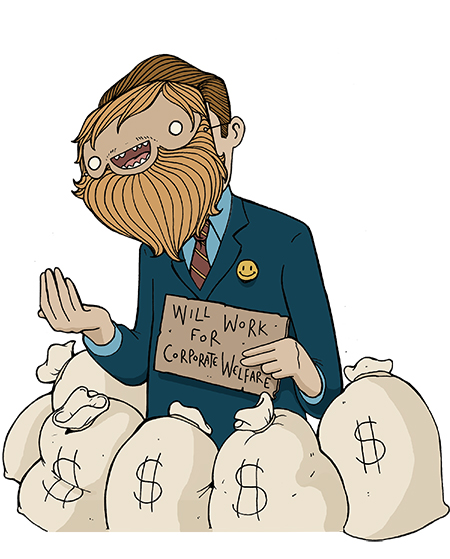
When Scheels, the sporting goods giant based in Fargo, North Dakota, started shopping cities for the expansion of their highly profitable mega-stores, Utah’s economic leaders offered a greater gift than Santa could ever provide. The combined efforts of Sandy City, Salt Lake County and the Canyons School District all ponied up to offer Scheels 25 years of paying zero property taxes, a total of $17.6 million of corporate welfare.
Local papers haven’t written questioning this practice, but a Sutherland Institute story posed the question, “Why does Scheels, a company based in Fargo, ND, get a tax break of mammoth proportions while Utah families and other businesses that have been paying full tax rates for years or decades get nothing?” A fair, and important, question.
At some point, the term “our community” becomes a trite and cheap description when there are almost no locally owned retailers or restaurants in our cities anymore. No Joe’s Flyfishing shop, Sports Den or locally owned Gart Brothers will be opening shop in Draper anytime soon because the economic development of Utah is focused only on massive corporate investment. Cabela’s in Lehi also received property tax breaks. That retail giant has received over $2 billion in tax breaks by fishing for cities that take the bait of huge sales tax revenue in exchange for corporate welfare.
“Retail is not economic development,” says Greg Leroy, executive director of Good Jobs First, a non-partisan economic development watchdog group based in Washington, DC. In a citylabs.com article, he sates, “People don’t suddenly have more money to spend on hip waders because a new Bass Pro or Cabela’s comes to town,” adds Leroy. “All that happens is that the money once spent at local mom and pop shops shifts to to the big box retailers.”
Of course Utah cities need to create jobs, investment and wealth, but with the way things are heading, will the future of our cities consist of corporations upon which we depend completely for jobs, products, services and sales tax revenue?
It’s clear that since the 2008 recession, the working poor are becoming more subservient to corporations. Low-skilled workers rely on corporations for both steady employment and cheap products and services. Symptomatic of this growing trend, we watch corporations such as Walmart, Dollar Tree, Savers and payday lending organizations thrive, posting record profits in our economy since 2008. And more companies that thrive because of economic disparity are growing like weeds, choking out the small business owner trying to make an honest buck.
In economic terms, these types of corporations provide ideal conditions for investors and politicians: cheap products, employment and a steady stream of rent and tax revenue. As long as there are working poor, there will be a steady supply of those who seek cheap products and low-wage jobs.
Developers build our communities for corporate chains, and local politicians hand out corporate welfare to entice them to invest. City leaders are pleased to make these hand-outs due to the clear numbers of jobs and tax revenue these places provide. But politicians are examining only the benefits without examining the bigger picture.
When corporations such as Scheels, Cabela’s and Walmart shop towns for their next large expansion, they seek the best deal they can get from various cities. Sandy City was the winner. They offered Scheels the best deal. $17.5 million in tax breaks over the next 25 years.
With these tax breaks. Scheels can offer even lower prices, and squash the competition. Locally owned businesses are the losers because they can’t compete on price. This is a losing proposition and promotes the killing of communities and creates a huge disadvantage for entrepreneurs who provide authentic value to communities and a much greater economic benefit than retail chains. To view the study results, click here.
Why is it fair that these corporations should receive such huge tax subsidies while local businesses receive nothing? This is not a level playing field. This is not a “free market,” and this practice is essentially taxing the strong local businesses to subsidize Wall Street corporations. This is a scam, and the practice is weakening local economic vitality because it’s ultimately shifts power away from locals and hands it over to corporations.
As long as power continues to concentrate into the hands of corporations and cities and the poor come to rely on these types of corporations, towns are becoming slaves to corporate powers. Further, the working poor are becoming stuck on the socioeconomic ladder, unable to climb because of an inability to gain new skills at low-wage jobs, where they are trained to behave like automatons. We can’t blame the poor and unskilled for working at these places. We can’t blame the penny pinchers for shopping there. It is, afterall, steady employment, and they offer those with scarce income lower prices.
But there is another part of this equation which causes the homogenization of our communities by corporate chains: Investors love stores that cater to the poor. They are a safe bet. Local businesses are a riskier bet. One of Warren Buffet’s largest holdings in Berkshire Hathaway is in Walmart. This is because Warren knows that cheap products, plus stores everywhere, plus plenty of people who want the best deals, equals plenty of earnings. Warren is not greedy; he is a smart investor.
The Chinese economy is based on manufacturing cheap products that fill American consumers’ homes. We put up with the Chinese human rights violations and their poor labor and currency practices because China provides a steady supply of cheap products. Economists can also justify our huge trade imbalance we have with China because “it increases our overall standard of living for Americans.” If the standard we follow is cheap equals best, then they are right. But when the destruction of jobs and communities is factored into the equation, the practice of handing out welfare to corporations which rely on this model is a scam.
But who can blame investors for holding socks in these companies that consistently perform so well, even if it is based on a less than desirable model? Millions of American’s 401(k)s and retirements depend Wall Street earnings. It has become obvious in recent years that the main reason why the wealthy control our political leaders through campaign contributions is to protect their investments and ensure their success.
Very likely many of the wealthiest investors can see how corporate lobbyists affect their state and local politicians in the ways in which they write zoning laws and hand out subsidies and ensure success.
As a result of these conditions, we see the stagnation in competition, a lack of true wealth creation and innovation; local economies lacking in vibrancy, and a growing divide between the rich and the poor. The rich own the stocks and provide the capital for corporations to grow. The working poor provide the cheap labor and earnings which provides the record profits that ensures the rich get richer. Increasingly we all come to rely on corporations to a greater degree, which further concentrates corporate wealth and power.
Here we see an interesting irony: rich and the poor simply working in their best interests is exacerbating the problem. One can’t really blame the rich or the poor for the growing divide. But there are actions middle class Americans can take which could change the equation.
The middle class can chose to shift spending behavior and shop locally owned and operated businesses instead of corporate chains. If more people buy more local products, we would see fewer local politicians bowing and kissing the corporate ring of steady tax revenue. Political leaders, as well as developers, might instead see that there is still great value in assisting and building retail and restaurant space for locally-owned businesses. But are we too late?
In Communist Manifesto, Karl Marx outlines his belief that capitalism would create just two basic classes: the rich—who control corporations and our government, and the poor who are subservient to corporations for both jobs and products. He believed a government controlled economy was a better solution. It’s not. The fear Marx wrote about convinced millions of Europeans that socialism and communism were better solutions than capitalism. If we continue on this path, we may very well prove Marx right.
Last year the S&P 500 rose over 30 percent, while the jobs and wages of the poor and middle class remained stagnant. If shoppers support locally-owned shops, profits would circulate within local economies which would bolster local growth. This means more secure local employment.
It really can make a huge difference: our most powerful vote is with our wallets and pocketbooks. We literally have the power to shape and form our communities so that they can become places that create more wealth, jobs and opportunity simply by our choosing to buy local.
This article began as an Op-Ed piece for the Deseret News.
Do you believe that corporate America is increasing the divide between the rich and the poor? We’d like to hear from you in the comments below.