There are streets in places like Amsterdam; Munich; Paris; and even Austin, Texas where bikers rule the road and traffic engineers and city planners have worked in tandem to create amazing, true infrastructure to accommodate bikers in their own lanes.
The results have benefited the cities by significantly reducing pollution and creating an environment where not only bikers, but also pedestrians, can enjoy the streets and get around to a much greater degree than they would be able to otherwise. The only downside is that it makes it much more difficult for cars and motorists.
Enter Mayor Ralph Becker, esteemed city planner and architect, and the Salt Lake City Council. They want for Salt Lake City what they have in Europe: true urban infrastructure for bicycles. Mayor Becker bikes to work on most days.
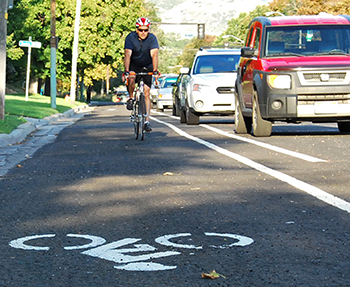
The new situation on 300 South is that two lanes have been reduced to one, and instead of motorists parking beside street curbs they park seemingly in the middle of the road where the second lane once was. Now bikers use a dedicated lane beside the curb.
Dick and Dixies is a neighborhood bar, Owner Will Bourne understands that they are operating, very much, a neighborhood bar, and parking is a problem. “People come here knowing they are going to have a hard time finding parking, but the parallel parking is very tough. It should be diagonal, like it is at Copper Onion.”
Residents agreed that the new solution is confusing Amy Eldredge lives in the apartments on the southwest corner of 500 East and 300 South, “Nobody understands the weird shapes, the triangles. We don’t need to reinvent the wheel. It now looks like cars are parked in the middle of the street. People are confused. I’m all for the bike lane, but it’s better to have it the way it was.”
Virginia Asher works at Classic Cleaners on 300 South and the business there is jeopardized by the new bike lanes because they have lost their two main drop off parking spots. “The new bike lanes have cut down business by a lot. Customers have not been able to come down. They see someone is parked here and so they just go home. We have elderly customers who have been coming here for 35 years who are very frustrated.”
However we spoke to bicycle commuter, Seth Reelitz, who says that he loves the new bike lanes and he hopes, “that the city adds more…I realize that it must be confusing for motorists, but I’ve almost been doored several times. I’ve had many friends injured by car doors, and the idea of having a buffer zone is very nice.”
Jessica Bock a visitor from Brooklyn, New York, said they accommodate bikers very well in New York, but she has never seen such an awkward solution addressing a non-problem. “I’ve seen so many cars turn right into the bike lane, this really appears to be less safe than just putting a regular bike lane.” She went on to say that in New York she has seen the city convert former two lane roads to one-way streets and put all the bikers on one side of the road and all of the parking and cars on the other side. She believes that would have been a much better solution than the current confusing situation.
Questions for the City Answers provided by Becka Roolf (Bicycle/Pedestrian Coordinator), Transportation Division, Community and Economic Development, Salt Lake City Corporation:
The shapes on the side of the roads is this permanent or is this just phase one?
We are painting the design in white paint. In 30 days there will be a separator curb as well as artistic bike racks and art placed on the median and the street. The concrete barriers are placed strategically where you currently see two parallel lines, painted on top of the asphalt.
We are working with the arts council and they will install city art sculptures called “flying objects”. They will be placed in the new concrete medians constructed on 300 east. The sculptures are rotated every few years.
Have other cities already adopted this type of design on similar streets?
Yes, Chicago, Austin Texas, San Francisco, Memphis. Austin is the most similar in terms of how they are doing the design with concrete, Washington D.C., Massachusetts I could go on and on. This is a national trend and we are all comparing notes on design. Salt Lake City is part of the national association of city transportation officials, so we are all comparing notes for what works for urban transportation.
There has been a strong national organization. They are looking at statewide transportation issues. And generally UDOT is responsible for state arterials, and for urban design. You want things that are more multi-modal transportation. And we are comparing the design with colleagues in other cities.
Did you consult business owners before moving forward with this project?
We have been engaged in a public outreach and door-to-door discussions with individual business owners. Manager at Q Clothing. We have been working with Bill Knowls. I know that we have talked to most of the business owners along the corridor.
Is this new design addressing a problem?
People are more inclined to ride their bikes when they feel safe and doing physically separated bike lanes is safe for a much broader part of the population than the percentage of people who would ride either on the sidewalk or in traffic. They have conducted studies which say that as many as 50-60 percent of the population will bike if there are separate lanes which provide a barrier between bike lanes and car lanes. And physical separation is what people want. We have had a lot of requests for more of this type of design.
What about the North-east corner of 5th east. And the way it is affecting the Classic Cleaners business? Did anybody ask them if it would be ok if you remove their parking?
We have heard concerns from business owners. We are revising designs and we will be changing it so that some of the parking is put back. That is particularly true at some of the corners and we are trying to work with it. We have both the blessing and the curse of really wide streets.
It sometimes means that the designs that work in the other cities when you apply them to Salt Lake City might not work as they do in other cities. So we are willing to address the problems that individual business owners are facing.
Map of the plan (Where is the additional angled parking?)