In the time it takes photographer Matthew Allred to capture a single image with his pinhole camera, more than 1.8 billion digital images are uploaded to Facebook. Allred’s work is as non-digital as it could be.
Allred, a Salt Lake City artist, has used sections of PVC pipe to build cameras and at present is building tiny pinhole cameras out of old 35mm film canisters. He literally screws them into place out in the field, 30-50 of them at a time. Each one will produce a unique image, slightly different from the others. He builds his equipment himself. “I like the idea that nearly everything is built from scratch, including the cameras and chemistry.” Exposures, burned onto film or photographic paper, can take long as six months. To do the project digitally would have lacked the authenticity that analog pinhole processes produce.
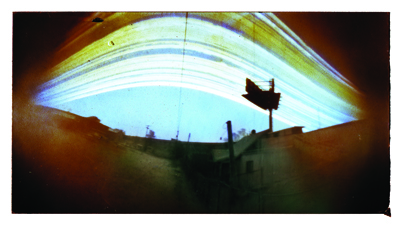
He calls it Heliography, an art form that requires the mind of a philosopher, an inventor, a chemist and astrologer. Allred’s images show dilapidated industrial sites and glass-faced buildings with long bands of sun trails across the sky. His subjects may be mountain ranges, billboards, water tanks or power lines. He likes to shoot factories “buildings we built to build other things,” he says. Some photographers aim to capture single decisive moments. Allred’s stunning images capture time on a single decisive frame.
Allred has spent weeks seeking out places to capture the upcoming winter solstice. He aims his cameras toward the southern sky and mounts them well above eye level, often on telephone poles with a stepladder. Only once was the easy-going Allred approached by a policeman who gave him tacit approval with “as long as you aren’t stealing anything.”
Somewhere between a week and six months later, Allred retrieves his cameras and develops the film or paper with a chemical process that has taken him years to perfect. He uses exotic developers that include gold and silver to produce vibrant colors. When he’s finished he studies his creations, printed on archival photographic material, deconstructing his images and pinpointing definitive weather patterns in the sun trails, showing days or weeks when the sun was obscured by weather. With each shooting cycle he makes new pinhole cameras. By the time the work is done, the elements have hopefully colluded with him to produce images, rendering the old cameras unusable.
A pinhole camera is a container with a small hole puncturing one side. A photographic paper or film is placed on the far side. Light enters the hole and reacts with the paper or film, creating an image. There are no lenses or shutters to alter the light. The trick is to keep the camera still since the amount of light is so small. The paper or film is then developed and a photographic image appears.
“These cameras are creating an image while they are being destroyed,” he says.