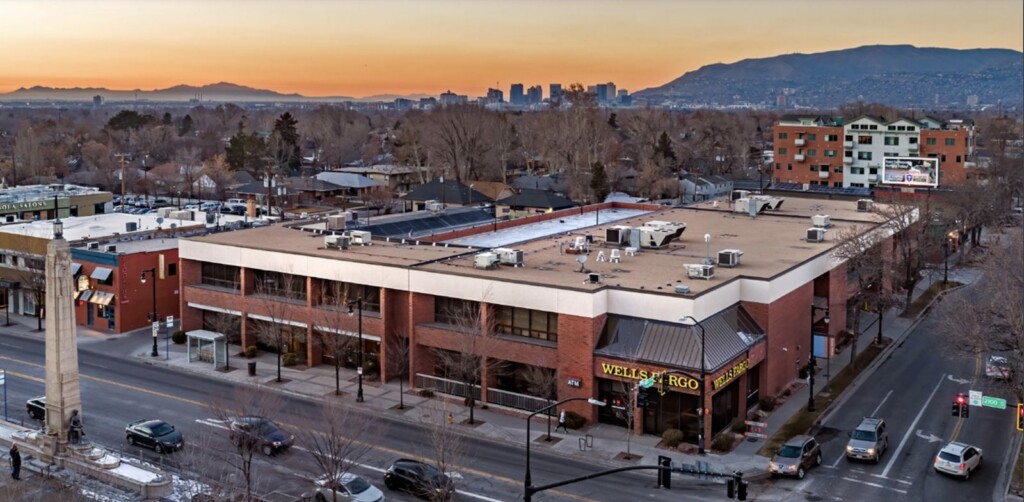
Four years ago, Laurie Bray took a walk around the Sugar House Business District with her dog Lola and a Nikon camera. Laurie is a professional photographer with an eye for images that tell a story. On that day she was collecting pictures of colorful vintage signs that were instantly recognizable as symbols of Sugar House.
It is fortunate that Bray took photos of those signs because today some of them are gone. The Ace sign came down when Rudy’s Key and Repair Service moved to 1000 East. The Smith-Crown Co. sign was put in storage when the business moved to its new location at 1941 S. 1100 East. Owner Barbara Green hopes the city will allow her to put the sign back up.
Thankfully, some of the most beloved signs are still in place, and their owners would like to restore them to their former glory. Mark Isaac, project manager for Boulder Ventures’ redevelopment of the Granite Furniture properties, believes that preserving the famous “Sputnik” sign is vital to the success of his new retail development.. “Historic signage represents a community’s identity and character,” Isaac said. “The sign identifies our location. When our new tenants advertise that they are on the Granite block under the Sputnik sign, everyone will know exactly where that is.”
Not every business is willing to maintain a sign that doesn’t advertise its name or product. But owner Helge Seljaas of Arendal Kitchen Design thinks it is worthwhile. He intends to keep the Salt Lake Costume Co. sign when his building is remodeled. He says the sign has been around for such a long time that it is a Sugar House icon. “We had a collector from Los Angeles offer to buy the sign,” Seljaas said, “but it is part of the history of the building, and it is important to the community.”
Salt Lake City’s sign ordinance does not provide incentives to preserve large neon signs like the Snelgrove’s ice cream cone or the animated Nu-Crisp Popcorn bowl. Signs of this type have not been permitted since the current ordinance was adopted in 1995. The restoration conditions for non-conforming signs and rules for moving or altering old signs make it challenging to preserve them and seem to discourage their restoration.
Preservationists made a great effort to save the Trolley Square water tower and Union Pacific Railroad Station signs. But both of these are on properties that are listed as Landmark Sites on the city’s Historic Register. Bray and Green wonder if it might be time to reconsider the city’s criteria for restoring and upgrading signs that are historic in their own right.
Bray has created an album of her photographs of the signs of Sugar House. To purchase copies of her photos, contact Bray at 801-746-0966 or email her at laurie@photographybylaurie.biz.