Local Spotlight

Blood Money II

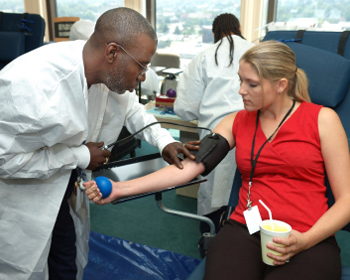
Healthy and STD free? Plasma donation is a viable way to earn $500 a month in extra income to make ends meet.

|


Healthy and STD free? Plasma donation is a viable way to earn $500 a month in extra income to make ends meet.

Car accident victims may need as many as 50 units of blood to stay alive. This means it requires 50 blood donors to save one life. As someone who has a rare blood type, I have always been aware of the importance of donating blood and plasma. Now, with the reality of having been out of a “day job” since October, donating plasma also seems like a good choice for my wallet. As Utah Stories reported last November, the numbers of donors and the frequency of donation are continuing to increase in Utah and across the US.


Phil Maher, creator of bloodbanker.com said that he has seen a huge increase in traffic to his website, and that the traffic of keyword searches like “How can I sell my plasma?” “How do I sell my blood?” and “Get paid for blood” on Google have skyrocketed. Maher usually sees a jump in traffic just before the holidays, which he attributes to people thinking more about giving back at that time of year.

utah blood doner

“This year traffic spiked a lot faster and went a lot higher than usual,” he said. And it’s still rising. This year Maher has seen over 50% more visitors to his website than last year. Another development Maher has noticed is that more “real families” seem to be turning to plasma donation as a means of filling up the car, paying the phone bill, or keeping the cupboards from becoming bare.

“I’ve been inviting people to share their stories with me through the site, and I’ve gotten some really good stories,” Maher said. “People who never would have thought about doing this are now seeing it as a real option financially.”

Typically, the majority of paid plasma donors tend to be college students or homeless people, according to Maher. He started donating when he was a college student and then started the site in 2002 to increase awareness of plasma donation and, eventually, help donors graduate to whole blood donation.


“My mission is to get people and families comfortable with the idea of donation with the paid option,” he explained. “Hopefully, people will get over any fear about the needles and the process while they’re young, and then once they are older they might go for the whole blood, Red Cross, aspect of donation.”

For the blood/plasma donation business, the poor economy may be a godsend. People who have never considered donating, or weren’t willing to give the time it takes are looking at donation as valuable not only to those who benefit medically, but to their own bank account.

Sarah Johnson, who also donated plasma while she was in college, recently told her husband about it. “At first he was appalled, he thought it was low-class,” she shared. “But once I told him about the money he wanted to do it.”


Johnson used to donate at ZLB Plasma Services at 2978 S. State Street. “I admit that the first time I went in as a 20-year old woman I was nervous about what type of people might be there,” she said, “But after a couple times I wasn’t weirded out by the people, and I saw how safe the whole process was.”

If you are thinking about checking into plasma donation, here are a few quick facts that may help:

You could make up to $500: Many local plasma centers have just increased their payments to up to $65 per donation. If you donate twice a week, that’s $520 a month.

  • Not everyone can donate: The most common reasons someone will be unable to donate are low iron in the blood (anemia), recent tattoos, exposure to infectious diseases like Hepatitis.
  • It doesn’t hurt: Everything is handled by medical professionals, and other than the typical discomfort of having a foreign object in your arm, there is no pain.
  • It helps to be prepared: Drinking plenty of water and eating some healthy foods like fruits and vegetables the day before you donate will build up your body to better recover from your donation.
  • Stay away from alcohol: Both before and after donating, is it best to avoid alcohol, as Maher says on his site, “It might seem like fun to get a 4-martini buzz on just one, but it could mess you up for days.”

Other resources to check out:

Reader Comments

Stephen Gaines I doubt if you will publish my comment but here is my comment. The plasma that is bought by these plasma centers does not go to your local hospitals to save that person who needs 50 units of blood. The FDA does not allow blood centers (United Blood Services, Red Cross, etc...) from paying for blood or blood products that are given directly to the people in need. You need to research deeper and you will see that this plasma is not used like you reported. If it is being bought by the place then they do not have a license or contract to give that product to any american hospital. Rondalyn Halm I used to give plasma in Chatnooga Tennessee. Now im back home in Michigan. I know it helps save lives, but it also helps when your having trouble finding a job and stuff.. John Petersen USA Red Cross The american red cross may make it a policy not to pay for donations, but I for one am layed off with 3 children and unemployment doesn't even pay my food bill. I am not dishonest when I answer my questions regarding my social habits or medications ect. I can use the extra cash. 20.00 or 25.00 buys milk, bread, eggs, and juice. If that trade off is not worth the american red cross compensation effort then others just like me will continue to go to plasma centers and the ARC should stop complaining about it's loss of donations. re: Ginger Gottschalk Nothing wrong with donating plasma for money but donors should know that their blood may be used to help hemophiliacs and other people who experience coagulation problems. Plasma products are also used to assist burn victims . Additionally, plasma is valuable in medical research, helping to create treatments for diseases that attack the immune system. But sometimes research includes the development of commercial products, like cosmetics. When you donate plasma for money, the center will inform you that your plasma can be used for many purposes. You do not retain any control over how your plasma is used.
they said donate twice a week not just per donation lets pay attention people
Unknown 8/27
there is nowhere in the sl valley that pays $65 per donation. didn't anyone bother to fact check??
Unknown 6/19
Did you read the story, it didn't say per donation. It said per week.
Unknown 7/17
Agreed, ridiculous claims like that do nothing but cause confusion and set people up for a false se... More »
Unknown 7/10
FYI: Any plasma donated for money cant be used to "help save lives" its against the law.

Other Living Well in Tough Times Stories

A week's groceries for around $20? It's for real. How to Get Free Dental Care in Utah (that isn't scary) Unemployed? Best careers for 21st century SLC Bicycle Collective- Free bikes for everyone 

,

Join our newsletter.
Stay informed.


  • Left in a Box as a Baby: Trauma, Alcoholism, and Addiction

    A man abandoned as a baby builds a structured life in law enforcement, but unresolved trauma and alcoholism slowly begin to unravel it. His story raises a harder question about how change actually happens.


  • The $7 Million Recruit: How NIL Changed College Athletics Forever

    In 2012, Jabari Parker, a top high school prospect and member of the Church of Jesus Christ of Latter-day Saints, was facing his biggest decision to that point in his life: where to play college basketball. 

    Fans of BYU athletics hoped and perhaps prayed that Parker would pick the school owned by the church he was raised in. BYU was listed as one of his final choices. But he ultimately chose to spend his college years at Duke before attempting a career in the NBA. BYU fans were disappointed, but no one was truly surprised. Duke over BYU was the best choice for a young prospect in 2012. 

    A.J. Dybantsa.

    What changed between 2012 and 2024 when A.J. Dybantsa, the number one high school prospect, chose BYU over every other school? The answer is roughly $7 million dollars. That is what Dybantsa is reportedly making to play basketball at BYU. 

    The deal was supported by Utah Jazz owner Ryan Smith, who met multiple times with the Dybantsa family in multiple attempts to bring the young player to Provo. 

    According to Smith, he had no financial role in bringing Dybantsa to BYU, but the influence of Utah’s most famous billionaire acting as a “booster” or unofficial recruiter certainly swayed the decision.

    Prior to 2021, boosters acting as recruiters was taboo to the NCAA governing body. It was called improper recruiting. But in 2021, California began the modern era of NIL, or the ability of a college athlete to benefit from their name, image, or likeness, when they passed the “Fair Pay to Play Act.” 

    This new law gave college athletes in California the ability to benefit from their NIL, something that was banned in the rest of the country to that point. The NCAA saw that this law would create an unfair advantage for California schools that could now give young athletes the chance to make money off their talent and image while still in college. 

    The NCAA knew they needed to do something quickly, so they rushed through a policy that opened up NIL to all college athletes in the country, and it has been expanding and evolving over the last four years. 

    Grant Duff, who has coached at the University of Utah, Weber State University, and is now the defensive coordinator for Idaho State University, says, “The best part of NIL is that athletes have an opportunity to make good money. The downside comes with the free-for-all that money causes.”

    Dybantsa confers with BYU Head coach, Kevin Young.

    One of the biggest current examples of what a school can do when the boosters are willing to pay for success is Texas Tech University. From 2020-2024, Texas Tech had 34 wins, which works out to 6.8 wins per year with a low of 4 wins and high of 8. Then Texas Tech’s boosters got involved, led by Cody Campbell, an oil industry businessman and Chairman of the Texas Tech board. The football program was given 28 million dollars for NIL with a simple message attached to the large pile of money: Win. And win now. And win they did. 

    By signing NIL deals with athletes in the transfer portal, Texas Tech went from a middle-of-the-pack school in their conference to one of the top 12 teams in the country. They didn’t just win games in 2025, they made many of their opponents look like they didn’t belong on the same field, including the University of Utah and BYU twice. That is what money can buy.

    Continue reading and support independent Utah journalism with a purchase of Utah Stories (Digital + Print) or 3 month free trial (Digital).


  • Cottonwood Heights Corruption Allegations: A Case That Never Reached a Courtroom

    A year ago, we here at Utah Stories recorded a podcast episode that we never published. We were revisiting corruption allegations from ten years ago. We decided not to publish the video, so it sat there on YouTube for nearly 12 months.

    Then somehow the video was published. How? We are not sure, but once it got out there, the comments came pouring in.

    Dozens of viewers, then hundreds, supported the video with their comments on our examination of allegations of police misconduct in Cottonwood Heights. The video recounts how the Police Department was reported by business owners as focusing enforcement on customers of the former Canyon Inn bar. These allegations did not result in a publicly documented, full investigation by Utah’s Justice Department nor the FBI (at least to our knowledge). So why rehash the past?

    We believe the story of The Canyon Inn (and other area business owners) vs. CHPD and Cottonwood Heights Mayor Kelvin Cullimore raises questions about what can happen when allegations surface and do not move forward through a formal legal process with state or federal oversight.

    In 2012, Cottonwood Heights business owners at the mouth of the canyons began publicly objecting to police activity whereby up to seven cruisers were pulling over 711 and Canyon Inn bar customers on their busiest evenings.

    According to those accounts, drivers leaving the bar were frequently pulled over by police and were given DUI tickets, sometimes even after passing a sobriety examination. The volume and concentration of those stops led residents and business owners to complain about the “heavy-handed treatment” of CHPD toward motorists, especially in and around the Canyon Inn and neighboring 711, and eventually the Porcupine Pub.

    Customers responded in predictable ways. Some chose not to return and avoid the area. Others went to different establishments. Over time, the owner of the Canyon Inn, Jim Stojack, stated that his revenue declined by 70% and that he believed police activity near his business was the main contributing factor.

    Utah Stories reported on these concerns by conducting interviews; gathering video documentation provided by those involved; and making public records requests. Through our GRAMA requests, we reviewed DUI citations issued by the Cottonwood Heights Police Department and examined how those cases were resolved in Holladay Justice Court. During that period, we observed a higher number based on our review of DUI cases dismissed in court due to lack of evidence compared to other jurisdictions. One DUI attorney, Tyler Ayers, went on record saying that CHPD was issuing a high volume of DUI citations that were later dismissed.

    That observation raised questions about how cases were being documented and prosecuted. It did not, on its own, establish intent or misconduct, but it became part of a broader set of concerns raised by multiple sources.

    Continue reading and support independent Utah journalism with a purchase of Utah Stories (Digital + Print) or 3 month free trial (Digital).


  • Why Did Salt Lake City Tear Down Its Most Beautiful Buildings?

    If you go into the Utah State Archives and spend time with photographs from the late 1800s and early 1900s, you start to notice something that doesn’t line up with what exists today.

    Main Street looks cohesive. Not in a uniform way, but in a way that suggests the people building it shared an understanding of proportion, material, and permanence. Four-story buildings line the street—stone, brick, cast iron—each one detailed in ways that don’t feel incidental. Arched windows, carved stone, brickwork that changes pattern as it rises. Even the cast iron facades were designed to replicate masonry, not hide behind it.

    Then you go downtown and try to find those same buildings.

    Most of them are gone.

    Out of more than 400 buildings designed by Richard Kletting, over 300 have been torn down. That number alone reframes the conversation. Kletting designed the Utah State Capitol, the Saltair resort, commercial buildings, schools, churches, mansions—virtually every type of structure…

    Continue reading and support independent Utah journalism with a purchase of Utah Stories (Digital + Print) or 3 month free trial (Digital).